
Close Menu
    Facebook X (Twitter) Instagram
    SciTechDaily
    • Biology
    • Chemistry
    • Earth
    • Health
    • Physics
    • Science
    • Space
    • Technology
    Facebook X (Twitter) Pinterest YouTube RSS
    SciTechDaily
    Home»Space»Astronomers Explore the First Three Billion Years of Stars
    Space

    Astronomers Explore the First Three Billion Years of Stars

    By Harvard-Smithsonian Center for AstrophysicsOctober 3, 20141 Comment3 Mins Read
    Facebook Twitter Pinterest Telegram LinkedIn WhatsApp Email Reddit
    Share
    Facebook Twitter LinkedIn Pinterest Telegram Email Reddit
    The Mass Evolution of the First Galaxies
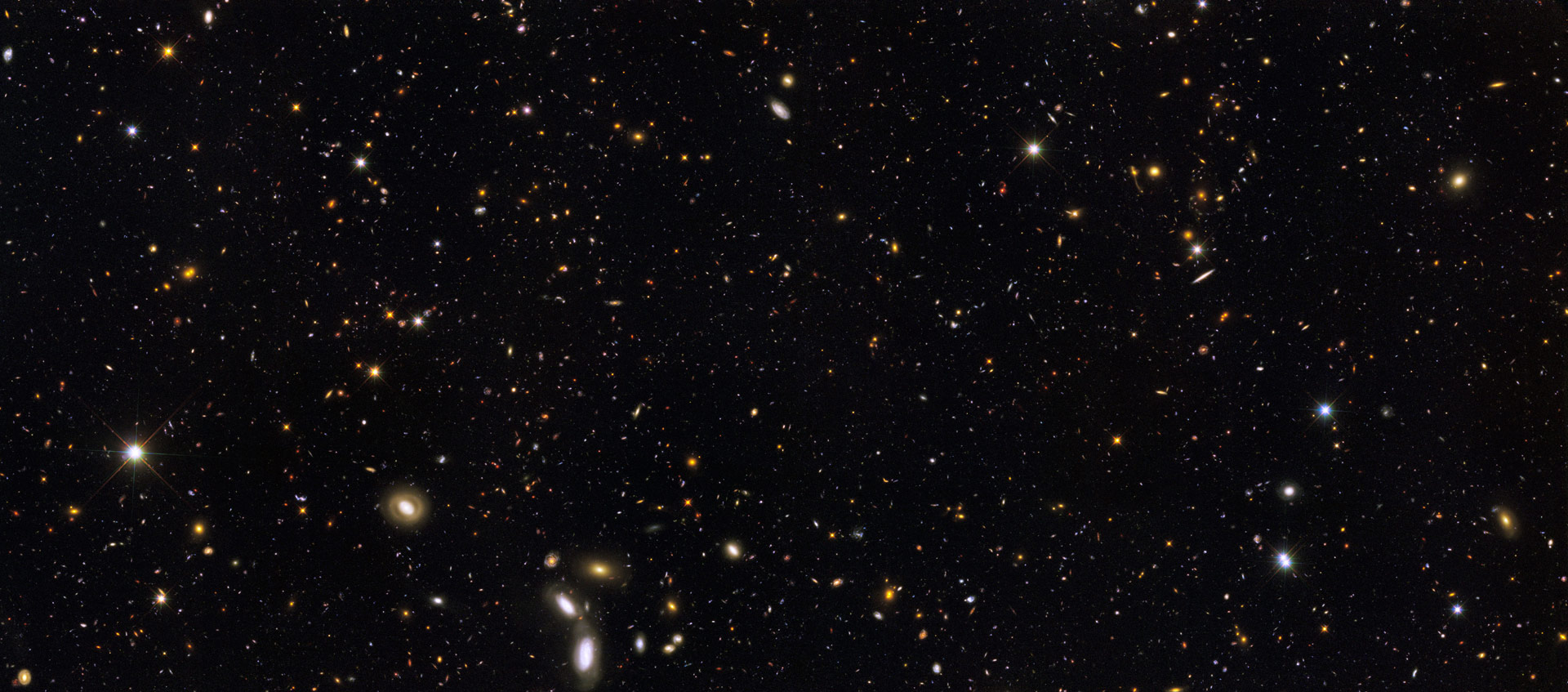
    A Hubble image of distant galaxies in the GOODS-South field. Astronomers have studied the galaxies in this field to determine how quickly stars were forming one billion years after the Big Bang and later. They found that the star formation rate was higher back then, with about ten times as many stars forming per year per unit volume ten billion years ago than there are today. Credit: NASA/HST/ GOODS Team

    Using the Hubble Space Telescope and the Spitzer Space Telescope, a team of astronomers studied the first few billion years of the universe to determine the distribution of stellar masses and the star formation rates in galaxies at epochs as early as about 800 million years after the big bang.

    In the last decade, the unprecedented sensitivity of astronomical observations has powered a revolution in our understanding of galaxies in the young universe. It is now possible to study directly the mechanisms and processes which formed the diverse array of galaxies we find in the local universe today. The results not only provide insight into the processes of galaxy formation, they also help us understand the role those first galaxies played in the cosmos: in particular, the ultraviolet light from hot, young stars ionized the intergalactic medium, which had contained neutral atoms ever since they formed during an earlier epoch that also produced the cosmic microwave background radiation.

    One of the key questions in cosmology is the stellar composition of young galaxies that formed about two billion years after the Big Bang. Surveys find that a significant contribution to the reionization must have come not from sources that are seen but from faint galaxies below the current detection limits. Although faint, these galaxies and their stars also contribute to the cumulative growth of the stellar population in the cosmos. Successful models of galaxy evolution need to include all sources of star formation.

    Measuring the stellar masses of galaxies at cosmological distances is hard. CfA astronomer Matt Ashby joined with a team of astronomers to use the Hubble Space Telescope and the Spitzer Space Telescope to study over 30,000 galaxies in a survey of the sky specifically targeting objects in the early universe. They studied the first few billion years of the universe to determine the distribution of stellar masses and the star formation rates in galaxies at epochs as early as about 800 million years after the Big Bang. In an impressive piece of observational and analytic skill, the team improved on earlier measurements and found (among other things) that the star formation rate per volume of space peaked about 3 billion years after the Big Bang and then declined, and that as the universe expanded and aged the star formation rate per unit of available mass also steadily decreased.

    Reference: “The mass evolution of the first galaxies: stellar mass functions and star formation rates at 4 < z < 7 in the CANDELS GOODS-South field” by Kenneth Duncan, Christopher J. Conselice, Alice Mortlock, William G. Hartley, Yicheng Guo, Henry C. Ferguson, Romeel Davé, Yu Lu, Jamie Ownsworth, Matthew L. N. Ashby, Avishai Dekel, Mark Dickinson, Sandra M. Faber, Mauro Giavalisco, Norman A. Grogin, Dale Kocevski, Anton M. Koekemoer, Rachel S. Somerville and Catherine E. White, 12 September 2014, MNRAS.
    DOI: 10.1093/mnras/stu1622
    arXiv: 1408.2527

    Never miss a breakthrough: Join the SciTechDaily newsletter.
    Follow us on Google and Google News.

    Astronomy Astrophysics Harvard-Smithsonian Center for Astrophysics Stars Stellar Evolution
    Share. Facebook Twitter Pinterest LinkedIn Email Reddit

    Related Articles

    Astronomers Explore Cosmic Ray Influences on Star Formation in Galaxies

    Astronomers Observe a New Type of Binary Star – “Exciting, Missing Evolutionary Link”

    Astronomers Have Discovered a Gigantic Sphere-Shaped Cavity in Space

    Mystery Solved: Astronomers Unravel the Puzzle of Betelgeuse’s “Great Dimming”

    Mega-Flares From Stars: 10 Million Times More Energetic Than the Most Powerful Flare Ever Observed on the Sun

    The Give and Take of Stellar Mega-Flares: By Studying Thousands of Young Stars, New Information Has Emerged

    Growing up Stardust: Astronomers Discover That Stars and Planets May Be Siblings

    Massive Rotating Stars in the Pleiades Cluster

    Chandra Studies Extraordinary Magnetar: Fastest Spinning and Possibly the Youngest Magnetar Known

    1 Comment

    1. Dilip G Banhatti on October 6, 2014 10:49 am

      There is another study that found from infrared observations that before the peak (i.e., at larger redshifts) is a plateau, rather than a decline. Here is a link [http://www.nature.com/nature/journal/v514/n7520/abs/514043a.html]. You will need subscription or use of a library computer which has such a subscription.

      Reply
    Leave A Reply Cancel Reply

    • Facebook
    • Twitter
    • Pinterest
    • YouTube

    Don't Miss a Discovery

    Subscribe for the Latest in Science & Tech!

    Trending News

    Breakthrough Bowel Cancer Trial Leaves Patients Cancer-Free for Nearly 3 Years

    Natural Compound Shows Powerful Potential Against Rheumatoid Arthritis

    100,000-Year-Old Neanderthal Fossils in Poland Reveal Unexpected Genetic Connections

    Simple “Gut Reset” May Prevent Weight Gain After Ozempic or Wegovy

    2.8 Days to Disaster: Scientists Warn Low Earth Orbit Could Suddenly Collapse

    Common Food Compound Shows Surprising Power Against Superbugs

    5 Simple Ways To Remember More and Forget Less

    The Atomic Gap That Could Cost the Semiconductor Industry Billions

    Follow SciTechDaily
    • Facebook
    • Twitter
    • YouTube
    • Pinterest
    • Newsletter
    • RSS
    SciTech News
    • Biology News
    • Chemistry News
    • Earth News
    • Health News
    • Physics News
    • Science News
    • Space News
    • Technology News
    Recent Posts
    • ADHD Isn’t Just a Deficit: Study Reveals Powerful Hidden Strengths
    • Scientists Uncover “Astonishing” Hidden Property of Light
    • Scientists Discover Stem Cells That Could Regrow Teeth and Bone
    • Scientists Discover Natural Molecule That Stops Alzheimer’s Protein Clumps From Forming
    • Early Cannabis Use May Stall Key Brain Skills in Teens
    Copyright © 1998 - 2026 SciTechDaily. All Rights Reserved.
    • Science News
    • About
    • Contact
    • Editorial Board
    • Privacy Policy
    • Terms of Use

    Type above and press Enter to search. Press Esc to cancel.