
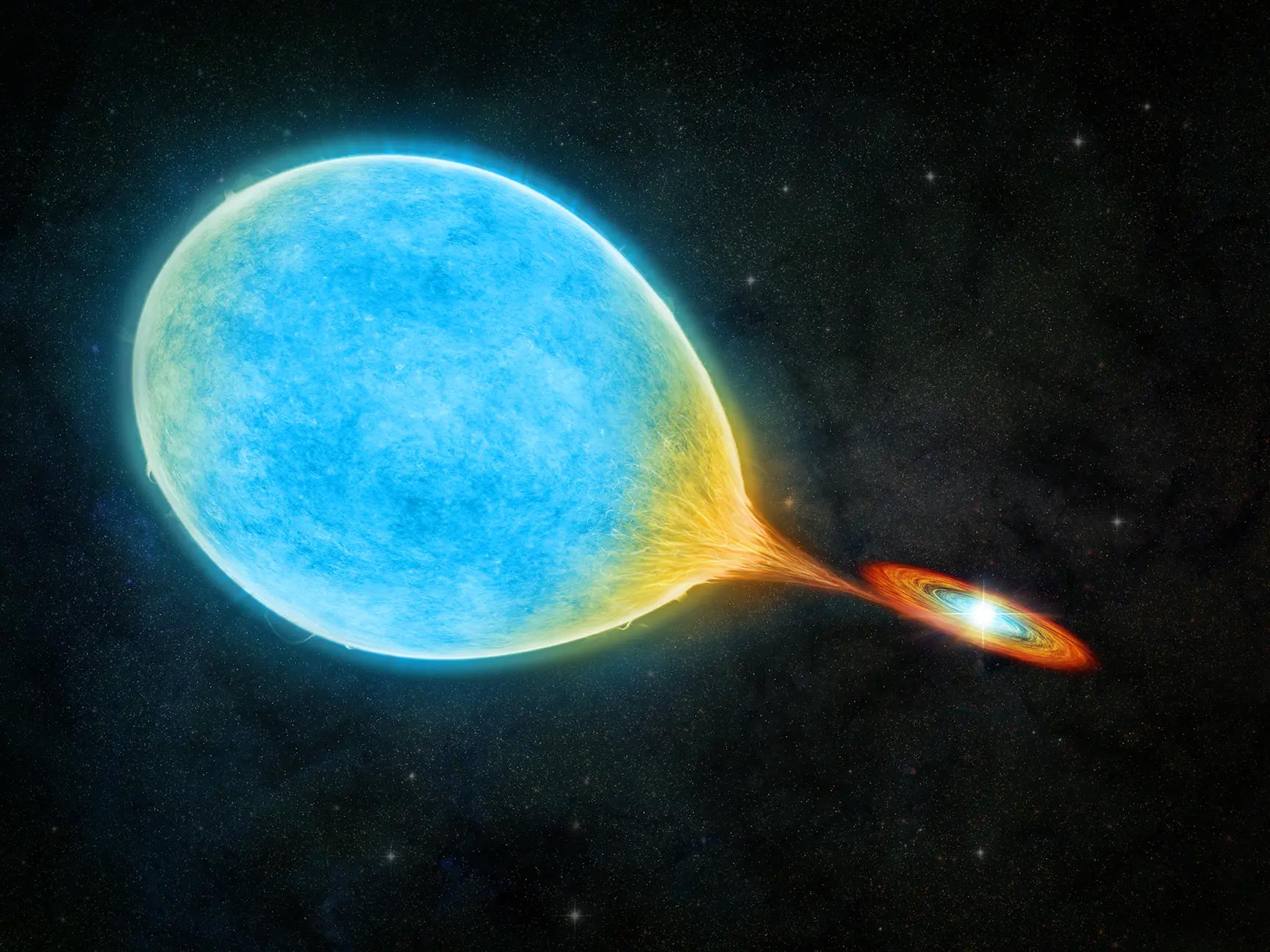
Researchers have predicted the new class of star’s existence for 50 years but until now, never observed it in space.
Researchers at the Center for Astrophysics | Harvard & Smithsonian have observed a new type of binary star that has long been theorized to exist. The discovery finally confirms how a rare type of star in the universe forms and evolves.
The new class of stars, described in this month’s issue of the Monthly Notices of the Royal Astronomical Society, was discovered by postdoctoral fellow Kareem El-Badry using the Shane Telescope at Lick Observatory in California and data from several astronomical surveys.
“We have observed the first physical proof of a new population of transitional binary stars,” says El-Badry. “This is exciting; it’s a missing evolutionary link in binary star formation models that we’ve been looking for.”
A New Type of Star
When a star dies, there’s a 97 percent chance it will become a white dwarf, a small dense object that has contracted and dimmed after burning through all its fuel.
But in rare instances, a star can become an extremely low mass (ELM) white dwarf. Less than one-third the mass of the Sun, these stars present a conundrum: if stellar evolution calculations are correct, all ELM white dwarfs would seem to be more than 13.8 billion years old — older than the age of the universe itself and thus, physically impossible.
“The universe is just not old enough to make these stars by normal evolution,” says El-Badry, a member of the Institute for Theory and Computation at the Center for Astrophysics.
Over the years, astronomers have concluded that the only way for an ELM white dwarf to form is with the help of a binary companion. The gravitational pull from a nearby companion star could quickly (at least, in less than 13.8B years) eat away at a star until it became an ELM white dwarf.
But evidence for this picture is not foolproof.
Astronomers have observed normal, massive stars like our Sun accreting onto white dwarfs — something called cataclysmic variables. They have also observed ELM white dwarfs with normal white dwarf companions. They had not, however, observed the transitional phase of evolution, or the transformation in between: when the star has lost most of its mass and has nearly contracted to an ELM white dwarf.
A Missing Evolutionary Link
El-Badry often compares stellar astronomy to 19th-century zoology.
“You go out into the jungle and find an organism. You describe how big it is, how much it weighs — and then you go on to some other organism,” he explains. “You see all these different types of objects and need to piece together how they are all connected.”
In 2020, El-Badry decided to go back into the jungle in search of the star that had long eluded scientists: the pre-ELM white dwarf (also referred to as an evolved cataclysmic variable).
Using new data from Gaia, the space-based observatory launched by the European Space Agency, and the Zwicky Transient Facility at Caltech, El-Badry narrowed down one billion stars to 50 potential candidates.
The astronomer emphasizes the importance of public data from astronomical surveys for his work. “If it weren’t for projects like the Zwicky Transient Facility and Gaia, which represent huge amount of work behind the scenes from hundreds of people — this work just wouldn’t be possible,” he says.
El-Badry then followed-up with close observations of 21 of the stars.
The selection strategy worked. “100 percent of the candidates were these pre-ELMs we’d been looking for,” he says. “They were more puffed up and bloated than ELMs. They also were egg-shaped because the gravitational pull of the other star distorts their spherical shape.”
“We found the evolutionary link between two classes of binary stars — cataclysmic variables and ELM white dwarfs — and we found a decent number of them,” El-Badry adds.
Thirteen of the stars showed signs that they were still losing mass to their companion, while eight of the stars seemed to no longer be losing mass. Each of them was also hotter in temperature than previously observed cataclysmic variables.
El-Badry plans to continue studying the pre-ELM white dwarfs and may follow up on the 29 other candidate stars he previously discovered.
Like modern-day anthropologists who are filling the gaps in human evolution, he is amazed by the rich diversity of stars that can arise from simple science.
Reference: “Birth of the ELMs: a ZTF survey for evolved cataclysmic variables turning into extremely low-mass white dwarfs” by Kareem El-Badry, Hans-Walter Rix, Eliot Quataert, Thomas Kupfer, Ken J Shen, 11 September 2021, Monthly Notices of the Royal Astronomical Society.
DOI: 10.1093/mnras/stab2583
Never miss a breakthrough: Join the SciTechDaily newsletter.
Follow us on Google and Google News.