
Gigantic Cavity in Space Sheds New Light on How Stars Form
Astronomers analyzing 3D maps of the shapes and sizes of nearby molecular clouds have discovered a gigantic cavity in space.
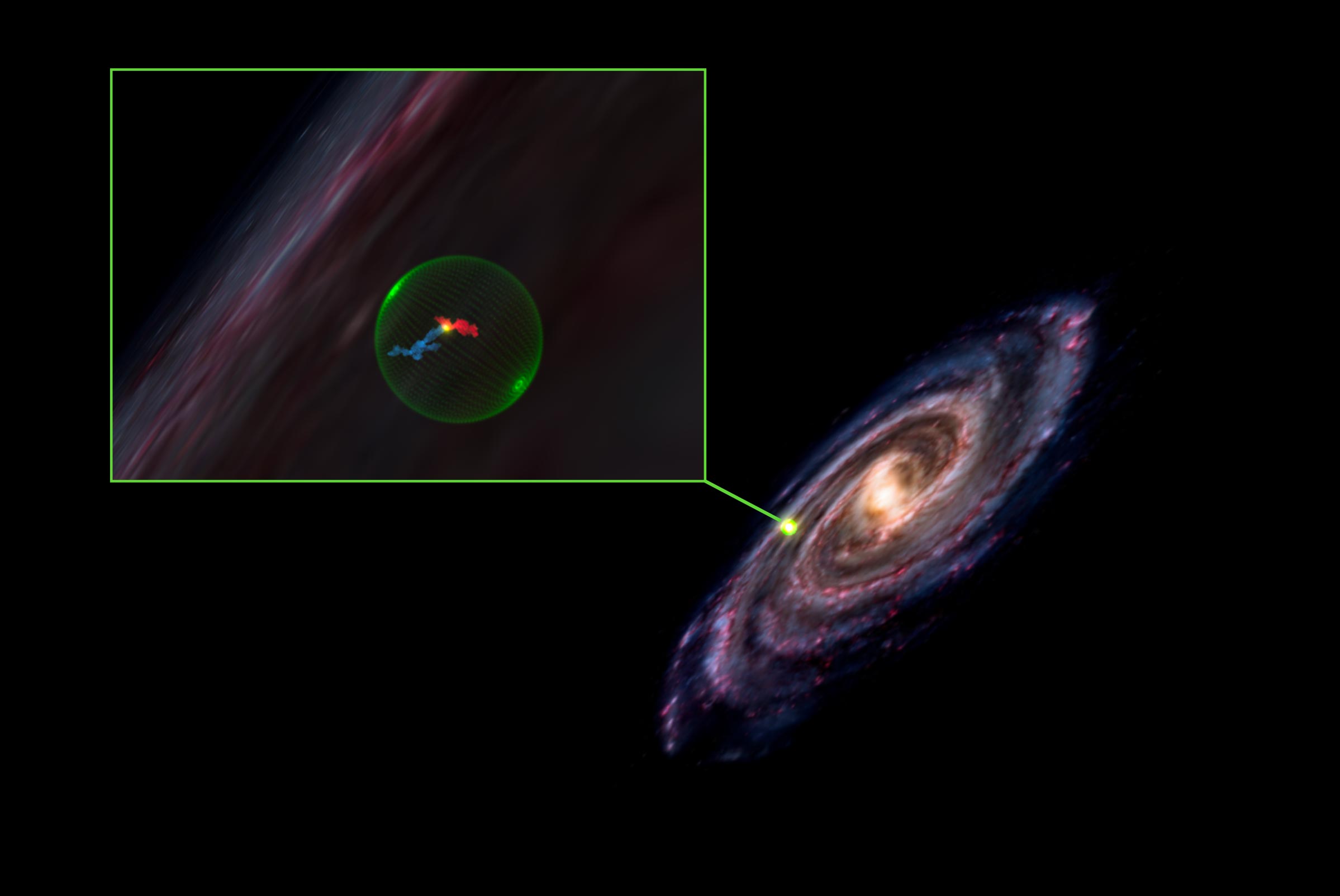
The sphere-shaped void, described today in the Astrophysical Journal Letters, spans about 150 parsecs — nearly 500 light-years — and is located on the sky among the constellations Perseus and Taurus. The research team, which is based at the Center for Astrophysics | Harvard & Smithsonian, believes the cavity was formed by ancient supernovae that went off some 10 million years ago.
The mysterious cavity is surrounded by the Perseus and Taurus molecular clouds — regions in space where stars form.
“Hundreds of stars are forming or exist already at the surface of this giant bubble,” says Shmuel Bialy, a postdoctoral researcher at the Institute for Theory and Computation (ITC) at the Center for Astrophysics (CfA) who led the study. “We have two theories—either one supernova went off at the core of this bubble and pushed gas outward forming what we now call the ‘Perseus-Taurus Supershell,’ or a series of supernovae occurring over millions of years created it over time.”
The finding suggests that the Perseus and Taurus molecular clouds are not independent structures in space. But rather, they formed together from the very same supernova shockwave. “This demonstrates that when a star dies, its supernova generates a chain of events that may ultimately lead to the birth of new stars,” Bialy explains.
Astronomers analyzing 3D maps of interstellar dust have discovered a huge, spherical-shaped cavity in space. The discovery shows that supernovae led to the creation of the Perseus and Taurus molecular clouds. Credit: Jasen Chambers/Center for Astrophysics | Harvard & Smithsonian
Mapping Stellar Nurseries
The 3D map of the bubble and surrounding clouds were created using new data from Gaia, a space-based observatory launched by the European Space Agency (ESA).
Descriptions of exactly how 3D maps of the Perseus and Taurus molecular clouds and other nearby clouds were analyzed appear in a separate study published today in the Astrophysical Journal (ApJ). Both studies make use of a dust reconstruction created by researchers at the Max Planck Institute for Astronomy in Germany.
The maps represent the first-time molecular clouds have been charted in 3D. Previous images of the clouds were constrained to two dimensions.
“We’ve been able to see these clouds for decades, but we never knew their true shape, depth, or thickness. We also were unsure how far away the clouds were,” says Catherine Zucker, a postdoctoral researcher at the CfA who led the ApJ study. “Now we know where they lie with only 1 percent uncertainty, allowing us to discern this void between them.”
But why map clouds in the first place?
“There are many different theories for how gas rearranges itself to form stars,” Zucker explains. “Astronomers have tested these theoretical ideas using simulations in the past, but this is the first time we can use real — not simulated — 3D views to compare theory to observation, and evaluate which theories work best.”
The Universe at Your Fingertips
The new research marks the first time journals of the American Astronomical Society (AAS) publish astronomy visualizations in augmented reality. Scientists and the public may interact with the visualization of the cavity and its surrounding molecular clouds by simply scanning a QR code in the paper with their smartphone.
“You can literally make the universe float over your kitchen table,” says Harvard professor and CfA astronomer Alyssa Goodman, a co-author on both studies and founder of glue, the data visualization software that was used to create the maps of molecular clouds.
Goodman calls the new publications examples of the “paper of the future” and considers them important steps toward the interactivity and reproducibility of science, which AAS committed to in 2015 as part of their effort to modernize publications.
“We need richer records of scientific discovery,” Goodman says. “And current scholarly papers could be doing much better. All of the data in these papers are available online — on Harvard’s Dataverse — so that anyone can build on our results.”
Goodman envisions future scientific articles where audio, video and enhanced visuals are regularly included, allowing all readers to more easily understand the research presented.
She says, “It’s 3D visualizations like these that can help both scientists and the public understand what’s happening in space and the powerful effects of supernovae.”
References:
“The Per-Tau Shell: A Giant Star-forming Spherical Shell Revealed by 3D Dust Observations” by Shmuel Bialy, Catherine Zucker, Alyssa Goodman, Michael M. Foley, João Alves, Vadim A. Semenov, Robert Benjamin, Reimar Leike and Torsten Enßlin, 22 September 2021, The Astrophysical Journal Letters.
DOI: 10.3847/2041-8213/ac1f95
“On the Three-dimensional Structure of Local Molecular Clouds” by Catherine Zucker, Alyssa Goodman, João Alves, Shmuel Bialy, Eric W. Koch, Joshua S. Speagle, Michael M. Foley, Douglas Finkbeiner, Reimar Leike, Torsten Enßlin, Joshua E. G. Peek and Gordian Edenhofer, 22 September 2021, The Astrophysical Journal.
DOI: 10.3847/1538-4357/ac1f96
Additional co-authors on the ApJ Letter are: Catherine Zucker, Alyssa Goodman, Michael Foley and Vadim Semenov of the Center for Astrophysics; João Alves of the University of Vienna; Robert Benjamin of the University of Wisconsin-Whitewater; and Reimar Leike and Torsten Ensslin of the Max Planck Institute for Astrophysics.
Co-authors on the ApJ study are: Alyssa Goodman, Shmuel Bialy, Eric Koch, Joshua Speagle, Michael Foley and Douglas Finkbeiner of the Center for Astrophysics; Joao Alves of the University of Vienna; Reimar Leike, Torsten Ensslin and Gordian Edenhofer of the Max Planck Institute for Astrophysics; and Joshua Peek of the Space Telescope Science Institute.
The augmented reality figure was made possible thanks to a collaboration between the glue team, the American Astronomical Society and Delightex, a commercial software company. glue is funded by the National Science Foundation, NASA and the Gordon and Betty Moore Foundation.
Never miss a breakthrough: Join the SciTechDaily newsletter.
Follow us on Google and Google News.
8 Comments
A gugantic smoke ring?
God smoking a cigar?
God loves circles, base theory of Gensai or Genesis, all things in creation are expanding orbs, from the tiniest particle to the universe and multiverse, like russian stacking dolls.Even the nature of creation is circular, environmental, phase changes, orbits, constants, time even life and death are two circular momentum that progress together. Everything has a vector. That’s why you don’t ever go thru a blackhole, use one of 9 points to go around it, possibly on the cusp. But for that you will need to review zoomwicky 18 and have a far better understanding of Radium.
can u inform me by return
taurus shell 125 150 par sec from sun diffuse envelope shell module
what composition is this gas co hi ha alu26 anything else
perseus shell 300 320 parsec from sun diffuse envelope shell module
what composition is this gas co hi ha alu26 anything else
is there any other elements known from the above two clouds
so can you also inform me
what type supernovae leaves this sort of gas trail
plus
what type of stars on the main sequence are going to be formed from the collapse of these gas clouds
… don’t know what you are going to find in the dark, if we scientist could predict all of it would be a boring place, but as we observe it is not a boring place…in another words, the road will reveal many things we are not able to anticipate as a Couch Potato civilization…
… sorry we should be changed with the…
Nasa never went to the moon because they can’t.
Even this article isn’t from observation but bullsh*t data they generated in a computer. They are hiding the truth from you, wake up
A Borg ship just passed… Carry on!