

Regular aerobic exercise may reduce inflammation, support brain health, and help slow the progression of symptoms.
With no known cure for Parkinson’s disease, exercise has emerged as one of the most promising tools for helping slow the disease’s progression.
“Exercise may be more than just good for your general health, as it can actually help slow the progression of Parkinson’s by reducing the brain inflammation at the root of the disease,” said Merrill Landers, interim dean for UNLV’s School of Integrated Health Sciences and a practicing physical therapist for the past 30 years.
Parkinson’s disease is a neurodegenerative disorder most often diagnosed between ages 55 and 65. It can affect movement, sleep, thinking, and even bladder control.
For adults over 60, early signs such as a slight hand tremor, slower movement, or a reduced sense of smell may point to a more serious problem that should be evaluated.
“Until a cure is found, one of the biggest goals in Parkinson’s research is finding a treatment that can actually slow or stop the disease,” Landers said. “One of the most promising candidates for slowing progression is aerobic exercise, which is the focus of my current research.”
Supported by research funding from the Cyrus Tang Foundation, Landers has spent decades caring for people with Parkinson’s disease as a clinician. In his current work, Landers and a small group of students in UNLV’s physical therapy department guide people with Parkinson’s through aerobic exercise at different intensity levels. They also collect blood samples during these sessions to better understand which amounts and intensities of exercise may be most helpful for people living with the disease.
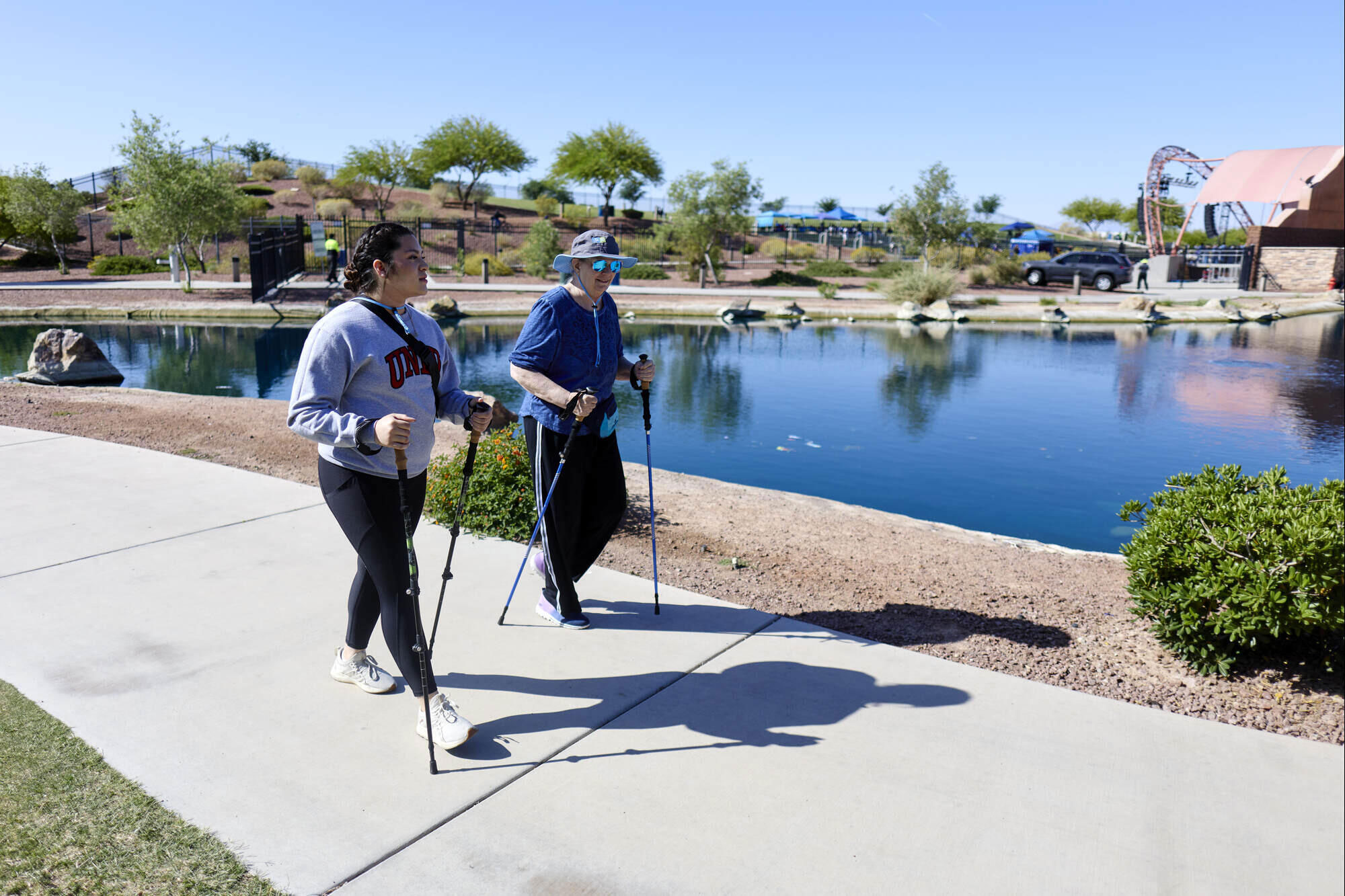
The Importance (and Benefits!) of Exercise
Landers said exercise works like “fertilizer for the brain.” It increases brain-derived neurotrophic factor (BDNF), a protein that helps neurons survive and grow.
“BDNF also dials down inflammation throughout the body and brain by triggering the release of anti-inflammatory signals from muscles and tissues during exercise,” Landers said.
Inflammation is an important part of immune defense, but too much of it can harm healthy tissue.
In simple terms, inflammation can speed up neuron death, while more aerobic exercise can lower a person’s baseline level of inflammation.
The right intensity matters
Landers recommends sustained aerobic activity of almost any kind, including treadmill walking, cycling, dancing, or another activity that raises the heart rate.
He suggests a level that feels moderate but challenging. A person should be working hard enough to speak only in short sentences, but not so lightly that carrying on a full conversation feels easy. That target range, about 60% to 75% of maximum heart rate, appears to produce the largest rise in BDNF.

“You want to be in this intensity zone so that you can sustain it over a relatively long time,” he said. “If the exercise is too intense, you would not be able to do it long enough to get the boost in BDNF.”
Training can challenge balance too
Brach Poston, a professor of kinesiology and nutrition sciences, said strength training, interval training, and boxing may also provide benefits. His research examines how noninvasive brain stimulation may improve motor skill learning in Parkinson’s disease, aging, and young adults.
“Boxing involves more complex movements,” he said. “It has an aerobic component and it has more interval training. It forces people to stand up, and it challenges their balance.”
When symptoms begin to disrupt everyday activities, people with Parkinson’s disease are often advised to take Levodopa, a medication that helps increase dopamine levels in the brain.
“For most people, it takes about six years after diagnosis before the symptoms get really bad,” Poston said.
More About Parkinson’s Disease
Actor Michael J. Fox helped bring Parkinson’s disease into the public spotlight after revealing his diagnosis at age 29, an unusually early age for the condition. Now 64, Fox continues to live with Parkinson’s and has spoken openly about dyskinesias, the uncontrolled, jerky movements that can develop as the disease progresses or after years of treatment. His advocacy has also fueled major investments in Parkinson’s research through the Michael J. Fox Foundation, now one of the world’s leading nonprofit funders of Parkinson’s studies.
“Bringing more attention to Parkinson’s is a good thing,” said Merrill Landers of UNLV’s School of Integrated Health Sciences. “It not only brings more people into the conversation, but we hope it ultimately leads to more funding for research that could change lives.”
Parkinson’s disease is a progressive neurological disorder that disrupts communication between brain cells. It is best known for reducing dopamine, the chemical messenger responsible for coordinating movement, but the disease also affects other neurotransmitter systems involved in sleep, mood, digestion, and cognition.
Parkinson’s by the Numbers
- Most Parkinson’s diagnoses occur between ages 55 and 65.
- About 1.1 million Americans are living with Parkinson’s disease, with roughly 90,000 new diagnoses each year.
- Although it affects only around 1% of adults over age 60, Parkinson’s is now considered the fastest-growing neurodegenerative disorder in the United States.
- Around 10% to 20% of patients are diagnosed before age 50, a condition known as early-onset Parkinson’s disease.
- Diagnoses before age 40 are rare and account for only about 2% of cases.
- Younger patients often experience a longer disease course and face a greater risk of developing long-term movement complications such as dyskinesias.
Early Symptoms and Disease Progression
- Many of the earliest warning signs appear years before the classic movement symptoms begin.
- Common early symptoms include constipation, R.E.M. sleep behavior disorder, depression, excessive daytime fatigue, and a reduced sense of smell.
- Research shows that 96% of newly diagnosed patients experienced changes in their sense of smell before receiving a diagnosis.
- Constipation and loss of smell frequently appear long before tremors or slowed movement become noticeable.
- By the time obvious motor symptoms develop, people with Parkinson’s have often already lost about 70% of their dopamine-producing neurons.
- Parkinson’s disease and Alzheimer’s disease can both affect cognition and movement, but Parkinson’s is generally associated more strongly with motor impairment, while Alzheimer’s primarily affects memory and cognitive function.
Never miss a breakthrough: Join the SciTechDaily newsletter.
Follow us on Google and Google News.