
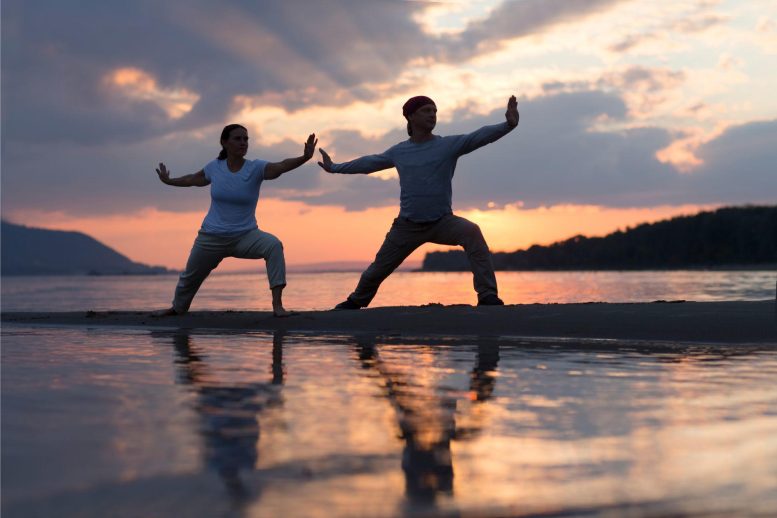
Associated with slower disease progression and lower doses of required drugs.
Tai Chi, the Chinese martial art that involves sequences of very slow controlled movements, may curb the symptoms and complications of Parkinson’s disease for several years, reveals research, published online on October 24 in the Journal of Neurology Neurosurgery & Psychiatry.
Its practice was associated with slower disease progression and lower doses of required drugs over time, the findings show.
Understanding Parkinson’s Disease
Parkinson’s disease is a debilitating and progressive neurodegenerative disorder, characterized by slowness of movement, resting tremors, and stiff and inflexible muscles.
It is the fastest-growing neurological condition in the world, with the number of those affected projected to reach nearly 5 million by 2030 in China alone. In the UK 2 people are diagnosed with the disease every hour according to the charity, Parkinson’s UK.
As yet, there is no cure for Parkinson’s, and while drugs can improve clinical symptoms, they don’t treat all the manifestations of the disease. And there’s no evidence that they slow progression either, explain the researchers.
Research Methodology
Previously published research suggests that Tai Chi eases Parkinson’s symptoms in the short term, but whether this improvement can be sustained over the long term isn’t known.
In a bid to find out, the researchers monitored two groups of patients with Parkinson’s disease for more than 5 years from January 2016 to June 2021.
One group of 147 patients practiced Tai Chi twice a week for an hour, aided by the provision of classes to improve their technique. The other group of 187 patients continued with their standard care, but didn’t practice Tai Chi.
Disease severity was formally assessed in all the participants at the start of the monitoring period, and disease progression, including increases in the need for medication, were subsequently monitored in November 2019, October 2020, and June 2021.
Assessment Parameters
The extent of movement and other symptoms, such as autonomic nervous system function (to include bowel movements, urinary and cardiovascular issues); mood, sleep quality, and cognition; and the prevalence of complications, such as dyskinesia (involuntary movement); dystonia (abnormal muscle tone); decline in responsiveness to drug treatment over time; mild cognitive impairment; hallucinations; restless leg syndrome were also tracked, using validated scales.
Disease severity, medication use, sex, age, and education level, were similar in both groups.
Disease progression was slower at all monitoring points in the Tai Chi group, as assessed by three validated scales to assess overall symptoms, movement, and balance.
The number of patients who needed to increase their medication in the comparison group was also significantly higher than it was in the Tai Chi Group: 83.5% in 2019 and just over 96% in 2020 compared with 71% and 87.5%, respectively.
Benefits of Tai Chi
Cognitive function deteriorated more slowly in the Tai Chi group as did other non-movement symptoms, while sleep and quality of life continuously improved.
And the prevalence of complications was significantly lower in the Tai Chi group than in the comparison group: dyskinesia 1.4% vs 7.5%; dystonia 0% vs 1.6%; hallucinations 0% vs just over 2%; mild cognitive impairment 3% vs 10%; restless legs syndrome 7% vs 15.5%.
Falls, dizziness, and back pain were the three side effects reported by study participants, but these were all significantly lower in the Tai Chi group. While 23 people sustained a fracture, these all occurred during routine daily life and were fewer in the Tai Chi group: 6 vs 17.
Study Limitations and Conclusions
This is an observational study, and as such, can’t establish cause and effect. And the researchers acknowledge that the number of study participants was relatively small and they weren’t randomly assigned to their group.
But they conclude: “Our study has shown that Tai Chi retains the long-term beneficial effect on [Parkinson’s disease], indicating the potential disease-modifying effects on both motor and non-motor symptoms, especially gait, balance, autonomic symptoms and cognition.”
They add: “[Parkinson’s disease] can worsen motor function and non-motor symptoms progressively with time, resulting in disability and influencing the quality of life. The long-term beneficial effect on [the disease] could prolong the time without disability, leading to a higher quality of life, a lower burden for caregivers, and less drug usage.”
Reference: “Effect of long-term Tai Chi training on Parkinson’s disease: a 3.5-year follow-up cohort study” by Gen Li, Pei Huang, Shishuang Cui, Yachao He, Yuyan Tan and Shengdi Chen, 24 October 2023, Journal of Neurology, Neurosurgery & Psychiatry.
DOI: 10.1136/jnnp-2022-330967
Never miss a breakthrough: Join the SciTechDaily newsletter.
Follow us on Google and Google News.