
Close Menu
    Facebook X (Twitter) Instagram
    SciTechDaily
    • Biology
    • Chemistry
    • Earth
    • Health
    • Physics
    • Science
    • Space
    • Technology
    Facebook X (Twitter) Pinterest YouTube RSS
    SciTechDaily
    Home»Science»Brain Activity Reveals When White Lies Are Selfish
    Science

    Brain Activity Reveals When White Lies Are Selfish

    By Society for NeuroscienceMay 31, 2021No Comments2 Mins Read
    Facebook Twitter Pinterest Telegram LinkedIn WhatsApp Email Reddit
    Share
    Facebook Twitter LinkedIn Pinterest Telegram Email Reddit
    Brain Activity Scan Concept
    Activity patterns in the prefrontal cortex reveal selfish motives behind white lies.

    Activity in Prefrontal Cortex Provides Clues About if a White Lie Has Selfish Motives

    You may think a little white lie about a bad haircut is strictly for your friend’s benefit, but your brain activity says otherwise. Distinct activity patterns in the prefrontal cortex reveal when a white lie has selfish motives, according to new research published in JNeurosci.

    White lies — formally called Pareto lies — can benefit both parties, but their true motives are encoded by the medial prefrontal cortex (MPFC). This brain region computes the value of different social behaviors, with some subregions focusing on internal motivations and others on external ones. Kim and Kim predicted activity patterns in these subregions could elucidate the true motive behind white lies.
    Brain Activity Reveals When White Lies Are Selfish
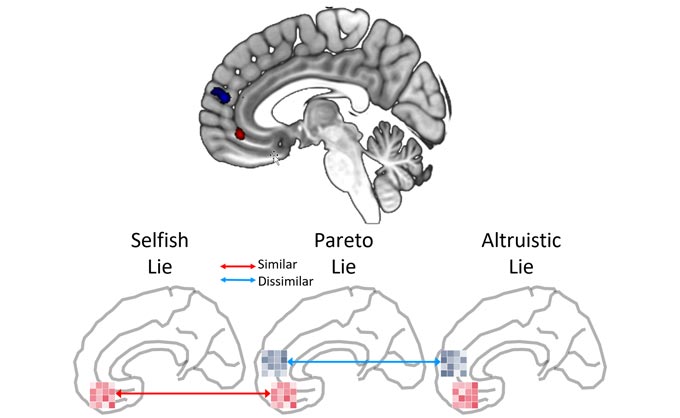
    People with higher selfish motivation in Pareto white lies showed increased VMPFC activity (red) for selfish lies and increased RMPFC activity (blue) for altruistic lies. In addition, their neural representations in the VMPFC were similar between selfish and Pareto lies, but those in the RMPFC were dissimilar between altruistic and Pareto lies. Credit: Kim and Kim, JNeurosci 2021

    The research team deployed a stand-in for white lies, having participants tell lies to earn a reward for themselves, for an unknown person, or for both. The team used fMRI to measure the MPFC activity of participants and, by comparing the brain activity of white lies with the selfish and altruistic lies, they could predict the true motivation for the lies. Selfish white lies elicited greater activity in the ventral and rostral MPFC. Activity patterns in the ventral subregion was similar to that of selfish lies, while activity patterns in the rostral subregion was dissimilar to altruistic lies.

    Reference: “Neural Representation in MPFC Reveals Hidden Selfish Motivation in White Lies” by JuYoung Kim and Hackjin Kim, 31 May 2021, JNeurosci.
    DOI: 10.1523/JNEUROSCI.0088-21.2021

    Never miss a breakthrough: Join the SciTechDaily newsletter.
    Follow us on Google and Google News.

    Behavioral Science Brain Neuroscience Society for Neuroscience
    Share. Facebook Twitter Pinterest LinkedIn Email Reddit

    Related Articles

    New Research Reveals Why We Help Some People but Not Others

    A Mathematical Equation Can Uncover Your Preferences via Brain Activity and Mood

    Neuroscientists Track How Bad Moods Develop and Persist in the Brain

    Musicians Have Brains With Stronger Connections Than Non-musicians

    Infant Brain Circuitry Shaped by Language Exposure

    “Area 32” – How the Brain Balances Emotion and Reason

    Why Time Sometimes Flies or Drags: How the Brain Creates the Experience of Time

    Scientists Can See the Bias in Your Brain – Even Before You Make Your Decision

    The Science of a Hit Song – Unlocking the Secrets of Musical Pleasure

    Leave A Reply Cancel Reply

    • Facebook
    • Twitter
    • Pinterest
    • YouTube

    Don't Miss a Discovery

    Subscribe for the Latest in Science & Tech!

    Trending News

    Mezcal “Worm” in a Bottle Mystery: DNA Testing Reveals a Surprise

    New Research Reveals That Your Morning Coffee Activates an Ancient Longevity Switch

    This Is What Makes You Irresistible to Mosquitoes

    Shockingly Powerful Giant Octopuses Ruled the Seas 100 Million Years Ago

    Scientists Stunned by New Organic Molecules Found on Mars

    Rewriting Dinosaur Evolution: Scientists Unearth Remarkable 150-Million-Year-Old Stegosaur Skull

    Omega-3 Supplements Linked to Cognitive Decline in Surprising New Study

    First-of-Its-Kind Discovery: Homer’s Iliad Found Embedded in a 1,600-Year-Old Egyptian Mummy

    Follow SciTechDaily
    • Facebook
    • Twitter
    • YouTube
    • Pinterest
    • Newsletter
    • RSS
    SciTech News
    • Biology News
    • Chemistry News
    • Earth News
    • Health News
    • Physics News
    • Science News
    • Space News
    • Technology News
    Recent Posts
    • These Simple Daily Habits Can Quickly Improve Blood Pressure and Heart Risk Factors
    • A Common Nutrient May Play a Surprising Role in Anxiety
    • Doing This After 9 p.m. Could Double Your Risk of Gut Issues
    • New Research Challenges Long-Held Beliefs About How the Brain Makes Decisions
    • Breakthrough Technology Reveals New Treatment Targets for Cancer
    Copyright © 1998 - 2026 SciTechDaily. All Rights Reserved.
    • Science News
    • About
    • Contact
    • Editorial Board
    • Privacy Policy
    • Terms of Use

    Type above and press Enter to search. Press Esc to cancel.