
A research team, comprised of Sandia chemists, is researching ways to make nuclear fuel reprocessing cleaner and to reduce the volume of high-level wastes. By focusing on the radioactive components that can’t be burned as fuel, the goal is to find a methodology for highly selective separations. By using metal-organic frameworks (MOFs), they are able to capture and remove volatile radioactive gas from spent nuclear fuel.
Research by a team of Sandia chemists could impact worldwide efforts to produce clean, safe nuclear energy and reduce radioactive waste.
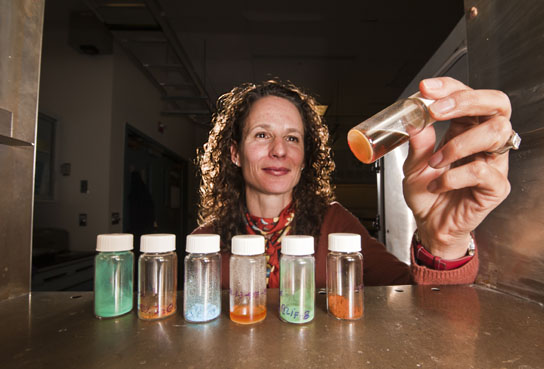
Sandia chemist Tina Nenoff heads a team of researchers focused on removal of radioactive iodine from spent nuclear fuel. They identified a metal-organic framework that captures and holds the volatile gas, a discovery that could be used for nuclear fuel reprocessing and other applications. (Photo by Randy Montoya) Click on the thumbnail for a high-resolution image.
The Sandia researchers have used metal-organic frameworks (MOFs) to capture and remove volatile radioactive gas from spent nuclear fuel. “This is one of the first attempts to use a MOF for iodine capture,” said chemist Tina Nenoff of Sandia’s Surface and Interface Sciences Department.
The discovery could be applied to nuclear fuel reprocessing or to clean up nuclear reactor accidents. A characteristic of nuclear energy is that used fuel can be reprocessed to recover fissile materials and provide fresh fuel for nuclear power plants. Countries such as France, Russia and India are reprocessing spent fuel.
The process also reduces the volume of high-level wastes, a key concern of the Sandia researchers. “The goal is to find a methodology for highly selective separations that result in less waste being interred,” Nenoff said.
Part of the challenge of reprocessing is to separate and isolate radioactive components that can’t be burned as fuel. The Sandia team focused on removing iodine, whose isotopes have a half-life of 16 million years, from spent fuel.
They studied known materials, including silver-loaded zeolite, a crystalline, porous mineral with regular pore openings, high surface area and high mechanical, thermal and chemical stability. Various zeolite frameworks can trap and remove iodine from a stream of spent nuclear fuel, but need added silver to work well.
“Silver attracts iodine to form silver iodide,” Nenoff said. “The zeolite holds the silver in its pores and then reacts with iodine to trap silver iodide.”
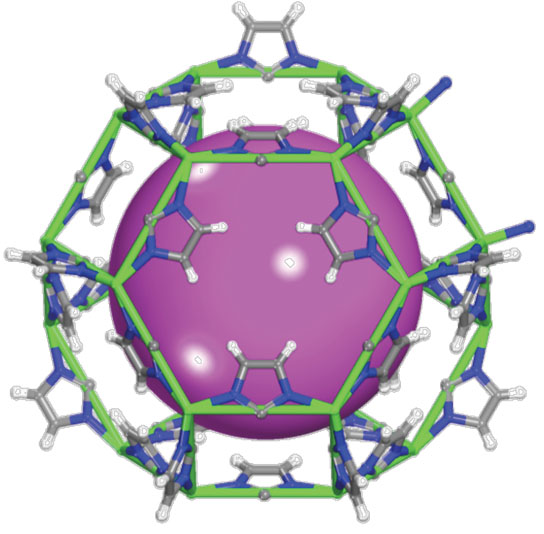
But silver is expensive and poses environmental problems, so the team set out to engineer materials without silver that would work like zeolites but have higher capacity for the gas molecules. They explored why and how zeolite absorbs iodine, and used the critical components discovered to find the best MOF, named ZIF-8.
“We investigated the structural properties on how they work and translated that into new and improved materials,” Nenoff said.
MOFs are crystalline, porous materials in which a metal center is bound to organic molecules by mild self-assembly chemical synthesis. The choice of metal and organic result in a very specific final framework.
The trick was to find a MOF highly selective for iodine. The Sandia researchers took the best elements of the zeolite Mordenite — its pores, high surface area, stability and chemical absorption — and identified a MOF that can separate one molecule, in this case iodine, from a stream of molecules. The MOF and pore-trapped iodine gas can then be incorporated into glass waste for long-term storage.
The Sandia team also fabricated MOFs, made of commercially available products, into durable pellets. The as-made MOF is a white powder with a tendency to blow around. The pellets provide a stable form to use without loss of surface area, Nenoff said.
Sandia has applied for a patent on the pellet technology, which could have commercial applications.
The Sandia researchers are part of the Off-Gas Sigma Team, which is led by Oak Ridge National Laboratory and studies waste-form capture of volatile gasses associated with nuclear fuel reprocessing. Other team members — Pacific Northwest, Argonne and Idaho national laboratories — are studying other volatile gases such as krypton, tritium, and carbon.
The project began six years ago and the Sigma Team was formalized in 2009. It is funded by the U.S. Department of Energy Office of Nuclear Energy.
Sandia’s iodine and MOFs research was featured in two recent articles in the Journal of the American Chemical Society authored by Nenoff and team members Dorina Sava, Mark Rodriguez, Jeffery Greathouse, Paul Crozier, Terry Garino, David Rademacher, Ben Cipiti, Haiqing Liu, Greg Halder, Peter Chupas, and Karena Chapman. Chupas, Halder, and Chapman are from Argonne.
“The most important thing we did was introduce a new class of materials to nuclear waste remediation,” said Sava, postdoctoral appointee on the project.
Nenoff said another recent paper in Industrial & Engineering Chemistry Research shows a one-step process that incorporates MOFs with iodine in a low-temperature, glass waste form. “We have a volatile off-gas capture using a MOF and we have a durable waste form,” Nenoff said.
Nenoff and her colleagues are continuing their research into new and optimized MOFs for enhanced volatile gas separation and capture.
“We’ve shown that MOFs have the capacity to capture and, more importantly, retain many times more iodine than current materials technologies,” said Argonne’s Chapman.
Never miss a breakthrough: Join the SciTechDaily newsletter.
Follow us on Google and Google News.
2 Comments
Hi, Neat post. There’s a problem along with your site in web explorer, might check this? IE nonetheless is the market leader and a huge element of other people will omit your excellent writing due to this problem.
Thanks, we will take a look ASAP.