
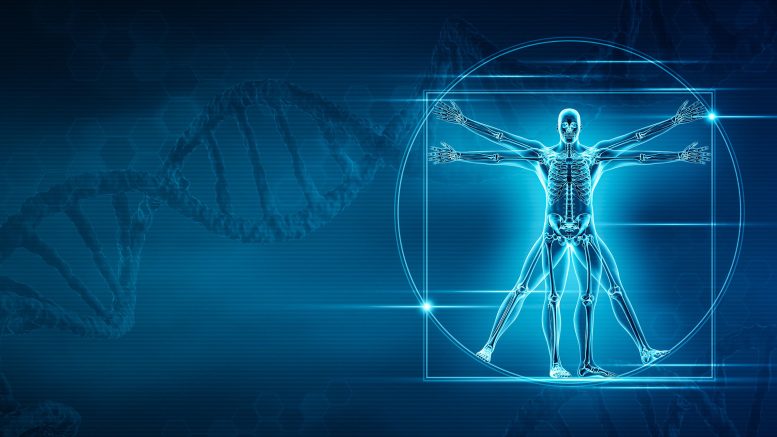
The use of artificial intelligence on medical imaging datasets has, for the first time, unveiled the genetics of the skeletal form.
By leveraging artificial intelligence to scrutinize tens of thousands of X-ray pictures and genetic sequences, a team of researchers from The University of Texas at Austin and New York Genome Center have successfully identified the genes that shape our skeletons, from the width of our shoulders to the length of our legs.
This groundbreaking study, which was published as the cover article in the journal Science, not only sheds light on our evolutionary history but also paves the way for a future where physicians could more accurately assess a patient’s likelihood of suffering from ailments like back pain or arthritis later in life.
“Our research is a powerful demonstration of the impact of AI in medicine, particularly when it comes to analyzing and quantifying imaging data, as well as integrating this information with health records and genetics rapidly and at large scale,” said Vagheesh Narasimhan, an assistant professor of integrative biology as well as statistics and data science, who led the multidisciplinary team of researchers, to provide the genetic map of skeletal proportions.
Humans are the only large primates to have longer legs than arms, a change in the skeletal form that is critical in enabling the ability to walk on two legs. The scientists sought to determine which genetic changes underlie anatomical differences that are clearly visible in the fossil record leading to modern humans, from Australopithecus to Neanderthals. They also wanted to find out how these skeletal proportions allowing bipedalism affect the risk of many musculoskeletal diseases such as arthritis of the knee and hip — conditions that affect billions of people in the world and are the leading causes of adult disability in the United States.
Deep Learning Reveals 145 Key Genetic Points
The researchers used deep learning models to perform automatic quantification on 39,000 medical images to measure distances between shoulders, knees, ankles, and other points in the body. By comparing these measurements to each person’s genetic sequence, they found 145 points in the genome that control skeletal proportions.
“Our work provides a road map connecting specific genes with skeletal lengths of different parts of the body, allowing developmental biologists to investigate these in a systematic way,” said Tarjinder (T.J.) Singh, the study’s co-author, and associate member at NYGC and assistant professor in the Columbia University Department of Psychiatry.
The team also examined how skeletal proportions associate with major musculoskeletal diseases and showed that individuals with a higher ratio of hip width to height were found to be more likely to develop osteoarthritis and pain in their hips. Similarly, people with higher ratios of femur (thigh bone) length to height were more likely to develop arthritis in their knees, knee pain, and other knee problems. People with a higher ratio of torso length to height were more likely to develop back pain.
“These disorders develop from biomechanical stresses on the joints over a lifetime,” said Eucharist Kun, a UT Austin biochemistry graduate student and lead author on the paper. “Skeletal proportions affect everything from our gait to how we sit, and it makes sense that they are risk factors in these disorders.”
Tracing Human Evolution Through Our Genes
The results of their work also have implications for our understanding of evolution. The researchers noted that several genetic segments that controlled skeletal proportions overlapped more than expected with areas of the genome called human accelerated regions. These are sections of the genome shared by great apes and many vertebrates but are significantly diverged in humans. This provides a genomic rationale for the divergence in our skeletal anatomy.
One of the most enduring images of the Rennaisance—Leonardo Da Vinci’s “The Vitruvian Man” –contained similar conceptions of the ratios and lengths of limbs and other elements that make up the human body.
“In some ways, we’re tackling the same question that Da Vinci wrestled with,” Narasimhan said. “What is the basic human form and its proportion? But we are now using modern methods and also asking how those proportions are genetically determined.”
Reference: “The genetic architecture and evolution of the human skeletal form” by Eucharist Kun, Emily M. Javan, Olivia Smith, Faris Gulamali, Javier de la Fuente, Brianna I. Flynn, Kushal Vajrala, Zoe Trutner, Prakash Jayakumar, Elliot M. Tucker-Drob, Mashaal Sohail, Tarjinder Singh and Vagheesh M. Narasimhan, 21 June 2023, Science.
DOI: 10.1126/science.adf8009
In addition to Kun and Narasimhan, the co-authors are Tarjinder Singh of the New York Genome Center and Columbia University; Emily M. Javan, Olivia Smith, Javier de la Fuente, Brianna I. Flynn, Kushal Vajrala, Zoe Trutner, Prakash Jayakumar and Elliot M. Tucker-Drob of UT Austin; Faris Gulamali of Icahn School of Medicine at Mount Sinai; and Mashaal Sohail of Universidad Nacional Autonoma de Mexico.
The research was funded by the Allen Institute, Good Systems, the Ethical AI research grand challenge at UT Austin, and the National Institutes of Health, with graduate student fellowship support provided by the National Science Foundation and UT Austin’s provost’s office.
Never miss a breakthrough: Join the SciTechDaily newsletter.
Follow us on Google and Google News.