
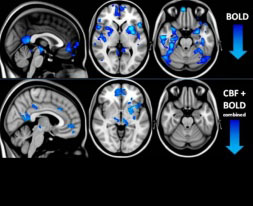
A recent study shows how psilocybin, the active ingredient in magic mushrooms, affects brain activity. 30 healthy volunteers underwent MRIs while having psilocybin in their blood and researchers found that psilocybin actually caused activity to decrease in the medial prefrontal cortex, the posterior cingulate cortex, reduced blood flow in the hypothalamus, while participants recalled their recollections as being more vivid after taking psilocybin compared with a placebo.
Brain scans of people under the influence of the psilocybin, the active ingredient in magic mushrooms, have given scientists the most detailed picture to date of how psychedelic drugs work. The findings of two studies being published in scientific journals this week identify areas of the brain where activity is suppressed by psilocybin and suggest that it helps people to experience memories more vividly.
In the first study, published today in Proceedings of the National Academy of Sciences (PNAS), 30 healthy volunteers had psilocybin infused into their blood while inside magnetic resonance imaging (MRI) scanners, which measure changes in brain activity. The scans showed that activity decreased in “hub” regions of the brain – areas that are especially well-connected with other areas.
The second study, due to be published online by the British Journal of Psychiatry on Thursday, found that psilocybin enhanced volunteers’ recollections of personal memories, which the researchers suggest could make it useful as an adjunct to psychotherapy.
Professor David Nutt, from the Department of Medicine at Imperial College London, the senior author of both studies, said: “Psychedelics are thought of as ‘mind-expanding’ drugs so it has commonly been assumed that they work by increasing brain activity, but surprisingly, we found that psilocybin actually caused activity to decrease in areas that have the densest connections with other areas. These hubs constrain our experience of the world and keep it orderly. We now know that deactivating these regions leads to a state in which the world is experienced as strange.”
The intensity of the effects reported by the participants, including visions of geometric patterns, unusual bodily sensations, and altered sense of space and time, correlated with a decrease in oxygenation and blood flow in certain parts of the brain.
The function of these areas, the medial prefrontal cortex (mPFC) and the posterior cingulate cortex (PCC), is the subject of debate among neuroscientists, but the PCC is proposed to have a role in consciousness and self-identity. The mPFC is known to be hyperactive in depression, so psilocybin’s action on this area could be responsible for some antidepressant effects that have been reported. Similarly, psilocybin reduced blood flow in the hypothalamus, where blood flow is increased during cluster headaches, perhaps explaining why some sufferers have said symptoms improved under psilocybin.
In the British Journal of Psychiatry study 10 volunteers viewed written cues that prompted them to think about memories associated with strong positive emotions while inside the brain scanner. The participants rated their recollections as being more vivid after taking psilocybin compared with a placebo, and with psilocybin there was increased activity in areas of the brain that process vision and other sensory information.
Participants were also asked to rate changes in their emotional well-being two weeks after taking the psilocybin and placebo. Their ratings of memory vividness under the drug showed a significant positive correlation with their well-being two weeks afterward. In a previous study of 12 people in 2011, researchers found that people with anxiety who were given a single psilocybin treatment had decreased depression scores six months later.
Dr Robin Carhart-Harris, from the Department of Medicine at Imperial College London, the first author of both papers, said: “Psilocybin was used extensively in psychotherapy in the 1950s, but the biological rationale for its use has not been properly investigated until now. Our findings support the idea that psilocybin facilitates access to personal memories and emotions.
“Previous studies have suggested that psilocybin can improve people’s sense of emotional wellbeing and even reduce depression in people with anxiety. This is consistent with our finding that psilocybin decreases mPFC activity, as many effective depression treatments do. The effects need to be investigated further, and ours was only a small study, but we are interested in exploring psilocybin’s potential as a therapeutic tool.”
The researchers acknowledged that because the participants in this study had volunteered after having previous experience of psychedelics, they may have held prior assumptions about the drugs which could have contributed to the positive memory rating and the reports of improved wellbeing in the follow-up.
Functional MRI measures brain activity indirectly by mapping blood flow or the oxygen levels in the blood. When an area becomes more active, it uses more glucose, but generates energy in rapid chemical reactions that do not use oxygen. Consequently, blood flow increases but oxygen consumption does not, resulting in a higher concentration of oxygen in blood in the local veins.
In the PNAS study, the volunteers were split into two groups, each studied using a different type of fMRI: 15 were scanned using arterial spin labeling (ASL) perfusion fMRI, which measures blood flow, and 15 using blood-oxygen-level-dependent (BOLD) fMRI. The two modalities produced similar results, strongly suggesting that the observed effects were genuine.
The studies were carried out with a Home Office license for storing and handling a schedule 1 drug and were approved by NHS research ethics committees. All the volunteers were mentally and physically healthy and had taken hallucinogenic drugs previously without any adverse response. The research involved scientists from Imperial, the University of Bristol, and Cardiff University and was funded by the Beckley Foundation, the Neuropsychoanalysis Foundation, Multidisciplinary Association for Psychedelic Studies, and the Heffter Research Institute.
Never miss a breakthrough: Join the SciTechDaily newsletter.
Follow us on Google and Google News.
16 Comments
There is no mention of dosage.Why?
This is kind of awareness is very good and
would benefit a lot of people in the long run.
I hope that this will progress and
improve people’s lives.
Great piece of work. I hope the world gets to understand the benefits of nature.
Thanks for the such informational articles. Can you please add dosages information.
Nice article! Always love to hear of studies corroborating what shamanistic cultures have known for centuries – that psychedelics are a potent psychiatric tool. Can you update with a link to the actual study abstract?
Thanks for giving us a clear idea about the importance of mushrooms and how it’s working for our mental health. Really a wonderful article.
A very good thing that psilocybin mushrooms are being studied for medicinal benefits. When its full potential is reached, it’ll be groundbreaking.
If you have never met an Eclectus I must warn you that it only takes a moment for these birds to steal your heart away. They can make you laugh, make your heart melt, and at times make you want to bite nails because they can be terribly hard-headed little critters. For more information visit https://electrus.company.com/
I am sure that the study of mushrooms will help in the future to cope with various problems. Because mushrooms are an amazing product about which humanity still does not know much.
Nice Blog,……
Thank you for sharing meaningful information with us
Excellent overview and interesting perspective. Having been a practicing psychiatrist for almost 40 years (just retired last month) I am well aware of the marginal benefits and excessive risks of so many of our psychoactive medicines. I believe the current research and “re-research” into the potential beneficial role of psychedelics actually offers a real hope for psychiatric progress, finally. At least allow the research…
Thank you for spreading awareness of the effects of this magic mushroom in our brain. Indeed that this magic mushrooms are truly magical because it contains a component that is responsible for our brain.
I am excited to see how much new research will come out in the next few years, now that money is being poured into psilocybin research by companies like Compass Pathways
Through this article, I get more knowledge about mushrooms. This concept is a good way to increase knowledge. Keep sharing this kind of articles, Thank you. magic mushrooms for sale usa
I am excited to see how much new research will come out in the next few years
https://sphynxkitty.company.com
I am happy this will get to us next year
https://sphynxkitty.company.com