

How to deal with the design, development, and qualification of the Tianwen-1 Mars parachute.
China’s Tianwen-1 Mars probe successfully landed on the Utopia Plain at 7:18 a.m. Beijing Time, on May 15, 2021. The success rate of Mars missions is about 50%, and most failures occur during the entry, descent, and landing (EDL) phase. Parachutes of low-density supersonic play a vital role in the EDL of Mars and directly determine the success of the entire mission. In a research paper recently published in Space: Science & Technology, Mingxing Huang from Beijing Institute of Space Mechanics and Electricity carried out the design, development, and qualification of the Tianwen-1 Mars parachute, which can provide a reference for the creation of future Mars exploration parachutes.
The author first focused on the analysis and selection of Mars parachute types. Compared with the parachutes that work on Earth, the parachutes of the Mars lander face more problems. On one hand, the open flight of the Mars parachute is characterized by supersonic speed, low density, and low dynamic pressure. On the other hand, atmospheric activities, such as Martian vortex activity and dust storms, may lead to harsh parachute opening conditions. Therefore, difficulties in opening the parachute, unstable inflation, and reduced drag coefficient should be considered in the design of parachute.
Disk-Gap-Band (DGB) Parachute as the Optimal Design
All of the other landers that have successfully achieved soft landing on Mars have used the DGB (Disk-Gap-Band) parachute, which has good stability and excellent inflation performance in the supersonic and low-density working environment. Due to its demonstrated high-altitude performance and lower technical risk, the DGB parachute with improved design modifications is selected as the candidate for the Tianwen-1 Mars probe. According to the ratio of the band area to the entire canopy, the DGB parachutes can be divided into the Viking type and the MPF (Mars Pathfinder) type. The Viking type DGB parachute has a high drag coefficient and weak stability, whereas the MPF and its improved DGB parachute have a smaller drag coefficient but better stability. Furthermore, two ideas were adopted to optimize and improve the existing DGB parachute structure. One is to increase the drag coefficient. The disk part is thus modified to a structure with a higher drag coefficient The other is to enlarge the band’s area to increase the parachute’s stability, such as adding a tapered band on the skirt of the canopy. Thus, five DGB parachute structures, including the MPF, Viking, hemisflo, triconical and tapered structure, were selected as candidates.
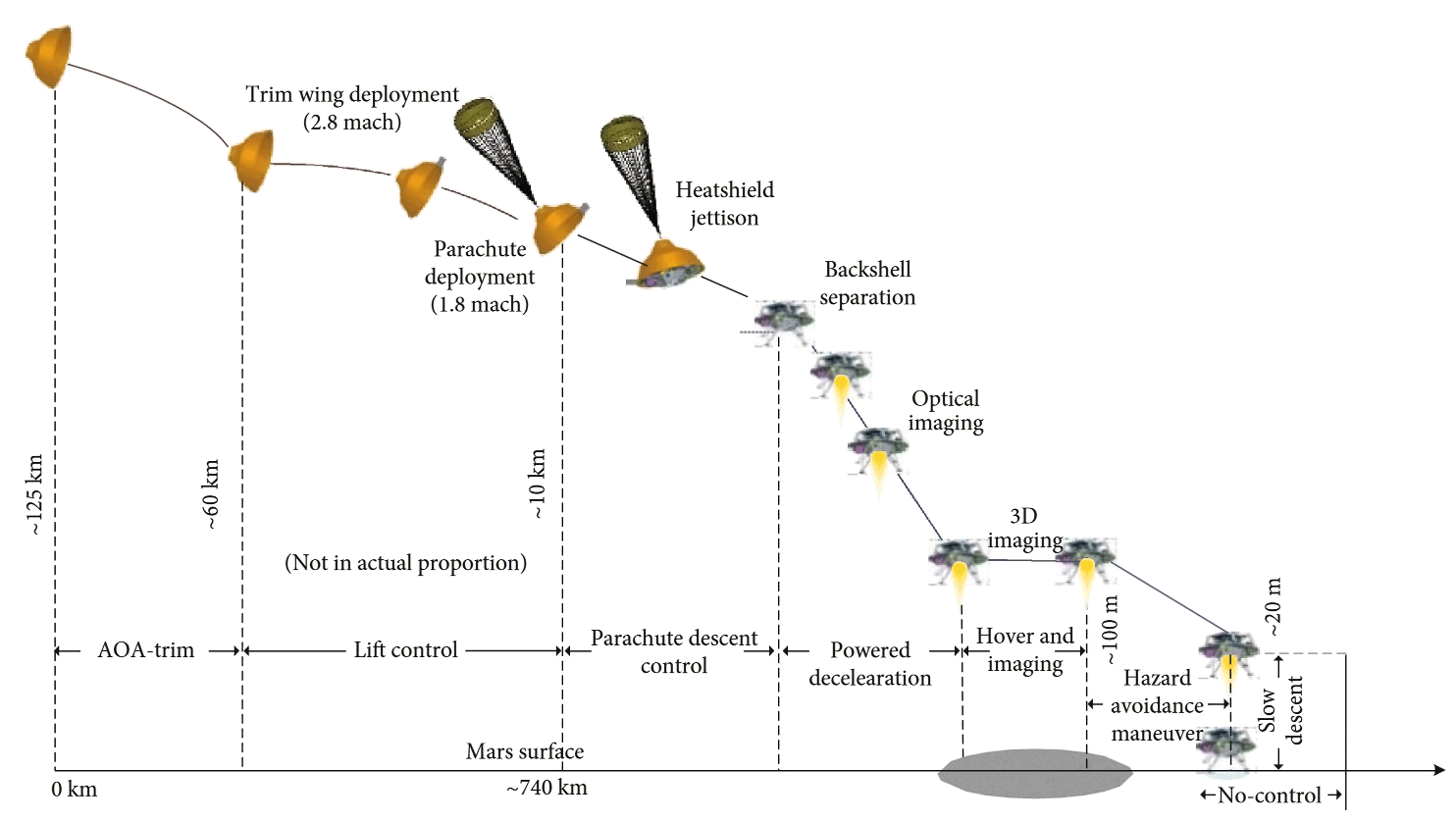
Afterward, to optimize the structure for the Mars parachute, the subsonic, transonic, and supersonic wind tunnel tests were carried out for the five DGB parachutes to obtain their drag coefficients and oscillation angles. Combined with the wind tunnel test results at different Mach numbers to select a parachute with better deceleration and stability performance, the tapered DGB parachute were the best deceleration parachute for the Tianwen-1.
High-Altitude Flight Tests for Parachute Validation
Finally, to demonstrate the capability of full scale tapered DGB parachutes in Mars flight conditions, four high-altitude flight tests were carried out by sounding rockets in April 2018. During the flight, the first stage burned out at altitudes of approximately 17 km~20 km (10.5 mi~12.4 mi), respectively, the payload section reached apogee between 49 km (30 mi) and 64 km(40 mi). When the payload got the target dynamic pressure and Mach number, the parachute was mortar-deployed.
The deployment, inflation, and supersonic and subsonic aerodynamics of the parachute were analyzed by a suite of instruments, including a high-speed video system trained on the parachute, a set of load pins at the interface of the parachute bridles and the payload, and a GPS and inertial measurement unit (IMU) onboard the payload. After decelerating to subsonic speed, the parachute and payload descended to the test range for recovery.
All of the tests targeted a specific dynamic pressure at parachute deployment to reach a desired load on the parachute at full inflation. The parachutes were mortar-fire deployed at dynamic pressures ranging from 100Pa to 950Pa and Mach numbers between 2.05 and 2.35. In comparison, the parachute of Tianwen-1 must be able to get opened reliably within the range of Ma1.6~Ma2.3 and dynamic pressure range of 250Pa~850Pa. Under the high-altitude opening test conducted on the earth and the actual working conditions of Mars, the Reynolds numbers are both in the order of 2×10⁶.
The test results indicate that the drag coefficient of the tapered DGB parachute varied from 0.39 to 0.70 with the Mach number increased from Ma 0.2-Ma 2.4 and reached the maximum value of 0.7 at Ma 1.5; the maximum AOA after parachute deployment is about 20°, which have all demonstrated that the performance of the tapered DGB parachute could meet the deceleration requirements of the Tianwen-1 Mars probe.
Reference: “Analysis and Verification of Aerodynamic Characteristics of Tianwen-1 Mars Parachute” by Mingxing Huang, Wenqiang Wang and Jian Li, 20 March 2022, Space: Science & Technology.
DOI: 10.34133/2022/9805457
Funding: Beijing Institute of Space Mechanics & Electricity
Never miss a breakthrough: Join the SciTechDaily newsletter.
Follow us on Google and Google News.
1 Comment
It’s great that China succeded on the very first try using our technique so well.
It’s almost like they were given all the data.