
Four advanced space concepts from NASA’s Jet Propulsion Laboratory (as well as 12 from elsewhere for a total of 16) have been selected to receive grants for further research and development.
Early-stage research into futuristic space ideas – a lunar levitation track system, light bending lunar power system, method for making soil from asteroid material, and more – could help revolutionize NASA’s technology toolbox and pioneer new kinds of missions. More than a dozen researchers from within the agency, industry, and academia will receive grants from the NASA Innovative Advanced Concepts (NIAC) program to study their concepts’ feasibility.
“NIAC Fellows are known to dream big, proposing technologies that may appear to border science fiction and are unlike research being funded by other agency programs,” said Jenn Gustetic, director of early-stage innovations and partnerships within NASA’s Space Technology Mission Directorate (STMD). “We don’t expect them all to come to fruition but recognize that providing a small amount of seed-funding for early research could benefit NASA greatly in the long run.”
For 2021, STMD selected 16 Phase I NIAC proposals, which offer a range of inventions and applications. Each selected proposal will receive a grant from NASA up to $125,000. If their initial 9-month feasibility studies are successful, NIAC Fellows can apply for Phase II awards. All NIAC studies, regardless of phase, are early-stage technology development efforts. They are not considered and may never become NASA missions.
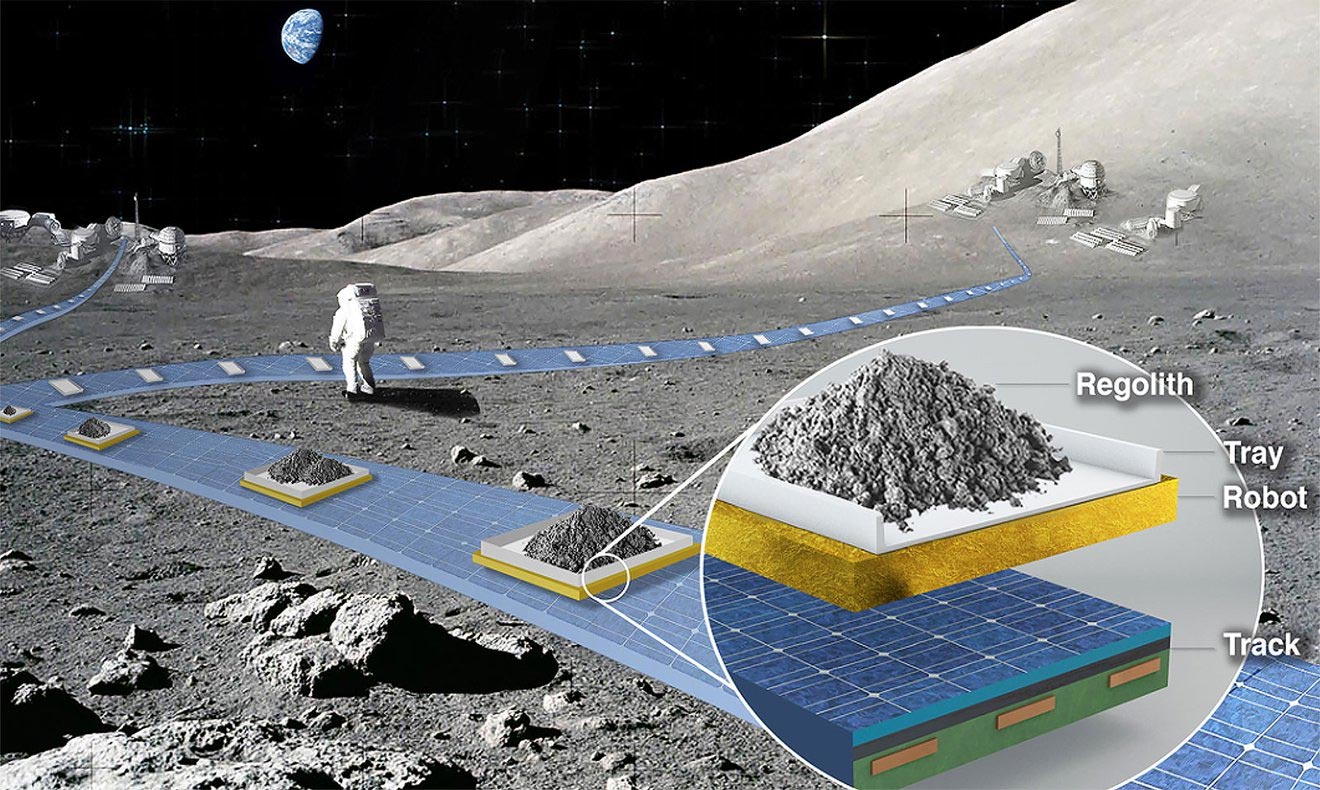
Among the selections is a robotics engineer at NASA’s Jet Propulsion Laboratory in Southern California, offering an infrastructure idea for autonomously transporting cargo on the Moon using magnetic robots that would levitate over a flexible track. The tracks would unroll on the lunar surface, forgoing major on-site construction associated with building roads and railways on Earth. The Fellow will research another NIAC Phase I study in parallel: swimming micro-robots for exploring ocean worlds.
A researcher at NASA’s Langley Research Center in Hampton, Virginia, will look into a concept for generating and distributing power on the Moon. The “light bender” system would capture, concentrate, and focus sunlight using telescope optics.
An industry-based researcher with Trans Astronautica Corporation proposed a conceptual method for making soil in space using carbon-rich asteroids and fungi. The concept suggests the fungi would break down the material and turn it into soil to grow food and sustain large-scale deep-space habitats.
An assistant professor at Carnegie Mellon University will investigate a lightweight and deployable structure design to allow for kilometer-scale structures in space. The proposal suggests the structure could serve as the backbone of a large rotating spacecraft capable of producing artificial gravity.
“There is an overwhelming number of new participants in the program this year,” said NIAC Program Executive Jason Derleth. “All but two of the researchers selected for Phase I awards will be first-time NIAC grant recipients, showing NASA’s early-stage opportunities continue to engage new creative thinkers from all over the country.”
The complete list of researchers selected to receive NIAC Phase I grants in 2021 and the titles of their proposals are:
Sarbajit Banerjee, Texas A&M Engineering Experiment Station in College Station
Regolith Adaptive Modification System to Support Early Extraterrestrial Planetary Landings
Sigrid Close, Stanford University in Stanford, California
Amelia Greig, University of Texas in El Paso
Ablative Arc Mining for In-Situ Resource Utilization
Zachary Manchester, Carnegie Mellon University in Pittsburgh
Kilometer-Scale Space Structures from a Single Launch
Patrick McGarey, JPL
Passively Expanding Dipole Array for Lunar Sounding (PEDALS)
Quinn Morley, Planet Enterprises in Gig Harbor, Washington
Autonomous Robotic Demonstrator for Deep Drilling (ARD3)
Christopher Morrison, Ultra Safe Nuclear Corporation (USNC-Tech) in Seattle
E. Joseph Nemanick, The Aerospace Corporation in Santa Monica, California
Atomic Planar Power for Lightweight Exploration (APPLE)
Steven Oleson, NASA’s Glenn Research Center in Cleveland
Titan Sample Return Using In-situ Propellants
Marco Pavone, Stanford University
ReachBot: Small Robot for Large Mobile Manipulation Tasks in Martian Cave Environments
Ronald Polidan, Lunar Resources Inc. in Houston
FarView: In-situ Manufactured Lunar Far Side Radio Observatory
Ethan Schaler, JPL (two selections)
FLOAT: Flexible Levitation on a Track
SWIM: Sensing with Independent Micro-swimmers
Jane Shevtsov, Trans Astronautica Corporation in Lake View Terrace, California
Making Soil for Space Habitats by Seeding Asteroids with Fungi
Charles Taylor, Langley
Joshua Vander Hook, JPL
NIAC supports visionary research ideas through multiple progressive phases of study. Researchers across U.S. government, industry, and academia with high-impact ideas can submit proposals.
Phase II NIAC researchers receive up to $500,000 grants to further develop their concepts for up to two years. Phase III aims to strategically transition NIAC concepts with the highest potential impact for NASA, other government agencies, or commercial partners. Phase III researchers receive a contract up to $2 million to mature their mission concept over two years.
Never miss a breakthrough: Join the SciTechDaily newsletter.
Follow us on Google and Google News.