
Close Menu
    Facebook X (Twitter) Instagram
    SciTechDaily
    • Biology
    • Chemistry
    • Earth
    • Health
    • Physics
    • Science
    • Space
    • Technology
    Facebook X (Twitter) Pinterest YouTube RSS
    SciTechDaily
    Home»Technology»Scientists Develop a New Family of ‘2D’ Materials With Promising Applications
    Technology

    Scientists Develop a New Family of ‘2D’ Materials With Promising Applications

    By Tulane UniversityMay 25, 20221 Comment3 Mins Read
    Facebook Twitter Pinterest Telegram LinkedIn WhatsApp Email Reddit
    Share
    Facebook Twitter LinkedIn Pinterest Telegram Email Reddit
    Abstract Nanocrystal Lattice Concept
    Researchers have created a new family of two-dimensional materials with promising applications in advanced electronics and high-capacity batteries.

    Researchers say the material has promising applications, such as advanced electronics and high-capacity batteries.

    Tulane University’s School of Science and Engineering has created a new family of two-dimensional materials with promising applications, including advanced electronics and high-capacity batteries.

    The research, which was led by Michael Naguib, an assistant professor in the Department of Physics and Engineering Physics, was published in the journal Advanced Materials.

    “Two-dimensional materials are nanomaterials with thickness in the nanometer size (a nanometer is one-millionth of a millimeter) and lateral dimensions thousands of times the thickness,” Naguib said. “Their flatness offers unique set of properties compared to bulk materials.”

    Transition Metal Carbo-Chalcogenides (TMCC)

    The new family of 2D materials is called transition metal carbo-chalcogenides, or TMCC. It combines the characteristics of two families of 2D materials — transition metal carbides and transition metal dichalcogenides.

    According to Naguib, the Ken & Ruth Arnold Early Career Professor in Science and Engineering, the latter is a broad family of materials that has been intensively researched and shown to be highly promising, particularly for electrochemical energy storage and conversion. However, he said that one of the difficulties in using them is their poor electrical conductivity and stability.
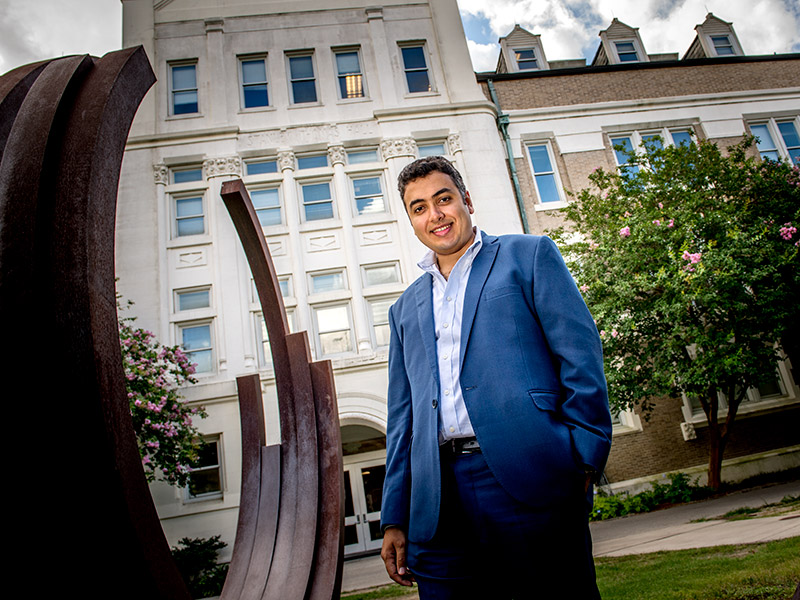
    Michael Naguib Tulane University
    Michael Naguib, the Ken & Ruth Arnold Early Career Professor in Science and Engineering, is an expert in two-dimensional material and electrochemical energy storage. Credit: Paula Burch-Celentano

    On the other hand, he said, transition metal carbides are excellent electrical conductors with much more powerful conductivity. Merging the two families into one is anticipated to have great potential for many applications such as batteries and supercapacitors, catalysis, sensors, and electronics.

    “Instead of stacking the two different materials like Lego building blocks with many problematic interfaces, here we develop a new 2D material that has the combination of both compositions without any interface,” he said.

    Innovative Synthesis Method for 2D TMCC Materials

    “We used an electrochemical-assisted exfoliation process by inserting lithium ions in-between the layers of bulk transition metals carbo-chalcogenides followed by agitation in water,” said Ahmad Majed, the first author of the article and a doctoral candidate in Materials Physics and Engineering at Tulane working in Naguib’s group.

    Unlike other exotic nanomaterials, Majed said, the process of making these 2D TMCC nanomaterials is simple and scalable.

    In addition to Naguib and Majed, the team includes Jiang Wei, an associate professor in physics and engineering physics; Jianwei Sun, an assistant professor in physics and engineering physics; PhD candidates Kaitlyn Prenger, Manish Kothakonda, and Fei Wang at Tulane; and Dr Eric N. Tseng and professor Per O.A. Persson of Linköping University in Sweden.

    This study was supported by Naguib’s National Science Foundation Career Award which he received less than a year ago.

    Reference: “Transition Metal Carbo-Chalcogenide “TMCC”: A New Family of 2D Materials” by Ahmad Majed, Manish Kothakonda, Fei Wang, Eric N. Tseng, Kaitlyn Prenger, Xiaodong Zhang, Per O. Å. Persson, Jiang Wei, Jianwei Sun and Michael Naguib, 13 April 2022, Advanced Materials.
    DOI: 10.1002/adma.202200574

    Never miss a breakthrough: Join the SciTechDaily newsletter.
    Follow us on Google and Google News.

    2D Materials Materials Science Nanomaterials Tulane University
    Share. Facebook Twitter Pinterest LinkedIn Email Reddit

    Related Articles

    Graphene Light Detector Has the Potential to Put Heat Vision Technology into a Contact Lens

    Researchers Produce Uniform Antimony Nanocrystals for the First Time

    Nanoengineers Develop ‘Nanosponge Vaccine’ to Fight MRSA Toxins

    Chemists Synthesize Nanomaterials with Stainless Steel-Like Interfaces

    New Spectroscopic Method Could Improve Optical Devices

    “Patterned Regrowth” May Lead to Graphene-Based Circuits

    Nanomaterials Actively Self-Regulate in Response to Environmental Change

    Nano-Sandwich Design Results in Slimmer Solar Cells With Decreased Costs

    SLIPS Prevents Ice From Sticking on Metal Surfaces

    1 Comment

    1. Earlier the Better on May 27, 2022 6:11 am

      We have Hydro turbines. We also have Volcanoes whose Heat is not utilized properly. Using Computer Monitored Tubes, Sea water has to be entered and flown out as Water back to the Sea…meanwhile turning the Turbines.

      Reply
    Leave A Reply Cancel Reply

    • Facebook
    • Twitter
    • Pinterest
    • YouTube

    Don't Miss a Discovery

    Subscribe for the Latest in Science & Tech!

    Trending News

    Scientists Uncover Potential Brain Risks of Popular Fish Oil Supplements

    Scientists Discover a Surprising Way To Make Bread Healthier and More Nutritious

    After 60 Years, Scientists Uncover Unexpected Brain Effects of Popular Diabetes Drug Metformin

    New Research Uncovers Hidden Side Effects of Popular Weight-Loss Drugs

    Scientists Rethink Extreme Warming After Surprising Ocean Discovery

    Landmark Study Links Never Marrying to Significantly Higher Cancer Risk

    Researchers Discover Unknown Beetle Species Just Steps From Their Lab

    Largest-Ever Study Finds Medicinal Cannabis Ineffective for Anxiety, Depression, PTSD

    Follow SciTechDaily
    • Facebook
    • Twitter
    • YouTube
    • Pinterest
    • Newsletter
    • RSS
    SciTech News
    • Biology News
    • Chemistry News
    • Earth News
    • Health News
    • Physics News
    • Science News
    • Space News
    • Technology News
    Recent Posts
    • Students Build Dark Matter Detector and Set New Experimental Limits
    • Scientists Discover Caffeine Can Repair Key Memory Circuits After Sleep Loss
    • Strange 65-Foot Dinosaur Discovered in Argentina
    • Researchers Uncover Source of Strange Deformation in Earth’s Largest Continental Rift
    • Scientists Solve Mystery of Where the Colorado River Vanished Millions of Years Ago
    Copyright © 1998 - 2026 SciTechDaily. All Rights Reserved.
    • Science News
    • About
    • Contact
    • Editorial Board
    • Privacy Policy
    • Terms of Use

    Type above and press Enter to search. Press Esc to cancel.