

Researchers have developed a novel mechanical computer inspired by kirigami, utilizing interconnected polymer cubes for data storage without electronics.
This system allows for multiple stable states, enhancing binary computing to potentially include additional data states. The design, leveraging the principles of kirigami, enables complex data storage and computation structures with practical applications in mechanical encryption and haptic systems.
Mechanical Computing Innovation
Researchers at North Carolina State University have developed a kirigami-inspired mechanical computer that uses a complex structure of rigid, interconnected polymer cubes to store, retrieve, and erase data without relying on electronic components. The system also includes a reversible feature that allows users to control when data editing is permitted and when data should be locked in place. The system is described in a paper, “Reprogrammable and Reconfigurable Mechanical Computing Metastructures with Stable and High-Density Memory” that was published today (June 26) in the open-access journal Science Advances.
Mechanical computers are computers that operate using mechanical components rather than electronic ones. Historically, these mechanical components have been things like levers or gears. However, mechanical computers can also be made using structures that are multistable, meaning they have more than one stable state – think of anything that can be folded into more than one stable position.
Enhancing Data Storage and Complexity
“We were interested in doing a couple of things here,” says Jie Yin, co-corresponding author of a paper on the work and an associate professor of mechanical and aerospace engineering at NC State. “First, we were interested in developing a stable, mechanical system for storing data.
“Second, this proof-of-concept work focused on binary computing functions with a cube being either pushed up or pushed down – it’s either a 1 or a 0. But we think there is potential here for more complex computing, with data being conveyed by how high a given cube has been pushed up. We’ve shown within this proof-of-concept system that cubes can have five or more different states. Theoretically, that means a given cube can convey not only a 1 or a 0, but also a 2, 3 or 4.”
Design Inspired by Kirigami
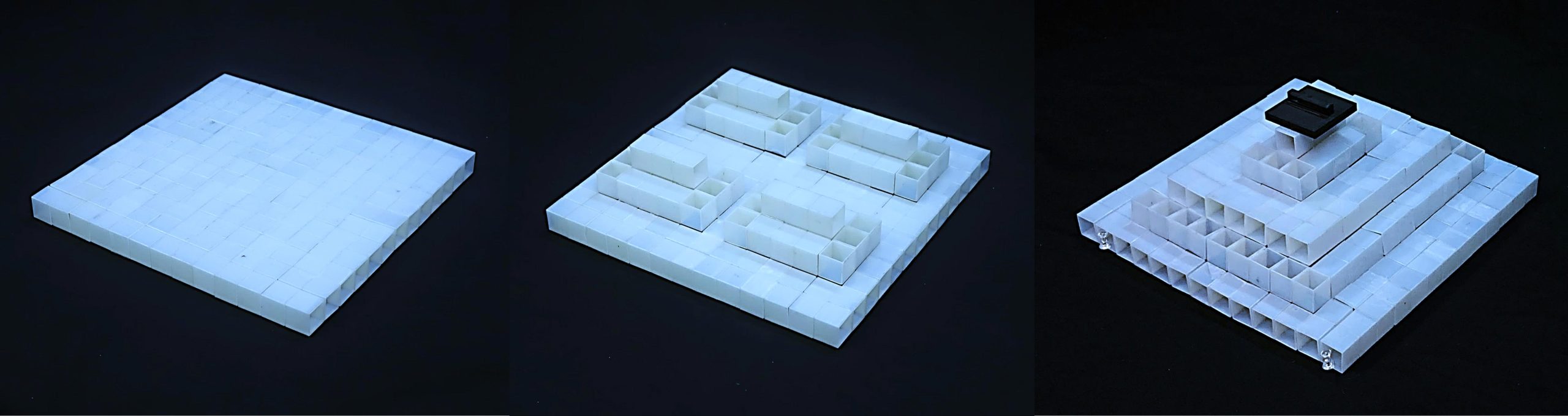
The fundamental units of the new mechanical computer are 1-centimeter plastic cubes, grouped into functional units consisting of 64 interconnected cubes. The design of these units was inspired by kirigami, which is the art of cutting and folding paper. Yin and his collaborators have applied the principles of kirigami to three-dimensional materials that are cut into connected cubes.
When any of the cubes are pushed up or down, this changes the geometry – or architecture – of all of the connected cubes. This can be done by physically pushing up or down on one of the cubes, or by attaching a magnetic plate to the top of the functional unit and applying a magnetic field to remotely push it up or down. These 64-cube functional units can be grouped together into increasingly complex metastructures that allow for storing more data or for conducting more complex computations.
The cubes are connected by thin strips of elastic tape. To edit data, you have to change the configuration of functional units. That requires users to pull on the edges of the metastructure, which stretches the elastic tape and allows you to push cubes up or down. When you release the metastructure, the tape contracts, locking the cubes – and the data – in place.
Potential Applications and Future Directions
“One potential application for this is that it allows for users to create three-dimensional, mechanical encryption or decryption,” says Yanbin Li, first author of the paper and a postdoctoral researcher at NC State. “For example, a specific configuration of functional units could serve as a 3D password.
“And the information density is quite good,” Li says. “Using a binary framework – where cubes are either up or down – a simple metastructure of 9 functional units has more than 362,000 possible configurations.”
“But we’re not necessarily limited to a binary context,” says Yin. “Each functional unit of 64 cubes can be configured into a wide variety of architectures, with cubes stacked up to five cubes high. This allows for the development of computing that goes well beyond binary code. Our proof-of-concept work here demonstrates the potential range of these architectures, but we have not developed code that capitalizes on those architectures. We’d be interested in collaborating with other researchers to explore the coding potential of these metastructures.”
Conclusion
“We’re also interested in exploring the potential utility of these metastructures to create haptic systems that display information in a three-dimensional context, rather than as pixels on a screen,” says Li.
Reference: “Reprogrammable and reconfigurable mechanical computing metastructures with stable and high-density memory” by Yanbin Li, Shuangyue Yu, Haitao Qing, Yaoye Hong, Yao Zhao, Fangjie Qi, Hao Su and Jie Yin, 26 June 2024, Science Advances.
DOI: 10.1126/sciadv.ado6476
Co-corresponding author of the paper is Hao Su, an associate professor of mechanical and aerospace engineering at NC State. The paper was co-authored by Shuangye Yu and Yaoye Hong, former Ph.D. students at NC State; Haitao Qing and Fangjie Qi, current Ph.D. students at NC State; and Yao Zhao, a former postdoctoral researcher at NC State.
The work was done with support from the National Science Foundation under grants 2005374, 2126072 and 2231419.
Never miss a breakthrough: Join the SciTechDaily newsletter.
Follow us on Google and Google News.