
Close Menu
    Facebook X (Twitter) Instagram
    SciTechDaily
    • Biology
    • Chemistry
    • Earth
    • Health
    • Physics
    • Science
    • Space
    • Technology
    Facebook X (Twitter) Pinterest YouTube RSS
    SciTechDaily
    Home»Science»A Simpler Path to Super-Resolution: Scientists Reinvent Microscopy
    Science

    A Simpler Path to Super-Resolution: Scientists Reinvent Microscopy

    By Smart Computational Imaging Laboratory (SCILab), Nanjing University of Science and TechnologyApril 20, 20261 Comment4 Mins Read
    Facebook Twitter Pinterest Telegram LinkedIn WhatsApp Email Reddit
    Share
    Facebook Twitter LinkedIn Pinterest Telegram Email Reddit
    Incoherent Structured Illumination Microscopy Based on Principal Component Analysis
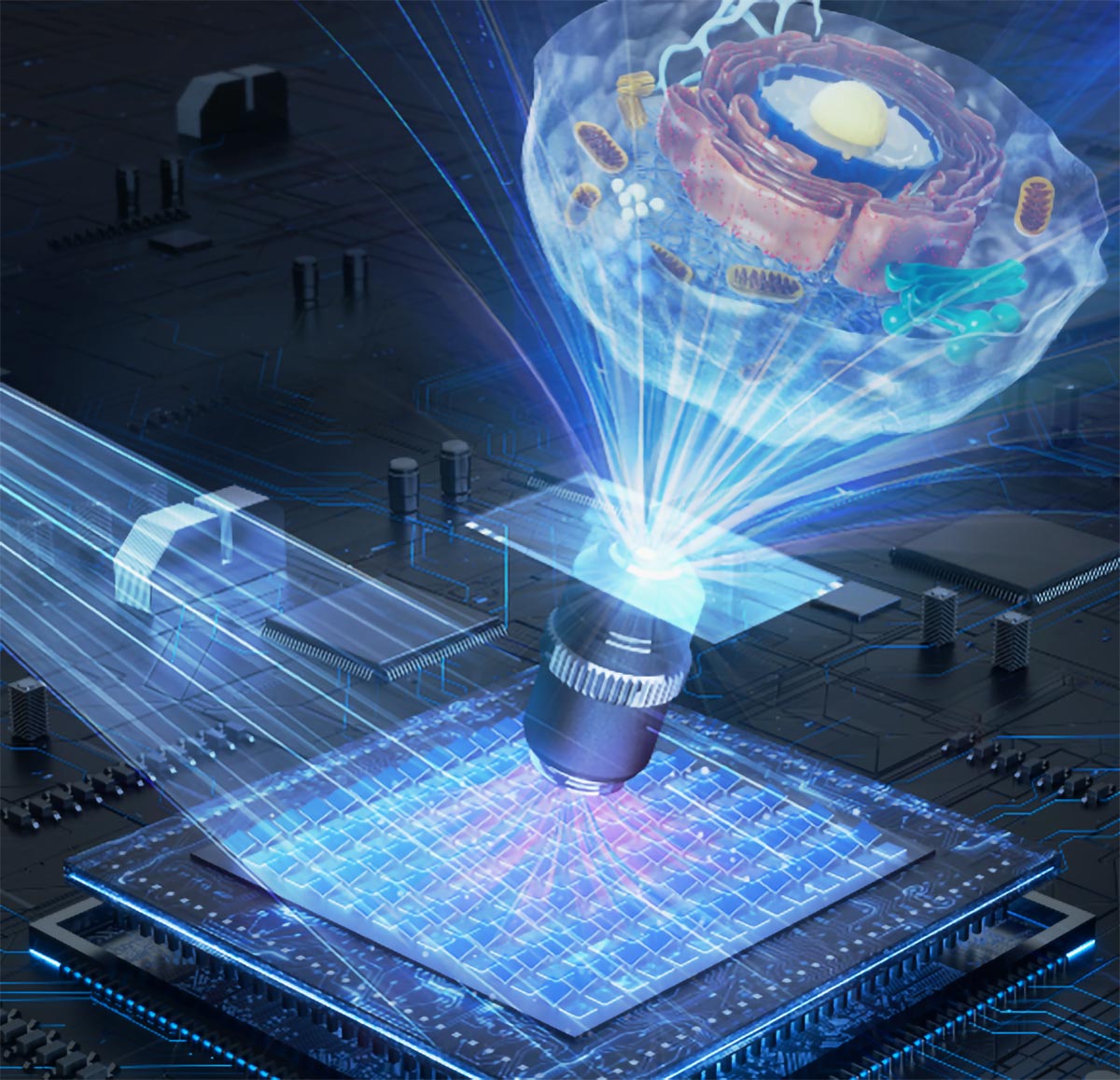
    Schematic of the imaging process. Incoherent light, modulated by the DMD, is directed into the microscope and focused onto the sample plane by the objective lens, creating structured illumination for super-resolution imaging of subcellular microstructures. Credit: Jiaming Qian et al. from Nanjing University of Science and Technology, Nanjing, China

    A new imaging framework is pushing the boundaries of how scientists observe life at the microscopic scale.

    Understanding life at the cellular and subcellular scale depends on seeing extremely small biological structures in fine detail. Super-resolution fluorescence microscopy has become essential in modern research because it allows scientists to image beyond the limits of traditional optical systems.

    Among these methods, structured illumination microscopy (SIM) stands out for combining strong resolution, fast imaging, and low phototoxicity, making it well-suited for long-term studies of living cells.

    Even with these advantages, many super-resolution systems remain difficult to use in practice. High-performance versions, particularly interference-based SIM, often rely on complex optical setups, precise alignment, and bulky equipment. These factors increase costs and limit accessibility, slowing the wider adoption of advanced imaging tools in everyday research and in labs with fewer resources.

    A New Approach: PCA-iSIM

    A team from the Smart Computational Imaging Laboratory (SCILab) at Nanjing University of Science and Technology, led by Professor Chao Zuo, has introduced a new imaging method called PCA-iSIM. This system delivers high-resolution, real-time imaging using a more compact and cost-effective design, addressing several limitations of conventional SIM techniques.

    SIM works by using patterned light to shift fine details of a sample into a range that the microscope can detect. Digital micromirror device (DMD)-based incoherent SIM systems have gained attention because they are smaller and simpler than other designs. However, they face a major challenge.

    When high-frequency patterns are used, the contrast of the projected fringes drops significantly due to the optical transfer function. This makes the patterns hard to detect, which complicates the process of estimating illumination parameters and producing accurate super-resolution images.

    Overcoming Fundamental Limitations

    To solve this issue, the researchers developed a computational strategy that combines high-modulation coefficient mapping with principal component analysis (PCA). Instead of relying on weak high-frequency signals, the method links easily detectable low-frequency patterns with their high-frequency counterparts. This approach allows the system to estimate illumination wave vectors even when contrast is very low.

    PCA is then applied to pull out the strongest signals from noisy data. Explaining the method, Prof. Zuo says, “By leveraging PCA’s capability for dimensionality reduction and noise suppression, we are able to isolate the illumination-related information embedded in the data and accurately recover sub-pixel illumination parameters.”

    This process improves both the reliability and accuracy of parameter estimation, which is essential for producing clear super-resolution images.

    Experimental Validation and Performance

    The team tested PCA-iSIM using a custom-built DMD-based incoherent SIM system. Their results show a resolution improvement of more than 1.9 times, reaching an effective resolution of about 100 nm (0.0001 mm), while maintaining real-time imaging speeds of up to 30 frames per second.

    These gains come with a much simpler optical design. Compared to traditional laser-based SIM systems, the new setup reduces overall complexity by nearly 70%, making it easier to build and use.

    In addition to improving resolution, the method performs reliably in low signal-to-noise conditions and in changing experimental settings. The researchers also demonstrated real-time imaging of mitochondrial activity in living cells, capturing structural details that standard wide-field microscopes cannot resolve.

    “This work fundamentally extends the performance ceiling of incoherent structured illumination microscopy,” the authors note. “By combining compact hardware with advanced computational reconstruction, PCA-iSIM opens new opportunities for accessible, high-performance super-resolution imaging.”

    Reference: “Breaking the Resolution Barrier in Incoherent Structured Illumination Microscopy via High-Modulation Coefficient Mapping and Principal Component Analysis (PCA-iSIM) (Laser Photonics Rev. 20(3)/2026)” by Maoxian Zhang, Xinyu Han, Jiaming Qian, Hongjun Wu, Tianchi Kang, Dongqin Lu, Jing Feng, Weihao Cheng, Yuzhen Zhang, Qian Chen and Chao Zuo, 5 February 2026, Laser & Photonics Reviews.
    DOI: 10.1002/lpor.70881

    Never miss a breakthrough: Join the SciTechDaily newsletter.
    Follow us on Google and Google News.

    Biomedical Engineering Cell Biology Imaging Microscopy Photonics
    Share. Facebook Twitter Pinterest LinkedIn Email Reddit

    Related Articles

    Peering Into the Nanoworld: New Microscope Reveals Tiniest Cell Processes

    Reimagining the Logic of Imaging: International Team of Scientists Develops Revolutionary Microscopy Method

    New Research Shatters Old Beliefs About Gold Nanoparticles and Cancer

    New Quantum-Enhanced Microscopy Unveils Cellular Force Secrets

    Incredible New Technique Measures Forces As Small as a Virus With Unprecedented Precision

    “Previously Only Theorized” – Researchers Demonstrate New Way To “Squeeze” Infrared Light

    New Microscopy Imaging Technique: RESORT Unveils Living Systems Like Never Before

    Landmark Advancement in Flow Cytometry Technology With Potential To Transform Immunology and Genomics Research

    Stunning Images Captured Using the Glowing Properties of Plant Cells

    1 Comment

    1. AGEAZIT EMBAYE on April 21, 2026 3:56 pm

      THE NEW TYPES OF EVERY EVEN ALL NOTED BY EACH AREAS COLLECTED BY ALL COMPLETE AREAS & ALL FOUNDATIONS ARE BETTER INVOLVED NOT ONLY EACH ARE THESE COLLECTIONS INTO RESULTS INTO THESE COLLECTIONS ANY YET NOT REVISED INTO THESE (PROCESSED-SPACE-TRAVELS) AND BECAUSE ALL VIRTUES ARE NOT EVEN EACH DESCRIPTIONS ALL ARE THESE QUESTIONS MEASURE COMPLEX-VARIETY OF ALL (BIO-ECOLOGY)/(BIO-EARTH) CONNECTED THESE AREAS ARE DESCRIPITONS ARE DEVELOPED ISSUES AND MASSIVE ISSUES OF THESE AREAS INTO THESE:THE FOLLOWING ISSUES ARE NOTED BY MEASUREMENTS OF REALITY INTO THESE QUESTIONS ARE EVERY THING IS ACCOMPLISHED IN THESE CONTROVERISAL ISSUES ARE NOT SERIES (BIO-METEROLOGY)-ARE COMPLETED ISSUES OF COMPLEX-ITYNOTED BY FACTORS INNER-CODES-OF SPACE-TRAVEL IS NOT (BIO-FICTIONS)THE WORD ITSELF DEFINED A SERIES DEFINED FACTORS ARE MASSIVE NOT EVEN IF ALL ISSUES INTO THESE QUESTIONS ARE DESCRIPTIONS ARE COMPLETED NOT DEINED IN THE AREAS OF LOGICAL ISSUES ARE CONSIDERED TO HAVE EVERYTHING INTO ALL SUBJECTS NOT ALLOWING (TRUE-PROVEN)ALL SIMPLE ISSUES OF REALITY& EVEN ITS ALL NOT NONE DECLINED BY EACH ;THE AREAS OF RESPONDES NOT PROCESS REDUCED BY EACH THROUGHTLY NOT REDUCED NOTES INTO THEORIES OF AND SERIES ANNALYSIS TO ALL AREAS INTO THESE AREAS OF SIMPLE ISSUES ARE NOTES OF RESLITY SUBJECTIONS OF ASSOCATIONS ARE VALID OUT-COME IN ALL REALITY THESE ASSUMPTIONS INTO THESE EARTH RELEASING DIFFERENT TO ALL SERIES NOT QUESTIONS INTO THESE QUESTIONS ARE VAID ISSUES OF COLLECTONS WITHOUT A SIMPLE ISSUES OF REALITY NOT REASONING INTO INCREASED ASSUMPTIONS MEASURES INTO REASONING ISSUES INTO THESE QUESTIONS ARE REPEATS INTO THERE ASSUMPTIONS ARE QUESTIONS ARE COMPLEX ASSUMPTIONS ARE AMOUNTS OF ALL THEORY COLLECTED DEFINITONS ARE DESCRIPTIOS MEASURES ARE COMPROMISED REALITY INTO INNER-CORE OF VALID COLLECTIONS ARE DESCRIPITONS INTO THESE QUESTIONS :THE FEATURES ACCOMPLISHESA CENTRAL ISSUES INTO THESE QUESTIONS ARE DESCRIPTIONS INTO THESE YOUR QUESTIONS

      Reply
    Leave A Reply Cancel Reply

    • Facebook
    • Twitter
    • Pinterest
    • YouTube

    Don't Miss a Discovery

    Subscribe for the Latest in Science & Tech!

    Trending News

    Scientists Uncover Potential Brain Risks of Popular Fish Oil Supplements

    Scientists Discover a Surprising Way To Make Bread Healthier and More Nutritious

    After 60 Years, Scientists Uncover Unexpected Brain Effects of Popular Diabetes Drug Metformin

    New Research Uncovers Hidden Side Effects of Popular Weight-Loss Drugs

    Scientists Rethink Extreme Warming After Surprising Ocean Discovery

    Landmark Study Links Never Marrying to Significantly Higher Cancer Risk

    Researchers Discover Unknown Beetle Species Just Steps From Their Lab

    Largest-Ever Study Finds Medicinal Cannabis Ineffective for Anxiety, Depression, PTSD

    Follow SciTechDaily
    • Facebook
    • Twitter
    • YouTube
    • Pinterest
    • Newsletter
    • RSS
    SciTech News
    • Biology News
    • Chemistry News
    • Earth News
    • Health News
    • Physics News
    • Science News
    • Space News
    • Technology News
    Recent Posts
    • Early Warning Signals of Esophageal Cancer May Be Hiding in Plain Sight
    • Researchers Have Discovered a THC-Free Cannabis Compound That May Replace Opioids
    • Common Blood Pressure Drug Shows Surprising Power Against Deadly Antibiotic-Resistant Superbug
    • Students Build Dark Matter Detector and Set New Experimental Limits
    • Scientists Discover Caffeine Can Repair Key Memory Circuits After Sleep Loss
    Copyright © 1998 - 2026 SciTechDaily. All Rights Reserved.
    • Science News
    • About
    • Contact
    • Editorial Board
    • Privacy Policy
    • Terms of Use

    Type above and press Enter to search. Press Esc to cancel.