
Close Menu
    Facebook X (Twitter) Instagram
    SciTechDaily
    • Biology
    • Chemistry
    • Earth
    • Health
    • Physics
    • Science
    • Space
    • Technology
    Facebook X (Twitter) Pinterest YouTube RSS
    SciTechDaily
    Home»Science»Peering Into the Nanoworld: New Microscope Reveals Tiniest Cell Processes
    Science

    Peering Into the Nanoworld: New Microscope Reveals Tiniest Cell Processes

    By University of GöttingenAugust 20, 20241 Comment3 Mins Read
    Facebook Twitter Pinterest Telegram LinkedIn WhatsApp Email Reddit
    Share
    Facebook Twitter LinkedIn Pinterest Telegram Email Reddit
    Newly Developed Fluorescence Microscope Highly Sensitive Detector
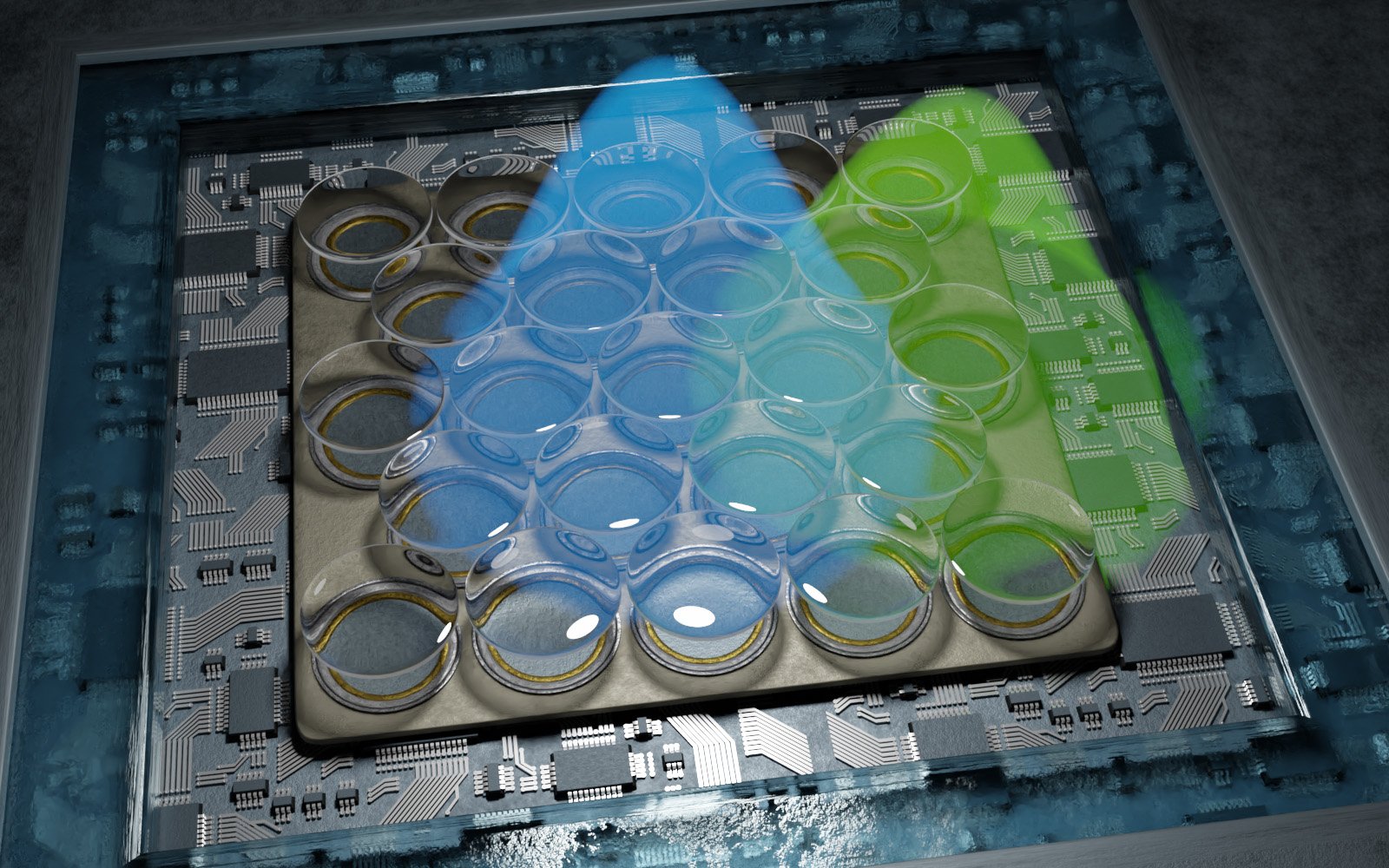
    Representation of the highly sensitive detector that is part of the newly developed fluorescence microscope. It consists of 23 individual detectors, enabling the resolution to be doubled. Credit: Alexey Chizhik, Göttingen University

    A research team has developed a high-resolution fluorescence microscope.

    What does the inside of a cell really look like? In the past, standard microscopes were limited in how well they could answer this question. Now, researchers from the Universities of Göttingen and Oxford, in collaboration with the University Medical Center Göttingen (UMG), have succeeded in developing a microscope with resolutions better than five nanometres (five billionths of a metre). This is roughly equivalent to the width of a hair split into 10,000 strands. Their new method was published in Nature Photonics.

    Many structures in cells are so small that standard microscopes can only produce fragmented images. Their resolution only begins at around 200 nanometres. However, human cells for instance contain a kind of scaffold of fine tubes that are only around seven nanometres wide. The synaptic cleft, meaning the distance between two nerve cells or between a nerve cell and a muscle cell, is just 10 to 50 nanometres – too small for conventional microscopes.

    Breakthrough in Microscopy Technology

    The new microscope, which researchers at the University of Göttingen have helped to develop, promises much richer information. It benefits from a resolution better than five nanometres, enabling it to capture even the tiniest cell structures. It is difficult to imagine something so tiny, but if we were to compare one nanometre with one meter, it would be the equivalent of comparing the diameter of a hazelnut with the diameter of the Earth.

    This type of microscope is known as a fluorescence microscope. Their function relies on “single-molecule localization microscopy”, in which individual fluorescent molecules in a sample are switched on and off and their individual positions are then determined very precisely. The entire structure of the sample can then be modeled from the positions of these molecules.

    The current process enables resolutions of around 10 to 20 nanometres. Professor Jörg Enderlein’s research group at the University of Göttingen’s Faculty of Physics has now been able to double this resolution again – with the help of a highly sensitive detector and special data analysis. This means that even the tiniest details of protein organization in the connecting area between two nerve cells can be very precisely revealed.

    “This newly developed technology is a milestone in the field of high-resolution microscopy. It not only offers resolutions in the single-digit nanometer range, but it is also particularly cost-effective and easy to use compared to other methods,” explains Enderlein. The scientists also developed an open-source software package for data processing in the course of publishing their findings. This means that this type of microscopy will be available to a wide range of specialists in the future.

    Reference: “Doubling the resolution of fluorescence-lifetime single-molecule localization microscopy with image scanning microscopy” by Niels Radmacher, Oleksii Nevskyi, José Ignacio Gallea, Jan Christoph Thiele, Ingo Gregor, Silvio O. Rizzoli and Jörg Enderlein, 2 August 2024, Nature Photonics.
    DOI: 10.1038/s41566-024-01481-4

    Never miss a breakthrough: Join the SciTechDaily newsletter.
    Follow us on Google and Google News.

    Microscopy Nanotechnology Photonics University of Göttingen
    Share. Facebook Twitter Pinterest LinkedIn Email Reddit

    Related Articles

    Incredible New Technique Measures Forces As Small as a Virus With Unprecedented Precision

    Revolutionizing Temperature Measurement: The Magic of Upconversion Luminescence

    Integrating Photonics with Silicon Nanoelectronics Into Chip Designs

    MIT Engineers Develop New Technique for Highly Conductive Graphene Wafers

    MIT Engineers Demonstrate Second-Order Nonlinearity in Silicon

    New Research Opens New Realms of Light-Matter Interaction

    Researchers Control Light Emission by Pairing Exotic 2D Materials

    New Metamaterial Gives Visible Light a Nearly Infinite Wavelength

    Grant May Lead to New Light Technology and Advances in Healthcare

    1 Comment

    1. Samuel Bess on August 21, 2024 10:21 am

      Tiniest cell processes!
      Amazing..tell politicians this.
      Each cell is a living unit. It is fundamental “life”. This is science confirming life and describing its function.
      .politicians beware of lies.
      Women, beware of lies.
      We are not our own.

      Reply
    Leave A Reply Cancel Reply

    • Facebook
    • Twitter
    • Pinterest
    • YouTube

    Don't Miss a Discovery

    Subscribe for the Latest in Science & Tech!

    Trending News

    New Pill Lowers Stubborn Blood Pressure and Protects the Kidneys

    Humans May Have Hidden Regenerative Powers, New Study Suggests

    Scientists Just Solved the Mystery of Why Crabs Walk Sideways

    Doctors Are Surprised by What This Vaccine Is Doing to the Heart

    This Popular Supplement May Boost Your Brain, Not Just Your Muscles

    Scientists Say This Simple Supplement May Actually Reverse Heart Disease

    Warming Oceans Could Trigger a Dangerous Methane Surge

    This Simple Movement Could Be Secretly Cleaning Your Brain

    Follow SciTechDaily
    • Facebook
    • Twitter
    • YouTube
    • Pinterest
    • Newsletter
    • RSS
    SciTech News
    • Biology News
    • Chemistry News
    • Earth News
    • Health News
    • Physics News
    • Science News
    • Space News
    • Technology News
    Recent Posts
    • Popular Sugar-Free Sweetener Linked to Liver Disease, Study Warns
    • Why Weight Loss Isn’t Enough for Everyone at Risk of Diabetes
    • What Is Hantavirus? The Deadly Disease Raising Alarm Worldwide
    • Interstellar Comet 3I/ATLAS Came From a Place Nothing Like Our Solar System
    • Webb Space Telescope Reveals Rare Planet Pair That Shouldn’t Exist
    Copyright © 1998 - 2026 SciTechDaily. All Rights Reserved.
    • Science News
    • About
    • Contact
    • Editorial Board
    • Privacy Policy
    • Terms of Use

    Type above and press Enter to search. Press Esc to cancel.