
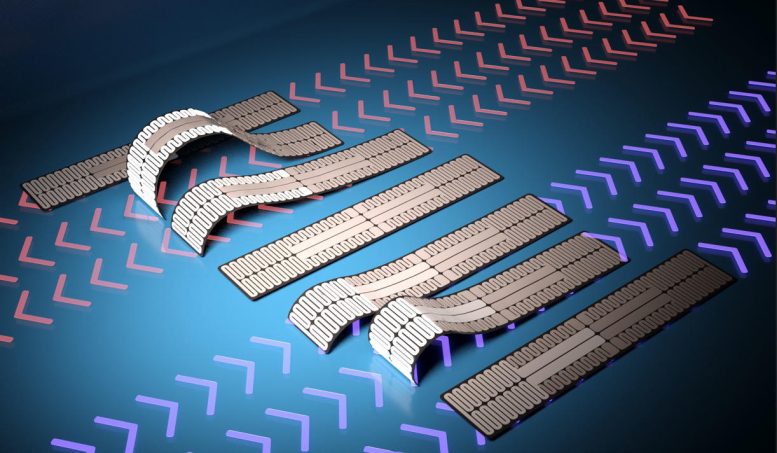
A new soft robot uses silver nanowires and heat to mimic caterpillar motion, enabling precise control for directional movement and obstacle navigation.
Scientists at North Carolina State University have showcased a soft robot, designed like a caterpillar, capable of moving forward, backward, and squeezing through tight spaces. The movement of this caterpillar-inspired robot is powered by a unique pattern of silver nanowires that use heat to regulate its bending, giving users the ability to direct the robot in any desired direction.
“A caterpillar’s movement is controlled by local curvature of its body – its body curves differently when it pulls itself forward than it does when it pushes itself backward,” says Yong Zhu, corresponding author of a paper on the work and the Andrew A. Adams Distinguished Professor of Mechanical and Aerospace Engineering at NC State. “We’ve drawn inspiration from the caterpillar’s biomechanics to mimic that local curvature, and use nanowire heaters to control similar curvature and movement in the caterpillar-bot.
“Engineering soft robots that can move in two different directions is a significant challenge in soft robotics,” Zhu says. “The embedded nanowire heaters allow us to control the movement of the robot in two ways. We can control which sections of the robot bend by controlling the pattern of heating in the soft robot. And we can control the extent to which those sections bend by controlling the amount of heat being applied.”
This video clip shows a caterpillar-inspired crawling-bot passing under a narrow opening by controlling the curvature of its body. Credit: Yong Zhu, NC State University
Nanowire-Driven Movement Control
The caterpillar-bot consists of two layers of polymer, which respond differently when exposed to heat. The bottom layer shrinks, or contracts, when exposed to heat. The top layer expands when exposed to heat. A pattern of silver nanowires is embedded in the expanding layer of polymer. The pattern includes multiple lead points where researchers can apply an electric current. The researchers can control which sections of the nanowire pattern heat up by applying an electric current to different lead points and can control the amount of heat by applying more or less current.
“We demonstrated that the caterpillar-bot is capable of pulling itself forward and pushing itself backward,” says Shuang Wu, first author of the paper and a postdoctoral researcher at NC State. “In general, the more current we applied, the faster it would move in either direction. However, we found that there was an optimal cycle, which gave the polymer time to cool – effectively allowing the ‘muscle’ to relax before contracting again. If we tried to cycle the caterpillar-bot too quickly, the body did not have time to ‘relax’ before contracting again, which impaired its movement.”
The researchers also demonstrated that the caterpillar-bot’s movement could be controlled to the point where users were able to steer it under a very low gap – similar to guiding the robot to slip under a door. In essence, the researchers could control both forward and backward motion as well as how high the robot bent upwards at any point in that process.
“This approach to driving motion in a soft robot is highly energy efficient, and we’re interested in exploring ways that we could make this process even more efficient,” Zhu says. “Additional next steps include integrating this approach to soft robot locomotion with sensors or other technologies for use in various applications – such as search-and-rescue devices.”
Reference: “Caterpillar-inspired soft crawling robot with distributed programmable thermal actuation” by Shuang Wu, Yaoye Hong, Yao Zhao, Jie Yin and Yong Zhu, 22 March 2023, Science Advances.
DOI: 10.1126/sciadv.adf8014
The study was funded by the National Science Foundation and the National Institutes of Health.
Never miss a breakthrough: Join the SciTechDaily newsletter.
Follow us on Google and Google News.