
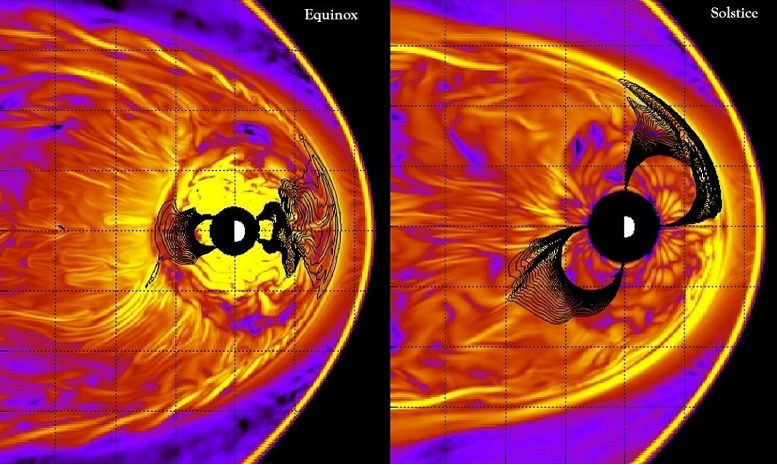
Kelvin-Helmholtz waves, driven by solar wind and Earth’s magnetic tilt, create space weather variations, affecting satellites and communication systems.
According to researchers at Embry-Riddle Aeronautical University, new understandings of “space waves” could lead to more precise space weather forecasts and safer navigation for satellites navigating through radiation belts.
The group’s recent findings, published in the journal Nature Communications, demonstrate that fluctuations in the Earth’s magnetic tilt, which varies seasonally and daily and is oriented towards or away from the Sun, can trigger changes in large-wavelength space waves.
These breaking waves, known as Kelvin-Helmholtz waves, occur at the boundary between the solar wind and the Earth’s magnetic shield. The waves happen much more frequently around the spring and fall seasons, researchers reported, while wave activity is poor around summer and winter.
As plasma or solar wind streams from the Sun at speeds up to 1 million miles per hour, it pushes energy, mass, and momentum toward the planet’s magnetic shield. It also whips up space waves.
Fast-moving solar wind can’t pass directly through the Earth’s magnetic shield, so it thunders along the magnetosphere, propelling Kelvin-Helmholtz waves with massive peaks up to 15,000 kilometers (km) high and 40,000 km long (9,300 mi high and 25,000 mi long).
Astronaut Safety and Satellite Communication
“Through these waves, solar wind plasma particles can propagate into the magnetosphere, leading to variations in radiation belt fluxes of energetic particles—regions of dangerous radiation—that may affect astronaut safety and satellite communications,” said Dr. Shiva Kavosi, a research associate at Embry-Riddle and first author of the paper. “On the ground, these events can impact power grids and Global Positioning Systems.”
Describing the properties of space waves and the mechanisms that cause them to intensify is key to understanding and forecasting space weather, Kavosi noted: “Space weather events represent an increasing threat, yet in many cases, we don’t understand exactly what controls it. Any progress we can make in understanding the mechanisms behind space weather disturbances will improve our ability to provide forecasts and warnings.”
In trying to understand the causes of seasonal and diurnal variations of geomagnetic activity, researchers in the field have set forth several different hypotheses. For example, the Russell-McPherron (R-M) effect, first described in 1973, explains why auroras are more frequent and brighter in the spring and fall, based on the interplay of the Earth’s dipole tilt and a small magnetic field near the Sun’s equator.
“We don’t have all the answers yet,” said Dr. Katariina Nykyri, professor of physics and associate director for the Center of Space and Atmospheric Research at Embry-Riddle, “but our paper shows that the R-M effect is not the only explanation for the seasonal variation of geomagnetic activities. Equinox-driven events, based on the Earth’s dipole tilt, and R-M effects could operate simultaneously.”
In the future, Nykyri added, constellations of spacecraft in the solar wind and magnetosphere could more fully explain the complicated, multi-scale physics of space weather phenomena. “Such a system would allow advanced warnings of space weather to inform the operators of rocket launches and electrical power grids,” she said.
The “Nature Communications” paper concludes that “KH waves activity exhibit seasonal and diurnal variations, indicating the critical role of dipole tilt in modulating KHI across the magnetopause as a function of time.”
Reference: “Seasonal and diurnal variations of Kelvin-Helmholtz Instability at terrestrial magnetopause” by S. Kavosi, J. Raeder, J. R. Johnson, K. Nykyri and C. J. Farrugia, 4 May 2023, Nature Communications.
DOI: 10.1038/s41467-023-37485-x
The study was funded by NASA grants as well as support from the Magnetospheric Multiscale mission (MMS) at the University of New Hampshire.
Never miss a breakthrough: Join the SciTechDaily newsletter.
Follow us on Google and Google News.