
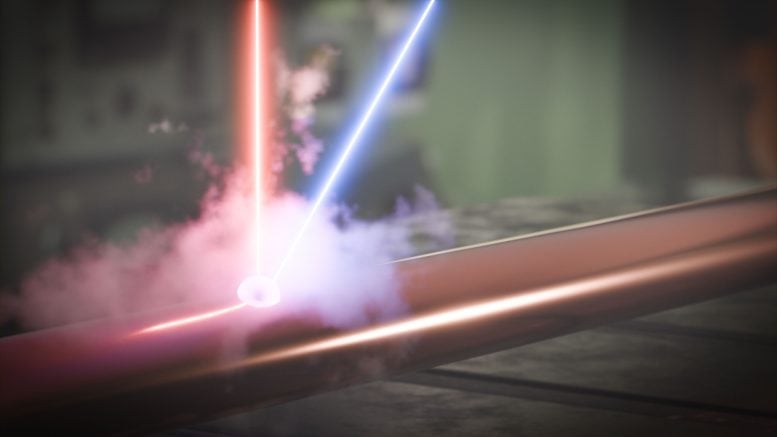
Ultrafast lasers tracked plasma formation and ionization in copper with picosecond precision. Results show rapid ion growth and decay, aiding fusion research.
When intense laser pulses strike matter, they can knock electrons out of their orbits around atomic nuclei. This process creates extremely hot plasma made up of charged particles such as ions and free electrons. Researchers at Helmholtz-Zentrum Dresden-Rossendorf (HZDR) report in Nature Communications that they have now observed this ionization process in unprecedented detail.
To achieve this, the team combined two advanced laser systems at the HED-HiBEF experiment station at the European XFEL in Schenefeld near Hamburg. One is an X-ray free-electron laser, and the other is the high-intensity optical laser ReLaX. This setup allowed them to closely study how high-energy lasers interact with matter under extreme conditions. It also introduces a new approach that could improve diagnostic methods used in laser fusion research.
Ionization unfolds extremely fast, within picoseconds, which are trillionths of a second. Capturing such rapid changes requires even shorter laser pulses. “These are exactly the conditions provided by the two lasers that have pulse durations of just 25 and 30 femtoseconds—that is, trillionths of a second,” explains Dr. Lingen Huang, head of experimentation in HZDR’s Division of High-Energy Density.
Extreme Laser Conditions and Plasma Creation
The experiment begins with an intense burst of light striking a thin copper wire that is about one-seventh the thickness of a human hair. The laser delivers roughly 250 trillion megawatts per square centimeter (about 1.6 x 10¹⁷ watts per square inch), focused onto a tiny area for a very brief moment. Such extreme energy levels are typically found only in rare cosmic environments, such as near neutron stars or during gamma-ray bursts.
This energy instantly vaporizes the wire, producing plasma at temperatures of several million degrees. As this happens, copper atoms lose many of their electrons and become highly ionized. A second laser pulse follows shortly after the first. The initial pulse creates the plasma, while the second, known as the probe pulse, consists of highly intense X-rays generated by the European XFEL.
A detector records how the probe pulse interacts with the plasma, effectively capturing a series of snapshots. Using this pump-probe method, researchers can observe how the plasma evolves. The first pulse initiates the process, and the second examines it after a controlled delay, allowing scientists to track changes step by step.
Resonant Absorption and X-ray Emission Tracking
The X-ray pulses are carefully tuned so that their energy is mainly absorbed by Cu²²⁺ ions, which are copper atoms missing 22 electrons. The photon energy of 8.2 kiloelectronvolts matches a specific electronic transition in these ions, a phenomenon known as resonant absorption.
After absorbing the energy, the ions emit their own distinct X-ray radiation. “In our pump-probe experiment, we exactly measure the temporal development of this stimulated X-ray emission,” says Huang. “Because it shows us how many Cu²²⁺ ions are present in the plasma at any given time.”
The measurements reveal a clear timeline. Cu²²⁺ ions appear almost immediately after the laser hits the wire. Their number rises quickly, reaching a peak after about 2.5 picoseconds. Then recombination begins, and the number of ions steadily declines. After roughly 10 picoseconds, these ions are no longer detectable. “No one has ever looked at this type of ionization so precisely before,” says Prof. Tom Cowan, former director of the Institute of Radiation Physics at HZDR.
Electron Dynamics and Fusion Implications
Computer simulations helped explain the underlying physics. The initial laser pulse removes a small number of electrons from copper atoms. “They are so energy rich that they spread out like a wave and knock ever more electrons out of neighboring copper atoms,” explains Cowan. Over time, these energetic electrons lose energy and are recaptured by the ions, returning the atoms to a neutral state.
“This experiment demonstrates how powerful our lasers are and paves the way for future laser fusion facilities,” concludes Dr. Ulf Zastrau, who is responsible for the HED-HIBEF experiment station at the European XFEL—because laser fusion is also based on extremely hot plasmas that are heated up by lasers and the resulting electron waves. “Thanks to our new concrete findings, we can now focus on continuing to refine our simulations of these processes,” explains Zastrau. These improvements are essential for designing efficient laser fusion reactors.
Reference: “Probing ultrafast heating and ionization dynamics in solid density plasmas with time-resolved resonant X-ray absorption and emission” by Lingen Huang, Mikhail Mishchenko, Michal Šmíd, Oliver S. Humphries, Thomas R. Preston, Xiayun Pan, Long Yang, Johannes Hagemann, Thea Engler, Yangzhe Cui, Thomas Kluge, Carsten Baehtz, Erik Brambrink, Alejandro Laso Garcia, Sebastian Göde, Christian Gutt, Mohamed Hassan, Hauke Höppner, Michaela Kozlova, Josefine Metzkes-Ng, Masruri Masruri, Motoaki Nakatsutsumi, Masato Ota, Özgül Öztürk, Alexander Pelka, Irene Prencipe, Lisa Randolph, Martin Rehwald, Hans-Peter Schlenvoigt, Ulrich Schramm, Jan-Patrick Schwinkendorf, Monika Toncian, Toma Toncian, Jan Vorberger, Karl Zeil, Ulf Zastrau and Thomas E. Cowan, 3 April 2026, Nature Communications.
DOI: 10.1038/s41467-026-71429-5
Never miss a breakthrough: Join the SciTechDaily newsletter.
Follow us on Google and Google News.
2 Comments
Fusion is stupid – unless you are selling unlimited research. Just do hydrogen and accomplish something good for a change.
Excuse my ignorance, but what is the purpose in this ? just wondering ..