
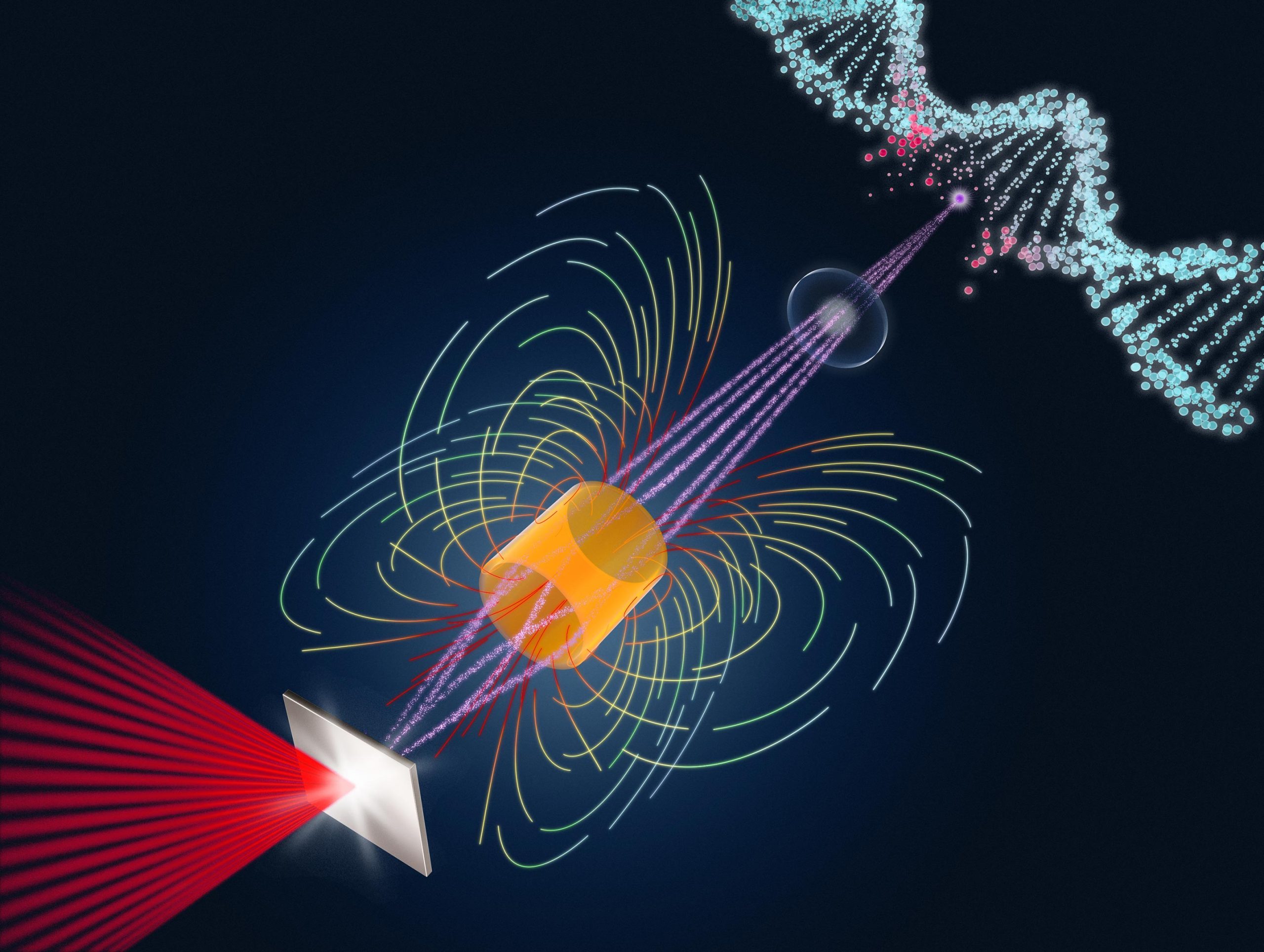
HZDR’s successful animal trials with laser-accelerated protons suggest a future of more precise, less invasive cancer treatment that better protects healthy tissue.
Irradiation with fast protons is a more effective and less invasive cancer treatment than X-rays. However, modern proton therapy requires large particle accelerators, which has experts investigating alternative accelerator concepts, such as laser systems to accelerate protons. Such systems are deployed in preclinical studies to pave the way for optimal radiation therapy. A research team led by the Helmholtz-Zentrum Dresden-Rossendorf (HZDR) has now successfully tested irradiation with laser protons on animals for the first time, as the group reports in the journal Nature Physics.
Radiation therapy is one of the main cancer treatment methods. It usually leverages strong, focused X-ray light. Protons – the nuclei of hydrogen atoms – accelerated to high energies and bundled into small, precisely targetable bunches are an alternative. They can penetrate deep into the tissue where they deposit most of their energy in the tumor, destroying the cancer while leaving the surrounding tissue largely intact. This makes the method both more effective and less invasive than X-ray therapy. “The method is particularly suitable for irradiating tumors at the base of the skull, in the brain, and in the central nervous system,” explains HZDR researcher Dr. Elke Beyreuther. “It is also used in pediatric cancer patients to reduce possible long-term effects.”
However, the method is significantly more complex than X-ray therapy as it requires elaborate accelerator facilities to generate the fast protons and transport them to the patient. This is why there are only a few proton therapy centers in Germany, including one at Dresden University Hospital. Currently, experts are working to steadily improve the method and adapt it to patients. Laser-based proton accelerators could make a decisive contribution here.
Customized Laser Flashes
“The approach is based on a high-power laser to generate strong and extremely short light pulses, which are fired at a thin plastic or metal foil,” explains HZDR physicist Dr. Florian Kroll. The intensity of these flashes knocks swathes of electrons out of the foil, creating a strong electric field that can bundle protons into pulses and accelerate them to high energies. Fascinatingly, the scale of this process is minuscule: The acceleration path is merely a few micrometers long.
“We have been working on the project for 15 years, but so far, the protons hadn’t picked up enough energy for irradiation,” Beyreuther reports. “Also, the pulse intensity was too variable, so we couldn’t make sure we were delivering the right dose.” But over the past few years, scientists finally achieved crucial improvements, in particular thanks to a better understanding of the interaction between the laser flashes and the foil. “Above all, the precise shape of the laser flashes is particularly important,” Kroll explains. “We can now tailor them to create proton pulses that have sufficient energy and are also stable enough.”
New Research Requirements
Finally, the parameters had been optimized to the point that the HZDR team was able to launch a crucial series of experiments: the first-ever, controlled irradiation of tumors in mice with laser-accelerated protons. The experiments were carried out in cooperation with experts from Dresden University Hospital at the OncoRay – National Center for Radiation Research in Oncology and benchmarked with comparative experiments at the conventional proton therapy facility. “We found that our laser-driven proton source can generate biologically valuable data,” Kroll reports. “This sets the stage for further studies that will allow us to test and optimize our method.”
Another special feature of laser-accelerated proton pulses is their enormous intensity. While in conventional proton therapy, the radiation dose is administered in a span of a few minutes, the laser-based process could occur within a millionth of a second. “There are indications that such a rapid dose administration helps spare the healthy surrounding tissue even better than before,” explains Elke Beyreuther. “We want to follow up on these indications with our experimental setup and conduct preclinical studies to investigate when and how this rapid irradiation method should be used to gain an advantage in cancer therapy.”
Reference: “Tumor irradiation in mice with a laser-accelerated proton beam” by F. Kroll, F.-E. Brack, C. Bernert, S. Bock, E. Bodenstein, K. Brüchner, T. Cowan, L. Gaus, R. Gebhardt, U. Helbig, L. Karsch, T. Kluge, S. Kraft, M. Krause, E. Lessmann, U. Masood, S. Meister, J. Metzkes-Ng, A. Nossula, J. Pawelke, J. Pietzsch, T. Püschel, M. Reimold, M. Rehwald, C. Richter, H.-P. Schlenvoigt, U. Schramm, M.E.P. Umlandt, T. Ziegler, K. Zeil and E. Beyreuther, 14 March 2022, Nature Physics.
DOI: 10.1038/s41567-022-01520-3
Never miss a breakthrough: Join the SciTechDaily newsletter.
Follow us on Google and Google News.
1 Comment
gooooooooooooooood