
Close Menu
    Facebook X (Twitter) Instagram
    SciTechDaily
    • Biology
    • Chemistry
    • Earth
    • Health
    • Physics
    • Science
    • Space
    • Technology
    Facebook X (Twitter) Pinterest YouTube RSS
    SciTechDaily
    Home»Science»Scientists Thought They Knew Why Ice Was Slippery, but Researchers Found Surprises
    Science

    Scientists Thought They Knew Why Ice Was Slippery, but Researchers Found Surprises

    By CNRSNovember 6, 2019No Comments3 Mins Read
    Facebook Twitter Pinterest Telegram LinkedIn WhatsApp Email Reddit
    Share
    Facebook Twitter LinkedIn Pinterest Telegram Email Reddit

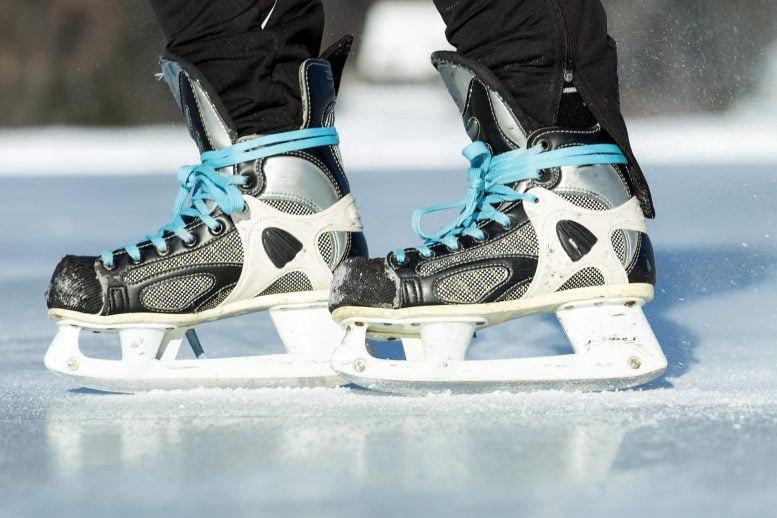
    Ice Skater Frozen Lake

    Why is ice so slippery?

    The answer lies in a film of water that is generated by friction, one that is far thinner than expected and much more viscous than usual water through its resemblance to the “snow cones” of crushed ice we drink during the summer. This phenomenon was recently demonstrated by researchers from the CNRS and ENS-PSL, with support from the École polytechnique, in a study that appeared in Physical Review X on November 4, 2019.

    The “slippery” nature of ice is generally attributed to the formation of a thin layer of liquid water generated by friction, which for instance allows an ice skater to “surf” on top of this liquid film. The properties of this thin layer of water had never been measured: its thickness remained largely unknown, while its properties, and even its very existence, were the subject of debate. What’s more, since liquid water is known to be a poor lubricant, how could this liquid film reduce friction and make ice slippery?

    To solve this paradox, researchers from the Laboratoire de physique de l’ENS (CNRS/ENS-PSL /Sorbonne Université/Université de Paris), in collaboration with a team from the Laboratoire d’hydrodynamique (LadHyX,CNRS/École polytechnique), developed a device equipped with a tuning fork—similar to those used in music—that can “hear” the forces at work during ice gliding with remarkable precision. Despite the instrument’s size, which measures a few centimeters, it is sensitive enough to probe ice and analyze the properties of friction on a nanometric scale.

    Thanks to their unique device, the scientists were able to clearly demonstrate for the first time that friction does indeed generate a film of liquid water. This film nevertheless offered a number of surprises: with a thickness measuring a few hundred nanometers to a micron, or one hundredth the thickness of a strand of hair, it is much thinner than theoretical estimates had suggested. Even more unexpectedly, this film is not at all “simple water,” but consists of water that is as viscous as oil, with complex viscoelastic properties. This unexpected behavior suggests that surface ice does not completely transform into liquid water, but instead ends up in a mixed state similar to “snow cones,” a mix of ice water and crushed ice. The mystery of sliding on ice can therefore be found in the “viscous” nature of this film of water.

    These results show that a thorough overhaul is needed for the theoretical descriptions that have been proposed to describe friction on ice. The unusual properties of meltwater are a key factor that has not been taken into consideration until now. This will help better understand the phenomenon of ice gliding, in winter sports for example, and will also help propose innovative solutions for increasing friction in order to avoid skidding on icy roads.

    Reference: “Nanorheology of Interfacial Water during Ice Gliding” by L. Canale, J. Comtet, A. Niguès, C. Cohen, C. Clanet, A. Siria and L. Bocquet, 4 November 2019, Physical Review X.
    DOI: 10.1103/PhysRevX.9.041025

    Never miss a breakthrough: Join the SciTechDaily newsletter.
    Follow us on Google and Google News.

    CNRS Ice Popular
    Share. Facebook Twitter Pinterest LinkedIn Email Reddit

    Related Articles

    This 125 Million-Year-Old Dinosaur Had Spikes Like a Porcupine

    No More Frost: Scientists Unveil Long-Lasting Anti-Freeze Technology

    Who Were the First Modern Humans To Settle in Europe? Scientists Shed New Light

    7 Million Years Old – New Secrets of the Oldest Representative of Humanity Revealed

    Prehistoric Cave Art: Neanderthals Indeed Painted Andalusia’s Cueva De Ardales

    Scientists Solve the Mystery of Romanesco Cauliflower Formation

    Discovery of a Bizarre, Winged “Eagle Shark” in the Cretaceous Seas

    Ancient Conch Shell Horn Plays Its Tune for the First Time in 18,000 Years – Hear It Here

    Remarkable Discovery on How Ice Forms Could Keep Windshields, Power Lines Ice-Free

    Leave A Reply Cancel Reply

    • Facebook
    • Twitter
    • Pinterest
    • YouTube

    Don't Miss a Discovery

    Subscribe for the Latest in Science & Tech!

    Trending News

    The Universe Is Expanding Too Fast and Scientists Can’t Explain Why

    “Like Liquid Metal”: Scientists Create Strange Shape-Shifting Material

    Early Warning Signals of Esophageal Cancer May Be Hiding in Plain Sight

    Common Blood Pressure Drug Shows Surprising Power Against Deadly Antibiotic-Resistant Superbug

    Scientists Uncover Dangerous Connection Between Serotonin and Heart Valve Disease

    Scientists Discover a “Protector” Protein That Could Help Reverse Hair Loss

    Bone-Strengthening Discovery Could Reverse Osteoporosis

    Scientists Uncover Hidden Trigger Behind Stem Cell Aging

    Follow SciTechDaily
    • Facebook
    • Twitter
    • YouTube
    • Pinterest
    • Newsletter
    • RSS
    SciTech News
    • Biology News
    • Chemistry News
    • Earth News
    • Health News
    • Physics News
    • Science News
    • Space News
    • Technology News
    Recent Posts
    • Scientists Overcome Major Quantum Bottleneck, Potentially Transforming Teleportation and Computing
    • Quantum Physics’ Strangest Problem May Hold the Key to Time Itself
    • Scientists Create “Liquid Gears” That Spin Without Touching
    • The Simple Habit That Could Help Prevent Cancer
    • Forgotten Medicinal Plant Shows Promise in Fighting Dangerous Superbugs
    Copyright © 1998 - 2026 SciTechDaily. All Rights Reserved.
    • Science News
    • About
    • Contact
    • Editorial Board
    • Privacy Policy
    • Terms of Use

    Type above and press Enter to search. Press Esc to cancel.