
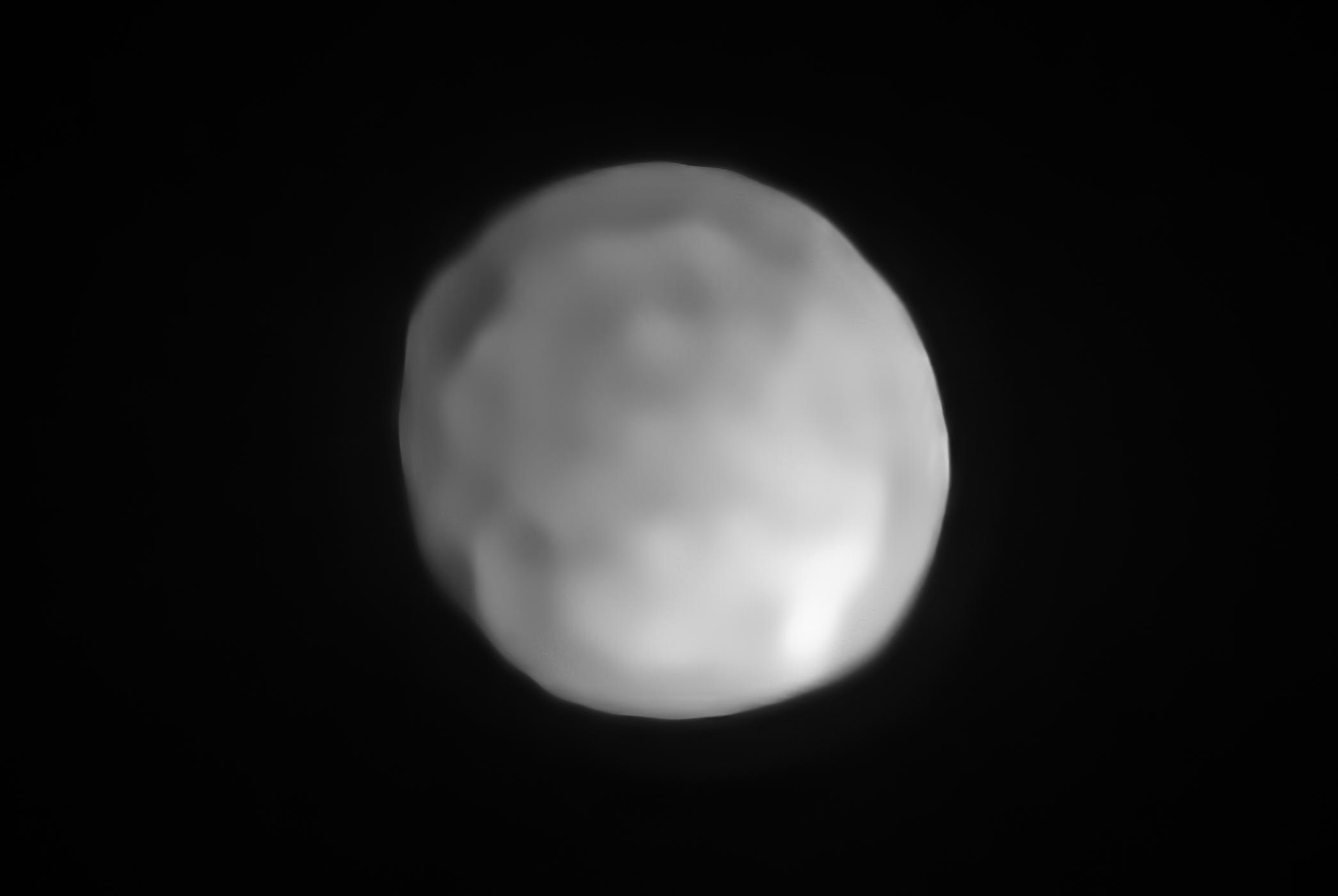
Astronomers using ESO’s SPHERE instrument at the Very Large Telescope (VLT) have revealed that the asteroid Hygiea could be classified as a dwarf planet. The object is the fourth largest in the asteroid belt after Ceres, Vesta, and Pallas. For the first time, astronomers have observed Hygiea in sufficiently high resolution to study its surface and determine its shape and size. They found that Hygiea is spherical, potentially taking the crown from Ceres as the smallest dwarf planet in the Solar System.
As an object in the main asteroid belt, Hygiea satisfies right away three of the four requirements to be classified as a dwarf planet: it orbits around the Sun, it is not a moon and, unlike a planet, it has not cleared the neighborhood around its orbit. The final requirement is that it has enough mass for its own gravity to pull it into a roughly spherical shape. This is what VLT observations have now revealed about Hygiea.
“Thanks to the unique capability of the SPHERE instrument on the VLT, which is one of the most powerful imaging systems in the world, we could resolve Hygiea’s shape, which turns out to be nearly spherical,” says lead researcher Pierre Vernazza from the Laboratoire d’Astrophysique de Marseille in France. “Thanks to these images, Hygiea may be reclassified as a dwarf planet, so far the smallest in the Solar System.”
The team also used the SPHERE observations to constrain Hygiea’s size, putting its diameter at just over 430 km. Pluto, the most famous dwarf planet, has a diameter close to 2400 km, while Ceres is close to 950 km in size.
Surprisingly, the observations also revealed that Hygiea lacks the very large impact crater that scientists expected to see on its surface, the team reported in the study published today (October 28, 2019) in Nature Astronomy. Hygiea is the main member of one of the largest asteroid families, with close to 7000 members that all originated from the same parent body. Astronomers expected the event that led to the formation of this numerous family to have left a large, deep mark on Hygiea.
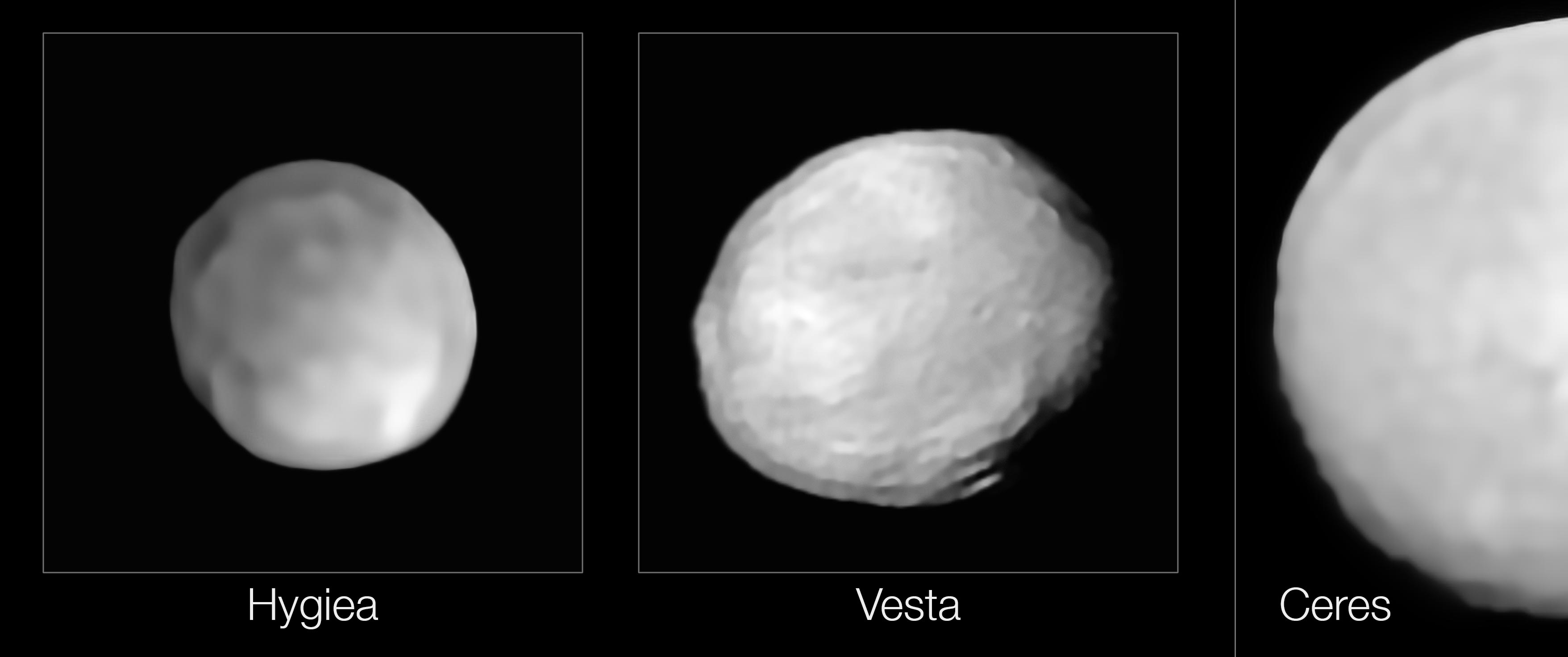
The new study also found that Hygiea is spherical, potentially taking the crown from Ceres as the smallest dwarf planet in the Solar System. The team used the SPHERE observations to constrain Hygiea’s size, putting its diameter at just over 430 km, while Ceres is close to 950 km in size. Credit: ESO/P. Vernazza et al., L. Jorda et al./MISTRAL algorithm (ONERA/CNRS)
“This result came as a real surprise as we were expecting the presence of a large impact basin, as is the case on Vesta,” says Vernazza. Although the astronomers observed Hygiea’s surface with a 95% coverage, they could only identify two unambiguous craters. “Neither of these two craters could have been caused by the impact that originated the Hygiea family of asteroids whose volume is comparable to that of a 100 km-sized object. They are too small,” explains study co-author Miroslav Brož of the Astronomical Institute of Charles University in Prague, Czech Republic.
The team decided to investigate further. Using numerical simulations, they deduced that Hygiea’s spherical shape and large family of asteroids are likely the result of a major head-on collision with a large projectile of diameter between 75 and 150 km. Their simulations show this violent impact, thought to have occurred about 2 billion years ago, completely shattered the parent body. Once the leftover pieces reassembled, they gave Hygiea its round shape and thousands of companion asteroids. “Such a collision between two large bodies in the asteroid belt is unique in the last 3–4 billion years,” says Pavel Ševecek, a Ph.D. student at the Astronomical Institute of Charles University who also participated in the study.
Studying asteroids in detail has been possible thanks not only to advances in numerical computation, but also to more powerful telescopes. “Thanks to the VLT and the new generation adaptive-optics instrument SPHERE, we are now imaging main belt asteroids with unprecedented resolution, closing the gap between Earth-based and interplanetary mission observations,” Vernazza concludes.
More information
This research was presented in a paper to appear in Nature Astronomy on October 28.
Reference: “A basin-free spherical shape as an outcome of a giant impact on asteroid Hygiea” by P. Vernazza, L. Jorda, P. Ševeček, M. Brož, M. Viikinkoski, J. Hanuš, B. Carry, A. Drouard, M. Ferrais, M. Marsset, F. Marchis, M. Birlan, E. Podlewska-Gaca, E. Jehin, P. Bartczak, G. Dudzinski, J. Berthier, J. Castillo-Rogez, F. Cipriani, F. Colas, F. DeMeo, C. Dumas, J. Durech, R. Fetick, T. Fusco, J. Grice, M. Kaasalainen, A. Kryszczynska, P. Lamy, H. Le Coroller, A. Marciniak, T. Michalowski, P. Michel, N. Rambaux, T. Santana-Ros, P. Tanga, F. Vachier, A. Vigan, O. Witasse, B. Yang, M. Gillon, Z. Benkhaldoun, R. Szakats, R. Hirsch, R. Duffard, A. Chapman and J. L. Maestre, 28 October 2019, Nature Astronomy.
DOI: 10.1038/s41550-019-0915-8
The team is composed of P. Vernazza (Aix Marseille Université, CNRS, Laboratoire d’Astrophysique de Marseille, Marseille, France), L. Jorda (Aix Marseille Université, CNRS, Laboratoire d’Astrophysique de Marseille, Marseille, France), P. Ševecek (Institute of Astronomy, Charles University, Prague, Czech Republic), M. Brož (Institute of Astronomy, Charles University, Prague, Czech Republic), M. Viikinkoski (Mathematics and Statistics, Tampere University, Tampere, Finland), J. Hanuš (Institute of Astronomy, Charles University, Prague, Czech Republic), B. Carry (Université Côte d’Azur, Observatoire de la Côte d’Azur, CNRS, Laboratoire Lagrange, Nice, France), A. Drouard (Aix Marseille Université, CNRS, Laboratoire d’Astrophysique de Marseille, Marseille, France), M. Ferrais (Space Sciences, Technologies and Astrophysics Research Institute, Université de Liège, Liège, Belgium), M. Marsset (Department of Earth, Atmospheric and Planetary Sciences, MIT, Cambridge, MA, USA), F. Marchis (Aix Marseille Université, CNRS, Laboratoire d’Astrophysique de Marseille, Marseille, France, and SETI Institute, Carl Sagan Center, Mountain View, USA), M. Birlan (Observatoire de Paris, Paris, France), E. Podlewska-Gaca (Astronomical Observatory Institute, Faculty of Physics, Adam Mickiewicz University, Poznan, Poland, and Institute of Physics, University of Szczecin, Poland), E. Jehin (Space Sciences, Technologies and Astrophysics Research Institute, Université de Liège, Liège, Belgium), P. Bartczak (Astronomical Observatory Institute, Faculty of Physics, Adam Mickiewicz University, Poznan, Poland), G. Dudzinski (Astronomical Observatory Institute, Faculty of Physics, Adam Mickiewicz University, Poznan, Poland), J. Berthier (Observatoire de Paris, Paris, France), J. Castillo-Rogez (Jet Propulsion Laboratory, California Institute of Technology, Pasadena, California, USA), F. Cipriani (European Space Agency, ESTEC – Scientific Support Office, The Netherlands), F. Colas (Observatoire de Paris, Paris, France), F. DeMeo (Department of Earth, Atmospheric and Planetary Sciences, MIT, Cambridge, MA, USA), C. Dumas (TMT Observatory, Pasadena, USA), J. Durech (Institute of Astronomy, Charles University, Prague, Czech Republic), R. Fetick (Aix Marseille Université, CNRS, Laboratoire d’Astrophysique de Marseille, Marseille, France and ONERA, The French Aerospace Lab, Chatillon Cedex, France), T. Fusco (Aix Marseille Université, CNRS, Laboratoire d’Astrophysique de Marseille, Marseille, France and and ONERA, The French Aerospace Lab, Chatillon Cedex, France), J. Grice (Université Côte d’Azur, Observatoire de la Côte d’Azur, CNRS, Laboratoire Lagrange, Nice, France and Open University, School of Physical Sciences, The Open University, Milton Keynes, UK), M. Kaasalainen (Mathematics and Statistics, Tampere University, Tampere, Finland), A. Kryszczynska (Astronomical Observatory Institute, Faculty of Physics, Adam Mickiewicz University, Poznan, Poland), P. Lamy (Aix Marseille Université, CNRS, Laboratoire d’Astrophysique de Marseille, Marseille, France), H. Le Coroller (Aix Marseille Université, CNRS, Laboratoire d’Astrophysique de Marseille, Marseille, France), A. Marciniak (Astronomical Observatory Institute, Faculty of Physics, Adam Mickiewicz University, Poznan, Poland), T. Michalowski (Astronomical Observatory Institute, Faculty of Physics, Adam Mickiewicz University, Poznan, Poland), P. Michel (Université Côte d’Azur, Observatoire de la Côte d’Azur, CNRS, Laboratoire Lagrange, Nice, France), N. Rambaux (Observatoire de Paris, Paris, France), T. Santana-Ros (Departamento de Fi´sica, Universidad de Alicante, Alicante, Spain), P. Tanga (Université Côte d’Azur, Observatoire de la Côte d’Azur, CNRS, Laboratoire Lagrange, Nice, France), F. Vachier (Observatoire de Paris, Paris, France), A. Vigan (Aix Marseille Université, CNRS, Laboratoire d’Astrophysique de Marseille, Marseille, France), O. Witasse (European Space Agency, ESTEC – Scientific Support Office, The Netherlands), B. Yang (European Southern Observatory, Santiago, Chile), M. Gillon (Space Sciences, Technologies and Astrophysics Research Institute, Université de Liège, Liège, Belgium), Z. Benkhaldoun (Oukaimeden Observatory, High Energy Physics and Astrophysics Laboratory, Cadi Ayyad University, Marrakech, Morocco), R. Szakats (Konkoly Observatory, Research Center for Astronomy and Earth Sciences, Hungarian Academy of Sciences, Budapest, Hungary), R. Hirsch (Astronomical Observatory Institute, Faculty of Physics, Adam Mickiewicz University, Poznan, Poland), R. Duffard (Instituto de Astrofísica de Andalucía, Glorieta de la Astronomía S/N, Granada, Spain), A. Chapman (Buenos Aires, Argentina), J. L. Maestre (Observatorio de Albox, Almeria, Spain).
ESO is the foremost intergovernmental astronomy organization in Europe and the world’s most productive ground-based astronomical observatory by far. It has 16 Member States: Austria, Belgium, the Czech Republic, Denmark, France, Finland, Germany, Ireland, Italy, the Netherlands, Poland, Portugal, Spain, Sweden, Switzerland and the United Kingdom, along with the host state of Chile and with Australia as a Strategic Partner. ESO carries out an ambitious program focused on the design, construction and operation of powerful ground-based observing facilities enabling astronomers to make important scientific discoveries. ESO also plays a leading role in promoting and organizing cooperation in astronomical research. ESO operates three unique world-class observing sites in Chile: La Silla, Paranal and Chajnantor. At Paranal, ESO operates the Very Large Telescope and its world-leading Very Large Telescope Interferometer as well as two survey telescopes, VISTA working in the infrared and the visible-light VLT Survey Telescope. Also at Paranal ESO will host and operate the Cherenkov Telescope Array South, the world’s largest and most sensitive gamma-ray observatory. ESO is also a major partner in two facilities on Chajnantor, APEX and ALMA, the largest astronomical project in existence. And on Cerro Armazones, close to Paranal, ESO is building the 39-meter Extremely Large Telescope, the ELT, which will become “the world’s biggest eye on the sky”.
Never miss a breakthrough: Join the SciTechDaily newsletter.
Follow us on Google and Google News.