

Cancer risk is higher among never-married adults, particularly for preventable cancers, likely due to behavioral and social factors.
Adults who have never married may face a much higher risk of developing cancer than those who are or have been married, according to a large U.S. study analyzing more than 4 million cases. The elevated risk was seen across nearly all major cancer types and was especially strong for preventable cancers linked to infections, smoking, and reproductive factors.
Conducted by researchers at the Sylvester Comprehensive Cancer Center at the University of Miami Miller School of Medicine, the findings were published in Cancer Research Communications.
“These findings suggest that social factors such as marital status may serve as important markers of cancer risk at the population level,” said Paulo Pinheiro, Ph.D., study co-author and a Sylvester physician-scientist whose lab conducts population-based cancer epidemiology.
The results do not suggest that marriage itself protects against cancer or that people should marry for health reasons.
Health Awareness and Prevention Implications
“It means that if you’re not married, you should be paying extra attention to cancer risk factors, getting any screenings you may need, and staying up to date on health care,” said Frank Penedo, Ph.D., associate director for population sciences and director of the Sylvester Survivorship and Supportive Care Institute (SSCI).
“For prevention efforts, our findings point to the importance of targeting cancer risk awareness and prevention strategies with attention to marital status,” he added.

Marriage has already been linked to earlier cancer detection and better survival outcomes. Married people often benefit from stronger social support, greater financial stability, and higher adherence to treatment plans.
However, most prior research has focused on outcomes after diagnosis. Only a limited number of smaller, older studies examined whether marital status affects the likelihood of developing cancer in the first place.
Study Design and Research Scope
“We wanted to know who is more likely to get cancer: married people or unmarried people?” Pinheiro said.
To answer this, researchers examined data from 12 states, covering more than 4 million cancer cases within a population exceeding 100 million people between 2015 and 2022. The analysis focused on malignant cancers diagnosed in adults aged 30 and older and compared cancer rates by marital status, while accounting for age, sex, and race.
Participants were grouped into two categories: those who were or had been married, including married, divorced, and widowed individuals, and those who had never married. The study began in 2015 to include same-sex couples after the legalization of gay marriage in the United States. About 20% of adults in the dataset had never married.
Pinheiro expected to find some links, given known associations between marriage and lifestyle factors such as smoking, routine health care, and parenthood. Still, the strength of several findings exceeded expectations.
Key Cancer Risk Differences by Marital Status
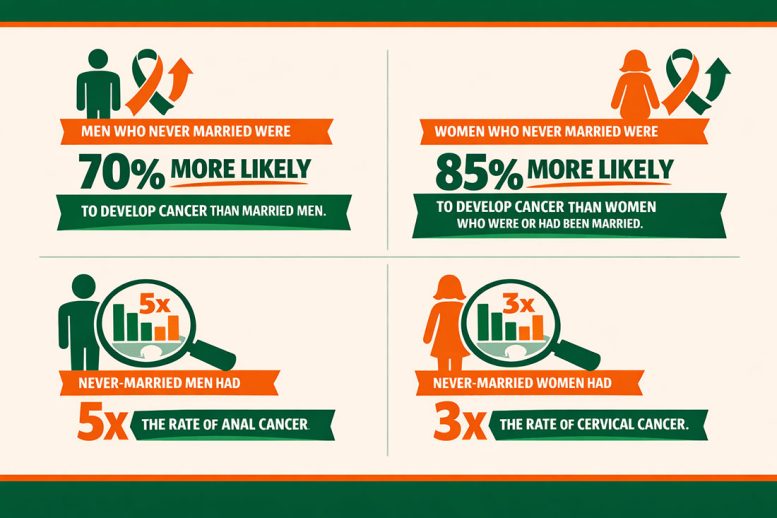
People who had never married showed significantly higher cancer rates than those who were or had been married. In some cases, the differences were striking. Never-married men had about five times the rate of anal cancer compared with married men, while never-married women had nearly three times the rate of cervical cancer compared with women who were or had been married.
Both cancers are strongly linked to HPV infection, suggesting differences in exposure and, for cervical cancer, screening and prevention. For cancers such as ovarian and endometrial, differences may partly reflect the protective effects of childbirth, which is more common among married individuals.
“It’s a clear and powerful signal that some individuals are at a greater risk,” Penedo said.
Patterns also varied by sex. Never-married men were about 70% more likely to develop cancer than married men, while never-married women had about an 85% higher risk compared with women who were or had been married.
Gender Patterns and Cancer Trends
This finding slightly reverses a broader trend in which men often gain more health benefits from marriage. In this study, women appeared to benefit somewhat more.
The strongest links between marital status and cancer were seen for cancers tied to infection, smoking, or alcohol use, and for women, reproductive cancers such as ovarian and endometrial cancer.
Weaker associations were observed for cancers with well-established screening programs, including breast, thyroid, and prostate cancers.
Differences also appeared across racial groups. Never-married Black men had the highest overall cancer rates. At the same time, married Black men had lower cancer rates than married White men, suggesting a particularly strong protective association of marriage in that group.
Study Limitations and Future Research Directions
The study has several limitations. People who smoke less, drink less, and maintain healthier lifestyles may also be more likely to marry, which could influence the results.
Still, the link between marital status and cancer risk was stronger among adults over age 50, suggesting that the benefits associated with marriage may become more important over time as risk factors accumulate.
The analysis did not include unmarried individuals in long-term partnerships, a group that may be relatively small but could be important to study in the future, according to Pinheiro.
Future research could break down the married category further into married, divorced, and widowed individuals and follow participants over longer periods to better understand how changes in marital status affect cancer risk.
Conclusions on Marriage and Cancer Risk
Overall, the researchers emphasized that marriage does not directly prevent cancer.
“But the association between marriage status and cancer risk is an interesting, new observation that deserves more research,” Pinheiro said.
Reference: “Marriage and Cancer Risk: A Contemporary Population-Based Study Across Demographic Groups and Cancer Types” by Paulo S. Pinheiro, Amber N. Balda, Hannah M. Cranford, Tracy E. Crane, Erin N. Kobetz and Frank J. Penedo, 8 April 2026, Cancer Research Communications.
DOI: 10.1158/2767-9764.CRC-25-0814
Never miss a breakthrough: Join the SciTechDaily newsletter.
Follow us on Google and Google News.
4 Comments
Aw…cummon….Married people take care of each other in uncountable ways.
There are signifant lifestyle diferences. Two people living together coordinate their lives which tends to establish a routine. The human body loves the less stressful routine lifestyle instead of the stressful single catch-as-can lifestyle.
Also, respect for one’s partner, or fear of reprimand, means you take better care of yourself.
Naturally healthy people have more energy for dating and marriage and family life whereas naturally unhealthy people just don’t have the energy for any of that. Plus, healthy people tend to be more attractive and more likely to marry. So, really all this is saying is that healthier people are healthier.
Another factor not mentioned in the article is that marriage affects finances and health insurance. Single people probably have less money and lower quality health insurance leading to poorer cancer outcomes. Married patients are also treated better by doctors because there are two people there and they can stand up for each other, vs. a single person that docs can intimidate and gaslight and dismiss much easier.
Not really. The study addresses that, as age increases advantages accumulate , given the adjustment, the differences are more than just baseline healthier status. In my opinion it is more about partners saying you are smoking too much or let’s lose weight together etc.