
Close Menu
    Facebook X (Twitter) Instagram
    SciTechDaily
    • Biology
    • Chemistry
    • Earth
    • Health
    • Physics
    • Science
    • Space
    • Technology
    Facebook X (Twitter) Pinterest YouTube RSS
    SciTechDaily
    Home»Technology»Scientists Develop Universal Brain-Computer Interface That Lets People Play Games With Just Their Thoughts
    Technology

    Scientists Develop Universal Brain-Computer Interface That Lets People Play Games With Just Their Thoughts

    By University of Texas at AustinApril 6, 20241 Comment5 Mins Read
    Facebook Twitter Pinterest Telegram LinkedIn WhatsApp Email Reddit
    Share
    Facebook Twitter LinkedIn Pinterest Telegram Email Reddit
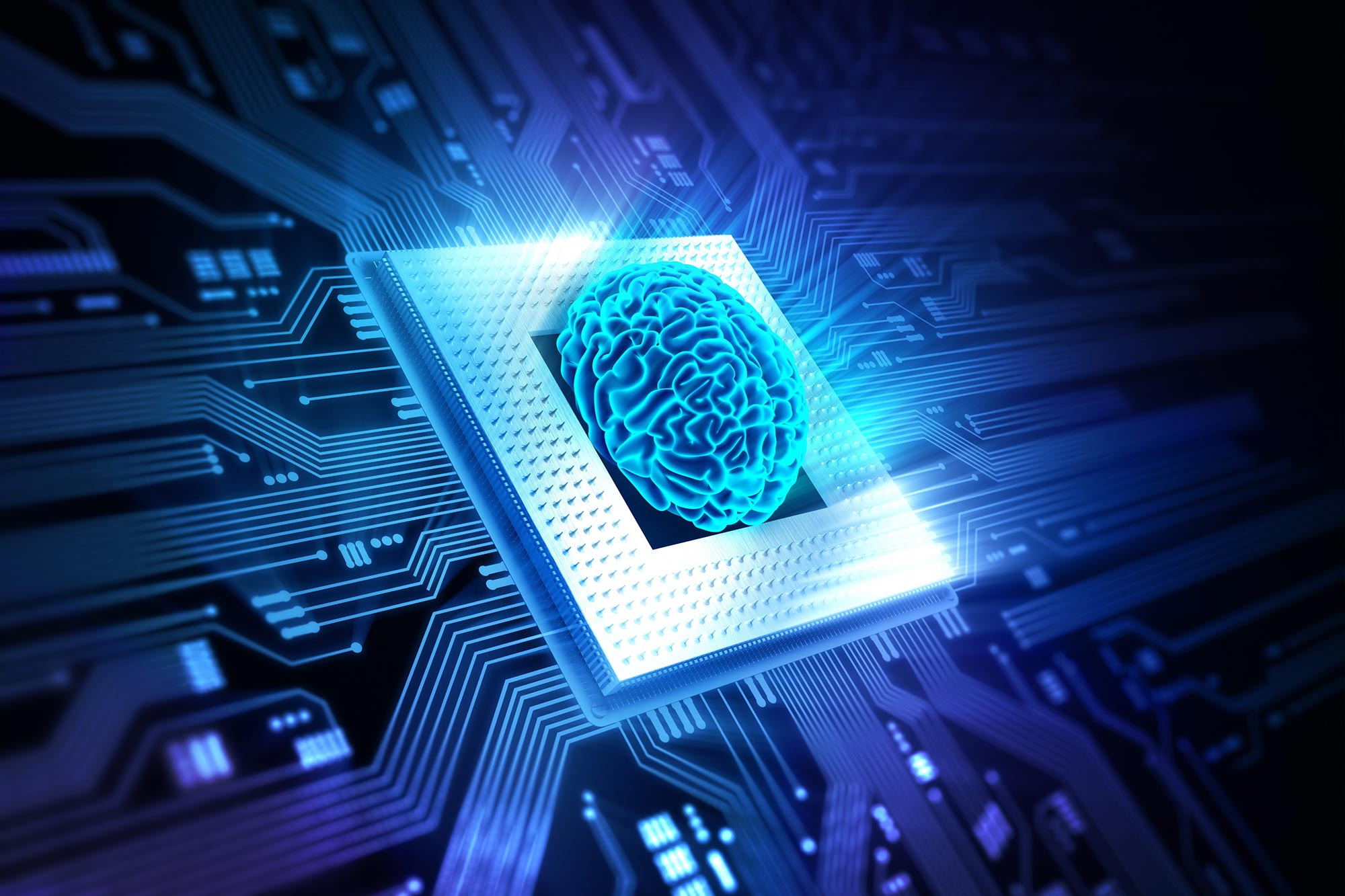
    Brain Computer CPU Illustration
    Researchers at The University of Texas at Austin have created an adaptive brain-computer interface (BCI) with machine learning, designed to assist individuals with motor disabilities without requiring individual calibration. This breakthrough enables easier adoption and demonstrates the technology’s application through engaging tasks and potential future uses, including brain-controlled wheelchairs and rehabilitation devices, aiming to improve quality of life for those with disabilities.

    Imagine playing a racing game like Mario Kart, using only your brain to execute the complex series of turns in a lap.

    This is not a video game fantasy, but a real program that engineers at The University of Texas at Austin have created as part of research into brain-computer interfaces to help improve the lives of people with motor disabilities. More importantly, the researchers incorporated machine learning capabilities with their brain-computer interface, making it a one-size-fits-all solution.

    Advancing Accessibility Through Self-Calibrating BCIs

    Typically, these devices require extensive calibration for each user — every brain is different, both for healthy and disabled users — and that has been a major hurdle to mainstream adoption. This new solution can quickly understand the needs of an individual subject and self-calibrate through repetition. That means multiple patients could use the device without needing to tune it to the individual.

    “When we think about this in a clinical setting, this technology will make it so we won’t need a specialized team to do this calibration process, which is long and tedious,” said Satyam Kumar, a graduate student in the lab of José del R. Millán, a professor in the Cockrell School of Engineering’s Chandra Family Department of Electrical and Computer Engineering and Dell Medical School’s Department of Neurology. “It will be much faster to move from patient to patient.”

    The research on the calibration-free interface is published in PNAS Nexus.
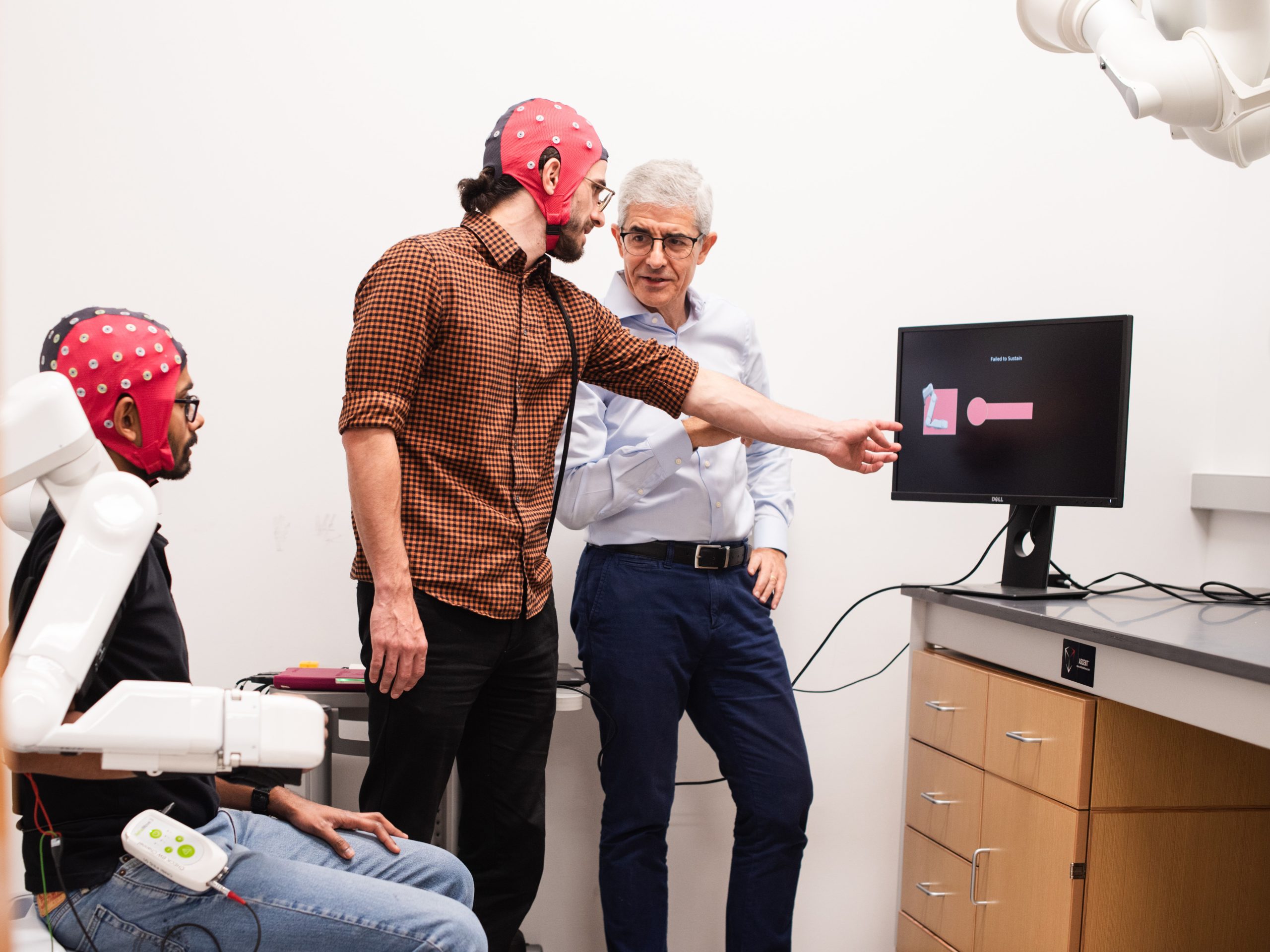
    Satyam Kumar, Hussein Alawieh and José del R. Millán
    From left to right: Satyam Kumar, Hussein Alawieh, and José del R. Millán. Credit: The University of Texas at Austin

    Implementation and Results

    The subjects wear a cap packed with electrodes that is hooked up to a computer. The electrodes gather data by measuring electrical signals from the brain, and the decoder interprets that information and translates it into game action.

    Millán’s work on brain-computer interfaces helps users guide and strengthen their neural plasticity, the ability of the brain to change, grow, and reorganize over time. These experiments are designed to improve brain function for patients and use the devices controlled by brain-computer interfaces to make their lives easier.

    In this case, the actions were twofold: the car racing game, and a simpler task of balancing the left and right sides of a digital bar. An expert was trained to develop a “decoder” for the simpler bar task that makes it possible for the interface to translate brain waves into commands. The decoder serves as a base for the other users and is the key to avoiding the long calibration process.
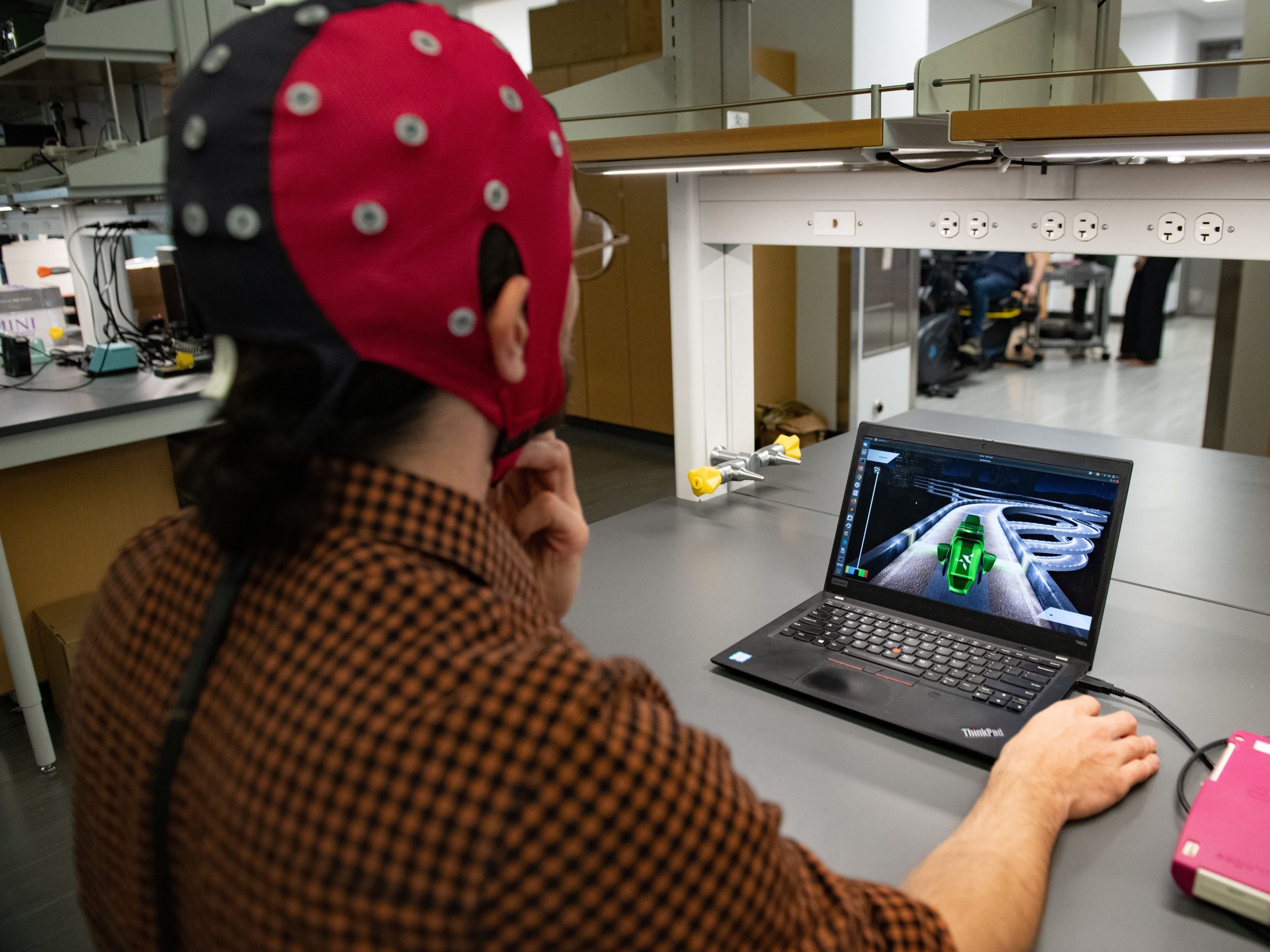
    Hussein Alawieh Wears a Cap Packed With Electrodes That Is Hooked Up to a Computer
    Hussein Alawieh, a graduate student in José del R. Millán’s lab, wears a cap packed with electrodes that is hooked up to a computer. The electrodes gather data by measuring electrical signals from the brain, and the decoder interprets that information and translates it into game action. Credit: The University of Texas at Austin

    The decoder worked well enough that subjects trained simultaneously for the bar game and the more complicated car racing game, which required thinking several steps ahead to make turns.

    The researchers called this work foundational, in that it sets the stage for further brain-computer interface innovation. This project used 18 subjects with no motor impairments. Eventually, as they continue down this road, they will test this on people with motor impairments to apply it to larger groups in clinical settings.

    “On the one hand, we want to translate the BCI to the clinical realm to help people with disabilities; on the other, we need to improve our technology to make it easier to use so that the impact for these people with disabilities is stronger,” Millán said.

    On the side of translating the research, Millán and his team continue to work on a wheelchair that users can drive with the brain-computer interface. At the South by Southwest Conference and Festivals this month, the researchers showed off another potential use of the technology, controlling two rehabilitation robots for the hand and arm. This was not part of the new paper but a sign of where this technology could go in the future. Several people volunteered and succeeded in operating the brain-controlled robots within minutes.

    “The point of this technology is to help people, help them in their everyday lives,” Millán said. “We’ll continue down this path wherever it takes us in the pursuit of helping people.”

    Reference: “Transfer learning promotes acquisition of individual BCI skills” by Satyam Kumar, Hussein Alawieh, Frigyes Samuel Racz, Rawan Fakhreddine and José del R Millán, 16 February 2024, PNAS Nexus.
    DOI: 10.1093/pnasnexus/pgae076

    Never miss a breakthrough: Join the SciTechDaily newsletter.
    Follow us on Google and Google News.

    Brain Computer Computer Technology University of Texas at Austin
    Share. Facebook Twitter Pinterest LinkedIn Email Reddit

    Related Articles

    Brain-Inspired AI Learns To See Like Humans in Stunning Vision Breakthrough

    Metamaterial Marvel: Kirigami Cubes Unlock the Future of Mechanical Computing

    Not Science Fiction: Brain Activity Decoder Transforms Thoughts Into Text

    A New Field of Computing Powered by Human Brain Cells: “Organoid Intelligence”

    The Future of Computing Includes Biology: AI Computers Powered by Human Brain Cells

    “Organoid Intelligence” – Revolutionary Biocomputers Powered by Human Brain Cells

    Computer Chips That Imitate the Brain

    Computer Model Monitors Brain Pressure Without Invasive Drilling

    SOLITAIRE Flow Restoration Device Improves the Removal of Stroke-Causing Blood Clots

    1 Comment

    1. rob on April 7, 2024 3:36 pm

      Imagine a pyschopathic leader getting hold of one of these gadgets and playing war games……..

      Dr Strangelove, MK II.

      Some science needs never to have been done.

      Reply
    Leave A Reply Cancel Reply

    • Facebook
    • Twitter
    • Pinterest
    • YouTube

    Don't Miss a Discovery

    Subscribe for the Latest in Science & Tech!

    Trending News

    Scientists Say This Natural Hormone Reverses Obesity by Targeting the Brain

    35-Million-Year-Old Mystery: Strange Arachnid Discovered Preserved in Amber

    Is AI Really Just a Tool? It Could Be Altering How You See Reality

    JWST Reveals a “Forbidden” Planet With a Baffling Composition

    The Protein “Sabotaging” Aging Muscle Recovery Could Be Key to Surviving Aging

    This Diet–Gut Interaction Could Transform Fat Into a Calorie-Burning Machine

    Scientists Discover Hidden Virus Linked to Colorectal Cancer

    Scientists Discover 132-Million-Year-Old Dinosaur Tracks on South Africa’s Coast

    Follow SciTechDaily
    • Facebook
    • Twitter
    • YouTube
    • Pinterest
    • Newsletter
    • RSS
    SciTech News
    • Biology News
    • Chemistry News
    • Earth News
    • Health News
    • Physics News
    • Science News
    • Space News
    • Technology News
    Recent Posts
    • Scientists Finally Crack the 100-Million-Year Evolutionary Mystery of Squid and Cuttlefish
    • This Algae Could One Day Pull Microplastics out of Your Drinking Water
    • Scientists Can Now Read Your Body Clock From a Single Hair
    • Beyond “Safe Levels”: Study Challenges What We Know About Pesticides and Cancer
    • Researchers Have Found a Dietary Compound That Increases Longevity
    Copyright © 1998 - 2026 SciTechDaily. All Rights Reserved.
    • Science News
    • About
    • Contact
    • Editorial Board
    • Privacy Policy
    • Terms of Use

    Type above and press Enter to search. Press Esc to cancel.