
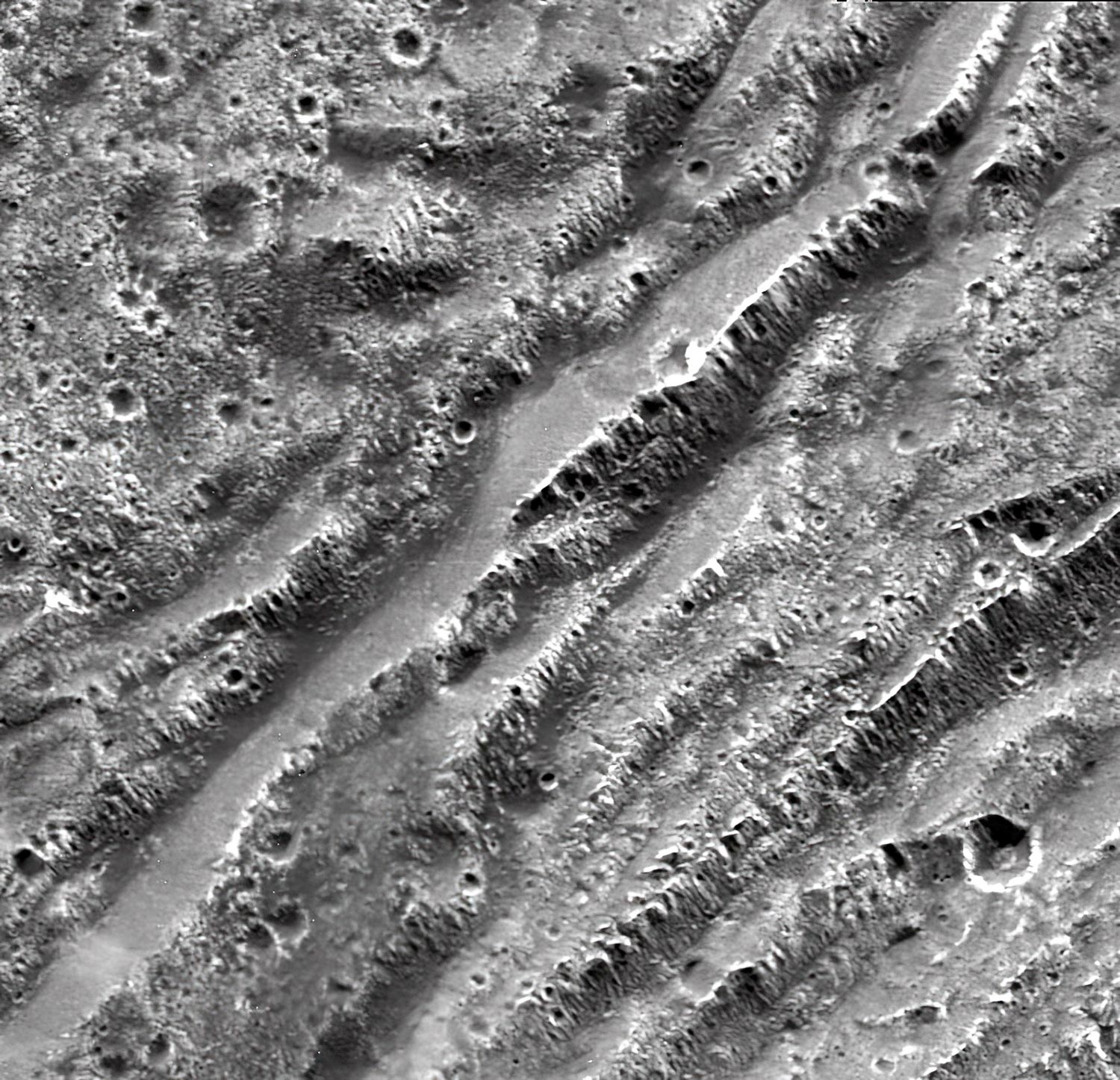
A new NASA study offers an explanation of how quakes could be the source of the mysteriously smooth terrain on moons circling Jupiter and Saturn.
Moonquakes could be the source of the mysteriously smooth terrain on moons orbiting Jupiter and Saturn, according to a new NASA study. The study shows how these quakes may trigger landslides that lead to remarkably smooth terrain, shedding new light on how icy moon surfaces and textures evolve. The upcoming Europa Clipper mission by NASA will provide the research with a significant boost.
Many of the ice-encrusted moons orbiting the giant planets in the far reaches of our solar system are known to be geologically active. Jupiter and Saturn have such strong gravity that they stretch and pull the bodies orbiting them, causing moonquakes that can crack the moons’ crusts and surfaces. New research shows for the first time how these quakes may trigger landslides that lead to remarkably smooth terrain.
The study, published in the journal Icarus, outlines the link between quakes and landslides, shedding new light on how icy moon surfaces and textures evolve.
On the surfaces of icy moons such as Europa, Ganymede, and Enceladus, it’s common to see steep ridges surrounded by relatively flat, smooth areas. Scientists have theorized that these spots result from liquid that flows out of icy volcanoes. But how that process works when the surface temperatures are so cold and inhospitable to fluids has remained a mystery.
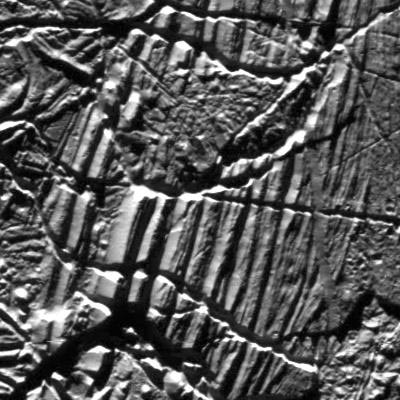
A simple explanation outlined in the study doesn’t involve liquid on the surface. Scientists measured the dimensions of the steep ridges, which are believed to be tectonic fault scarps (like those on Earth) – steep slopes caused when the surface breaks along a fault line and one side drops. By applying the measurements to seismic models, they estimated the power of past moonquakes and found they could be strong enough to lift debris that then falls downhill, where it spreads out, smoothing the landscape.
“We found the surface shaking from moonquakes would be enough to cause surface material to rush downhill in landslides. We’ve estimated the size of moonquakes and how big the landslides could be,” said lead author Mackenzie Mills, a graduate student at the University of Arizona in Tucson, who conducted the work during a series of summer internships at NASA’s Jet Propulsion Laboratory in Southern California. “This helps us understand how landslides might be shaping moon surfaces over time.”

Upcoming Investigations
NASA’s upcoming Europa Clipper mission, bound for Jupiter’s moon Europa in 2024, will give the research a significant boost, providing imagery and other science data. After reaching Jupiter in 2030, the spacecraft will orbit the gas giant and conduct about 50 flybys of Europa. The mission has a sophisticated payload of nine science instruments to determine if Europa, which scientists believe contains a deep internal ocean beneath an outer ice shell, has conditions that could be suitable for life.
“It was surprising to find out more about how powerful moonquakes could be and that it could be simple for them to move debris downslope,” said co-author Robert Pappalardo, project scientist of Europa Clipper at JPL, which manages the mission.

Credit: Image data: NASA/JPL-Caltech/SwRI/MSSSImage processing: Kevin M. Gill CC BY 3.0
Especially surprising were the modeling results for tectonic activity and quakes on Saturn’s moon Enceladus, a body that has less than 3% of the surface area of Europa and about 1/650 that of Earth. “Because of that moon’s small gravity, quakes on tiny Enceladus could be large enough to fling icy debris right off the surface and into space like a wet dog shaking itself off,” Pappalardo said.
When it comes to Europa, the high-resolution images gathered by Europa Clipper will help scientists determine the power of past moonquakes. Researchers will be able to apply the recent findings to understand whether quakes have moved ice and other surface materials and by how much. Images from the ESA (European Space Agency) Jupiter Icy Moons Explorer (JUICE) mission will offer similar information about Europa’s neighboring Jovian moon, Ganymede.
“We hope to gain a better understanding of the geological processes that have shaped icy moons over time and to what extent their surfaces may still be active today,” Pappalardo said.
Reference: “Moonquake-triggered mass wasting processes on icy satellites” by Mackenzie M. Mills, Robert T. Pappalardo, Mark P. Panning, Erin J. Leonard and Samuel M. Howell, 24 March 2023, Icarus.
DOI: 10.1016/j.icarus.2023.115534
More About the Mission
Europa Clipper’s main science goal is to determine whether there are places below the surface of Jupiter’s icy moon, Europa, that could support life. The mission’s three main science objectives are to understand the nature of the ice shell and the ocean beneath it, along with their composition and geology. The mission’s detailed exploration of Europa will help scientists better understand the astrobiological potential for habitable worlds beyond our planet.
Managed by Caltech in Pasadena, California, JPL leads the development of the Europa Clipper mission in partnership with the Johns Hopkins Applied Physics Laboratory (APL) in Laurel, Maryland, for NASA’s Science Mission Directorate in Washington. APL designed the main spacecraft body in collaboration with JPL and NASA’s Goddard Space Flight Center in Greenbelt, Maryland. The Planetary Missions Program Office at NASA’s Marshall Space Flight Center in Huntsville, Alabama, executes program management of the Europa Clipper mission.
Never miss a breakthrough: Join the SciTechDaily newsletter.
Follow us on Google and Google News.