
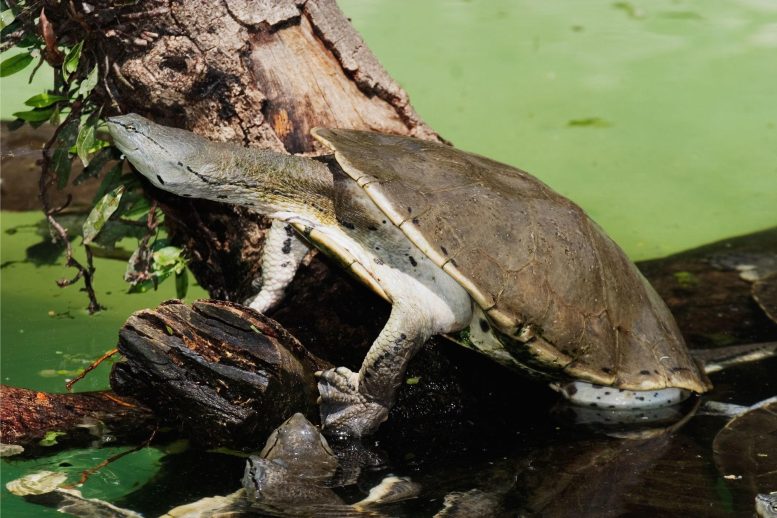
A 127-million-year-old side-necked turtle fossil discovered on the Isle of Wight marks a significant UK paleontological find.
An amateur fossil enthusiast, in collaboration with paleontologists from the University of Portsmouth, has uncovered the UK’s first side-necked turtle fossil.
These ancient remains represent the earliest known instance of a side-necked pan-pleurodiran turtle, named as such because they fold their neck into their shell sideways when threatened. This does mean they can only see out with one eye.
Originally found on a National Trust beach on the Isle of Wight, the turtle fossil is an almost complete shell with cervical, dorsal, and caudal vertebrae, scapulae, pelvic girdle, and appendicular bones. Sadly, the skull was missing.
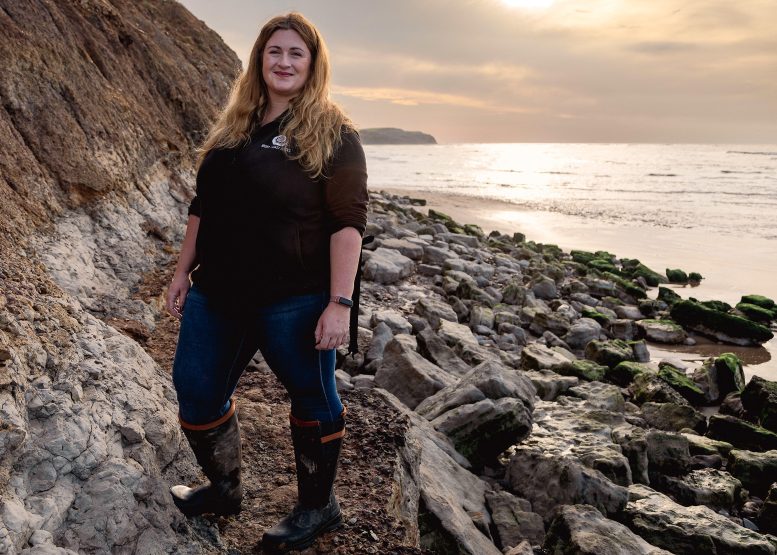
Lead author, Megan Jacobs, said: “This is an amazing discovery because it’s the first time this type of turtle has been found in the UK. Even more exciting is that we used a new technique of radiometric dating to determine the age of the fossil beyond any doubt. And to top it off, CT scanning revealed all the tiny bones inside. It’s really incredible for what looks like a rolled beach pebble!”
A Window Into the Lower Cretaceous Period
Megan and colleagues dissected minerals from inside the turtle shell and analyzed them for uranium and lead. By measuring the ratio of lead to radioactive uranium, they established the turtle was from the Lower Cretaceous period, around 127 million years ago.
The fossil was originally found on the foreshore at Brook Bay on the southwest coast of the Isle of Wight by fossil collector Steve Burbridge. This part of the coast is well-known for fossil vertebrates that come from the cliff and foreshore exposures of the upper part of the famous Isle of Wight fossil beds of the Wessex Formation.
This is the first time that radiometric dating has been used on a fossil from the Wessex formation.
Megan added: “We’ve nicknamed the turtle ‘Burby’ after Steve who very kindly donated the specimen to the Dinosaur Isle Museum at Sandown on the Isle of Wight.”
Cutting-Edge Imaging Reveals Hidden Details
The researchers also used cutting-edge micro CT scanning at the University of Portsmouth’s Future Technology Centre to discern various tiny bones. This advanced imaging technique provided invaluable insight into the structure and composition of the turtle’s shell, without damaging it.
Steve said: “It’s beyond my wildest dreams to have one of my finds published. I could never have guessed it was such an incredibly important fossil. It’s so wonderful to see all the tiny bones inside too.”
Geologist, Dr Catherine Mottram, from the University of Portsmouth’s School of the Environment, Geography, and Geosciences is one of the paper’s co-authors. She said: “It is exciting that we have been able to use cutting-edge radiometric dating techniques to provide absolute constraints for this important sequence for the first time.”
Reference: “A well preserved pan-pleurodiran (Dortokidae) turtle from the English Lower Cretaceous and the first radiometric date for the Wessex Formation (Hauterivian–Barremian) of the Isle of Wight, United Kingdom” by Megan L. Jacobs, Adán Pérez-García, Marcos Martín-Jiménez, Catherine M. Mottram, David M. Martill, Andrew S. Gale, Oliver L. Mattsson and Charles Wood, 27 May 2023, Cretaceous Research.
DOI: 10.1016/j.cretres.2023.105590
Never miss a breakthrough: Join the SciTechDaily newsletter.
Follow us on Google and Google News.
3 Comments
No mention of the sedimentary layers
Identified, whether rapidly buried and buried alive…some catastrophic events caused its death…naturally aquatic….no oxidation so buried and sealed so no decomposition….all scientifictests with machines ate designed long aged supportive based upon inconsistent half life history.
Found a dinosaur large fossil of that Dinasour with a ball with spikes on it and horns on the side of head and legs feet everything shell on back it’s nuts and shocking very heavy bit full body of a real dinisour 9372414584
I found a whole turtle I believe. It’s orange and brown 6″ x 4.5″