
The path of a light beam is bent by the presence of mass, as explained by General Relativity. A massive body can therefore act like a lens — a so called “gravitational lens” — to distort the image of an object seen behind it. Microlensing is a related phenomenon: a short flash of light is produced when a moving cosmic body, acting as a gravitational lens, modulates the intensity of light from a background star as it fortuitously passes in front of it. About fifty years ago scientists predicted that if it ever became possible to observe a microlensing flash from two well-separated vantage points, a parallax measurement would pin down the distance of the dark object. The Spitzer Space Telescope, orbiting the Sun at the distance of the Earth but trailing behind the Earth by about one-quarter of the orbital path, had been working with ground-based telescopes to do just that until it was shut down last month by NASA as a cost-savings measure.
CfA astronomer Jennifer Yee is a member of a large international team of astronomers making parallax microlensing measurements of small stellar objects. The technique is a powerful tool for probing isolated objects like free-floating planets, brown dwarfs, low-mass stars, and black holes. At the low-mass end, microlensing has already detected several free-floating planet candidates including several possible Earth-mass objects. Such discoveries are crucial for testing theories about the origin and evolution of free-floating planets. Similarly, microlensing observations of more massive objects like isolated brown dwarf stars have identified some objects orbiting in a sense opposite to that of normal disk stars. Stellar-mass sized objects found via microlensing reveal stellar-mass black holes and neutron stars.
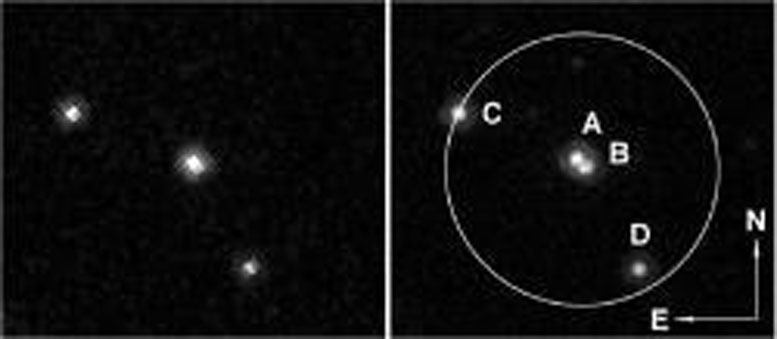
New microlensing parallax observations have been able to determine the masses of, and distances to, two small, isolated stars. One has a mass of about 0.6 solar-masses and is about 23,700 light-years away from us; modeling for the second is ambiguous, concluding that it is either 0.40 solar-masses at about 24,800 light-years or 0.38 solar-masses at 24,300 light-years distant. Both stars are red giants, and lie in the peanut-shaped bulge of old stars (about ten billion years old) in the Milky Way, about seven thousand light-years in radius in the central region of our galaxy. The new results, together with six earlier parallax microlensing measurements, lend strong support to current models of the Galaxy and its bulge formation.
Reference: “Spitzer Microlensing Parallax Reveals Two Isolated Stars in the Galactic Bulge” by Weicheng Zang, Yossi Shvartzvald, Tianshu Wang, Andrzej Udalski, Chung-Uk Lee, Takahiro Sumi, Jesper Skottfelt, Shun-Sheng Li, Shude Mao, Wei Zhu (Leading Authors), Jennifer C. Yee, Sebastiano Calchi Novati, Charles A. Beichman, Geoffery Bryden, Sean Carey, B. Scott Gaudi, Calen B. Henderson (The Spitzer Team), Przemek Mróz, Jan Skowron, Radoslaw Poleski, Michal K. Szymanski, Igor Soszynski, Pawel Pietrukowicz, Szymon Kozlowski, Krzysztof Ulaczyk, Krzysztof A. Rybicki, Patryk Iwanek (The OGLE Collaboration), Etienne Bachelet, Grant Christie, Jonathan Green, Steve Hennerley, Dan Maoz, Tim Natusch, Richard W. Pogge, Rachel A. Street, Yiannis Tsapras (The LCO and µFUN Follow-up Teams), Michael D. Albrow, Sun-Ju Chung, Andrew Gould, Cheongho Han, Kyu-Ha Hwang, Youn Kil Jung, Yoon-Hyun Ryu, In-Gu Shin, Sang-Mok Cha, Dong-Jin Kim, Hyoun-Woo Kim, Seung-Lee Kim, Dong-Joo Lee, Yongseok Lee, Byeong-Gon Park, (The KMTNet Collaboration), Ian A. Bond, Fumio Abe, Richard Barry, David P. Bennett, Aparna Bhattacharya, Martin Donachie, Akihiko Fukui, Yuki Hirao, Yoshitaka Itow, Iona Kondo, Naoki Koshimoto, Man Cheung Alex Li, Yutaka Matsubara, Yasushi Muraki, Shota Miyazaki, Masayuki Nagakane, Clément Ranc, Nicholas J. Rattenbury, Haruno Suematsu, Denis J. Sullivan, Daisuke Suzuki, Paul J. Tristram, Atsunori Yonehara (The MOA Collaboration), Martin Dominik, Markus Hundertmark, Uffe G. Jørgensen, Sohrab Rahvar, Sedighe Sajadian, Colin Snodgrass, Valerio Bozza, Martin J. Burgdorf, Daniel F. Evans, R. Figuera Jaimes, Yuri I. Fujii, Luigi Mancini, Penelope Longa-Peña, Christiane Helling, Nuno Peixinho, Markus Rabus, John Southworth, Eduardo Unda-Sanzana, Carolina von Essen and (The MiNDSTEp Collaboration), 27 February 2020, The Astrophysical Journal.
DOI: 10.3847/1538-4357/ab6ff8
Never miss a breakthrough: Join the SciTechDaily newsletter.
Follow us on Google and Google News.