
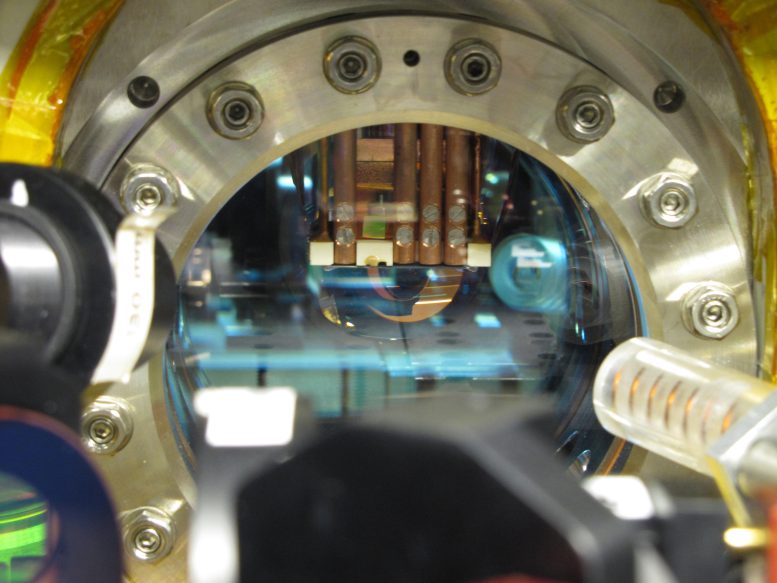
How do quantum particles exchange information? An intriguing hypothesis regarding quantum information has recently been validated through experimental verification conducted at TU Wien.
If you were to randomly pick an individual from a crowd who stands remarkably taller than the average, it’s quite likely that this person will also surpass the average weight. This is because, statistically, knowledge about one variable often gives us some insight into another.
Quantum physics takes these correlations to another level, establishing even more potent connections between disparate quantities: distinct particles or segments of a vast quantum system can “share” a specific amount of information. This intriguing theoretical premise suggests that the calculation of this “mutual information” is surprisingly not influenced by the system’s overall volume, but only by its surface.
This surprising result has been confirmed experimentally at the TU Wien and published in Nature Physics. Theoretical input to the experiment and its interpretation came from the Max-Planck-Institut für Quantenoptik in Garching, FU Berlin, ETH Zürich, and New York University.
Quantum Information: More Strongly Connected Than Classical Physics Allows
“Let’s imagine a gas container in which small particles fly around and behave in a very classical way like small spheres,” says Mohammadamin Tajik of the Vienna Center for Quantum Science and Technology (VCQ) — Atominstitut of TU Wien, first author of the current publication.
“If the system is in equilibrium, then particles in different areas of the container know nothing about each other. One can consider them completely independent of each other. Therefore, one can say that the mutual information these two particles share is zero.”
In the quantum world, however, things are different: If particles behave quantumly, then it may happen that you can no longer consider them independently of each other. They are mathematically connected — you can’t meaningfully describe one particle without saying something about the other.
“For such cases, there has long been a prediction about the mutual information shared between different subsystems of a many-body quantum system,” explains Mohammadamin Tajik. “In such a quantum gas, the shared mutual information is larger than zero, and it does not depend on the size of the subsystems — but only on the outer bounding surface of the subsystem.”
This prediction seems intuitively strange: In the classical world, it is different. For example, the information contained in a book depends on its volume — not merely on the area of the book’s cover. In the quantum world, however, information is often closely linked to surface area.
Measurements With Ultracold Atoms
An international research team led by Prof. Jörg Schmiedmayer has now confirmed for the first time that the mutual information in a many body quantum system scales with the surface area rather than with the volume. For this purpose, they studied a cloud of ultracold atoms.
The particles were cooled to just above absolute zero temperature and held in place by an atom chip. At extremely low temperatures, the quantum properties of the particles become increasingly important.
The information spreads out more and more in the system, and the connection between the individual parts of the overall system becomes more and more significant. In this case, the system can be described with a quantum field theory.
“The experiment is very challenging,” says Jörg Schmiedmayer. “We need complete information about our quantum system, as best as quantum physics allows. For this, we have developed a special tomography technique. We get the information we need by perturbing the atoms just a bit and then observing the resulting dynamics. It’s like throwing a rock into a pond and then getting information about the state of the liquid and the pond from the consequent waves.”
As long as the system’s temperature does not reach absolute zero (which is impossible), this “shared information” has a limited range. In quantum physics, this is related to the “coherence length” — it indicates the distance to which particles quantumly behave similarly, and thereby know from each other.
“This also explains why shared information doesn’t matter in a classical gas,” says Mohammadamin Tajik. “In a classical many-body system, coherence disappears; you can say the particles no longer know anything about their neighboring particles.” The effect of temperature and coherence length on mutual information was also confirmed in the experiment.
Quantum information plays an essential role in many technical applications of quantum physics today. Thus, the experiment results are relevant to various research areas — from solid-state physics to the quantum physical study of gravity.
Reference: “Verification of the area law of mutual information in a quantum field simulator” by Mohammadamin Tajik, Ivan Kukuljan, Spyros Sotiriadis, Bernhard Rauer, Thomas Schweigler, Federica Cataldini, João Sabino, Frederik Møller, Philipp Schüttelkopf, Si-Cong Ji, Dries Sels, Eugene Demler and Jörg Schmiedmayer, 24 April 2023, Nature Physics.
DOI: 10.1038/s41567-023-02027-1
Never miss a breakthrough: Join the SciTechDaily newsletter.
Follow us on Google and Google News.
6 Comments
When I first read this it brought to mind the holographic principle and how both describe information spread on the surface of a volume. Can there be a link between the two concepts?
How these 3-D volume is not related to 2-D surface area of infomation container system for any specific geometric shape.But,experiment found the fact that information contained only depends on surface area.Result is significant as the active area for containing information is only surface of the system.
So–what is an “atom chip” & how does it hold particles in place?
So your,saying: you got gravity in quantum ?
No. The research did not study gravity.
I’m not surprised since they study near equilibrium systems, where quantum field forces are constrained to elliptic partial differential equations [PDEs] and have potentials (such as the Poisson equation). Solutions for such PDEs can be determined by the surface conditions, compare with electrostatic potentials around a charge.