
In the latest issue of the journal Nature, astronomers from Stockholm University reveal the origin of a thermonuclear supernova explosion. Strong emission lines of helium and the first detection of such a supernova in radio waves show that the exploding white dwarf star had a helium-rich companion.
Researchers from Stockholm University have discovered a thermonuclear supernova’s origin traced to a helium-rich companion star of a white dwarf. This first-ever detection of a supernova in radio waves sheds light on the nature and processes leading to Type Ia supernovae, crucial for measuring the universe’s expansion. The finding helps resolve the long-standing question about the process leading to the explosion of a white dwarf star and the nature of its progenitor, identified here as a helium star that had lost much of its material just prior to the white dwarf’s explosion.
Supernovae of Type Ia are important for astronomers since they are used to measure the expansion of the Universe. However, the origin of these explosions has remained an open question. While it is established that the explosion is that of a compact white dwarf star somehow accreting too much matter from a companion star, the exact process and the nature of the progenitor are not known. The new discovery of supernova SN 2020eyj established that the companion star was a helium star that had lost much of its material just prior to the explosion of the white dwarf.
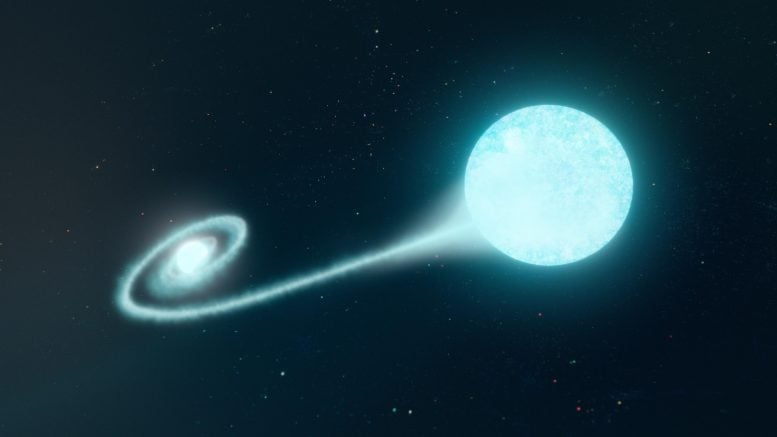
Artist impression of the double star system with a compact white dwarf star accreting matter from a helium-rich donor companion, surrounded by dense and dusty circumstellar material. It was the interaction of the exploded star and the material left over from this companion that gave rise to the strong radio signal and the conspicuous helium lines in the optical spectra of SN 2020eyj. Credit: Adam Makarenko/W. M. Keck Observatory
“Once we saw the signatures of strong interaction with the material from the companion we tried to also detect it in radio emission,” explains Erik Kool, post-doc at the Department of Astronomy at Stockholm University and lead author of the paper. “The detection in radio is the first one of a Type Ia supernova – something astronomers have tried to do for decades.”
Supernova 2020eyj was discovered by the Zwicky Transient Facility camera on Palomar mountain, where the Oskar Klein Centre at Stockholm University are members.
“The Nordic Optical telescope on La Palma was fundamental for following up this supernova,” says Professor Jesper Sollerman at the Department of Astronomy and co-author of the paper.
“As were spectra from the large Keck telescope on Hawai’i that immediately revealed the very unusual helium-dominated material around the exploded star.”

“This is clearly a very unusual Type Ia supernova, but still related to the ones we use to measure the expansion of the universe,” adds Joel Johansson from the Department of Physics.
“While normal Type Ia supernovae appear to always explode with the same brightness, this supernova tells us that there are many different pathways to a white dwarf star explosion,” he adds.
Reference: “A radio-detected type Ia supernova with helium-rich circumstellar material” by Erik C. Kool, Joel Johansson, Jesper Sollerman, Javier Moldón, Takashi J. Moriya, Seppo Mattila, Steve Schulze, Laura Chomiuk, Miguel Pérez-Torres, Chelsea Harris, Peter Lundqvist, Matthew Graham, Sheng Yang, Daniel A. Perley, Nora Linn Strotjohann, Christoffer Fremling, Avishay Gal-Yam, Jeremy Lezmy, Kate Maguire, Conor Omand, Mathew Smith, Igor Andreoni, Eric C. Bellm, Joshua S. Bloom, Kishalay De, Steven L. Groom, Mansi M. Kasliwal, Frank J. Masci, Michael S. Medford, Sungmin Park, Josiah Purdum, Thomas M. Reynolds, Reed Riddle, Estelle Robert, Stuart D. Ryder, Yashvi Sharma and Daniel Stern, 17 May 2023, Nature.
DOI: 10.1038/s41586-023-05916-w
The paper “A radio-detected Type Ia supernova with helium-rich circumstellar material” is published in Nature and is led by Erik Kool from the Department of Astronomy at Stockholm University and describes the first radio detection of a Type Ia supernova. Co-authors from Stockholm University are Joel Johansson, Jesper Sollerman, Steve Schulze, Peter Lundqvist, Sheng Yang, and Conor Omand. This work involved researchers from institutes across the world, including Caltech, Weizmann Institute, IAA-CSIC, NAOJ, Macquarie University, and Trinity College Dublin.
Funding: Vetenskapsrådet (Swedish Research Council), Wenner-Gren Foundation
Never miss a breakthrough: Join the SciTechDaily newsletter.
Follow us on Google and Google News.
2 Comments
A fine glimpse of Type la supernova for study of plasma physics in the context of expansion of universe.However,supernova 2020eyj is a perfect candidate to calculate the rate of expansion of universe and Hubble Tension.Thanks,for this good observation.
Type Ia supernova explòsions have all a characterstic feature of constant brightness.So,accordingly supernova 2020eyj can be studied regardless of mass as one universal phenomena.But,impotant fact is to serve as a right candidate for the measurement of rate of expansion of unìverse.