
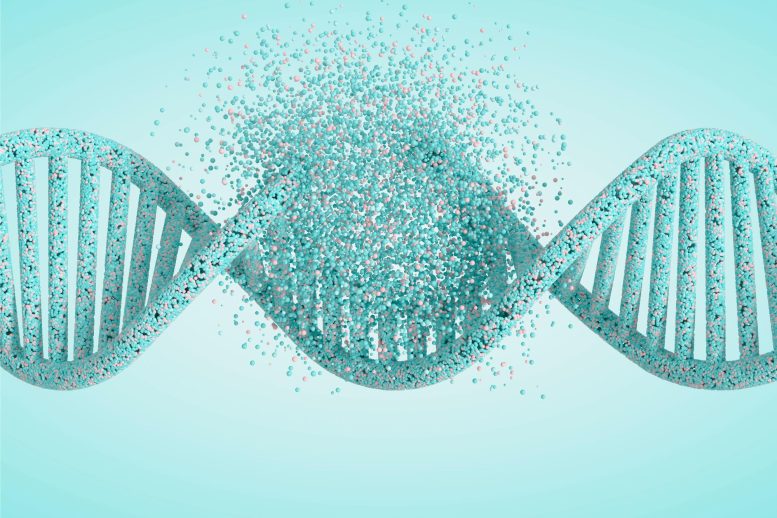
Researchers showed that inhibiting the DREAM complex in human cells and mice enhanced DNA repair, increasing resilience to genomic damage. The findings have far-reaching implications for aging, cancer prevention, and space exploration, where radiation-induced DNA damage is a significant challenge.
Researchers at the University of Cologne have found that a protein complex impedes the repair of genomic damage in human cells, mice, and the nematode Caenorhabditis elegans. Furthermore, they were able to successfully obstruct this complex with a pharmaceutical agent for the first time.
“When we suppress the so-called DREAM complex in body cells, various repair mechanisms kick in, making these cells extremely resilient towards all kinds of DNA damage,” said Professor Dr. Björn Schumacher, Director of the Institute for Genome Stability in Aging and Disease at the University of Cologne’s CECAD Cluster of Excellence in Aging Research.
DNA, which holds our genetic data, needs to be safeguarded carefully. However, it’s under constant threat due to environmental factors or our normal metabolism. Therefore, repairing DNA is vital for maintaining the stability of our genome and ensuring the proper functioning of our cells.
“Our findings for the first time allow us to improve DNA repair in body cells and to target the causes of aging and cancer development,” Schumacher added. Still, more research is needed until these results can be translated into new therapies for human patients. The study was published in Nature Structural & Molecular Biology.
DNA-Damage Leads to Aging and Disease
Our genetic material is passed on from generation to generation. That is why it is particularly well protected in our germ cells. Highly precise DNA repair mechanisms are at work there, ensuring that only very few changes in the genetic material are passed on to offspring. Thanks to DNA repair, our human genome has been passed on to us by our ancestors for two hundred thousand years. It has always ensured that the genetic information is preserved. DNA is also constantly repaired in our body cells, but only for the duration of the individual’s life.
Sometimes, children are born with faulty DNA repair systems, making them age more quickly and develop typical age-related diseases such as neuro-degradation and arteriosclerosis already in childhood. In some cases, they also have an extremely increased risk of cancer. These are all consequences of DNA damage not being properly repaired.
The DREAM Complex Prevents Repairs
Schumacher and his team explored why body cells do not have the same repair mechanisms as germ cells. In experiments with the nematode C. elegans, they found out that the DREAM protein complex limits the quantity of DNA repair mechanisms in body cells: the complex attaches to the DNA’s construction plans containing instructions for the repair mechanisms. This prevents them from being produced in large quantities. Germ cells, however, do not have the DREAM complex. Hence, they naturally produce large quantities of DNA repair mechanisms.
Mammals Also Have a DREAM-Complex
In further experiments with human cells in the laboratory (cell culture), the scientists showed that the DREAM complex functions in the same way in human cells. They were also able to override the DREAM complex with a pharmaceutical agent. “We were very pleased to see the same effect as we did in C. elegans. The human cells were much more resilient towards DNA damage after treatment,” said Arturo Bujarrabal, a postdoc in Schumacher’s team and lead author of the study. Treatment with the DREAM complex inhibitor also showed amazing effects in mice: The DNA in the retina of mice could be repaired and the function of the eye was preserved. The test was carried out in mice that, like some patients, age prematurely and show a typical degeneration of the eye’s retina.
DNA-Damage in Space
Genome damage also plays a major role in manned spaceflight because of the extremely high radiation in space. A longer stay in space without improved DNA repair is hardly imaginable. Schumacher sums up: “Therapies that target and improve this newly discovered master regulator of DNA repair could reduce the risk of cancer because genes remain intact.” In addition, the risk of age-related diseases would be reduced because cells can only fulfill their function with an intact genome.
Reference: “The DREAM complex functions as conserved master regulator of somatic DNA-repair capacities” by Arturo Bujarrabal-Dueso, Georg Sendtner, David H. Meyer, Georgia Chatzinikolaou, Kalliopi Stratigi, George A. Garinis and Björn Schumacher, 23 March 2023, Nature Structural & Molecular Biology.
DOI: 10.1038/s41594-023-00942-8
The study was carried out at the Institute for Genome Stability in Aging and Disease of the University of Cologne’s CECAD Cluster of Excellence in Aging Research.
Never miss a breakthrough: Join the SciTechDaily newsletter.
Follow us on Google and Google News.
7 Comments
That was one of the most difficult studies I’ve tried to read. They tried inhibiting DYRK1A, using harmine (an MAO inhibitor) and INDY. It’s hard to find info on INDY, apparently a benzothiazole derivative research chemical which also inhibits DYRK1B, developed by 2010 and first tested as a down-syndrome treatment for embryos.
Just a reminder, you are not a worm. Don’t be trying DIY geonomic experimentation at home, unless in the traditional copulatory way.
#traditional copulatory way Ha
what about the molecule B-NICOTINAMIDE MONONUCLEOTIDE.? It also does DNA repair! Read about this in the book called LIFESPAN : Why WE AGE AND WHY WE DON’T HAVE TO BY David A. Sinclair PhD. You will be in shock to learn about this agingstuff
How does. This method compare to Dr Sinclair sirtuins and activating and increasing NAD?
Hello!!! It seems to me that you have intellectual honesty and consider what genesis chapter one & two says about the orihin of aging and health problems. Yours
science will figure out how to stop the aging process in a couple of years. Till then you can slow it down with: Second Chance. Radiates Quantum Energy.Drink one bottle every two weeks or drink 3 bottles and keep one next to you at night.
Try it on me.