
Sweaty Workouts Equal Chemical Surges
One sweaty, huffing, exercising person emits as many chemicals from their body as up to five sedentary people, according to a new University of Colorado Boulder study. And notably, those human emissions, including amino acids from sweat or acetone from breath, chemically combine with bleach cleaners to form new airborne chemicals with unknown impacts to indoor air quality.
“Humans are a large source of indoor emissions,” said Zachary Finewax, CIRES research scientist and lead author of the new study out in the current edition of Indoor Air. “And chemicals in indoor air, whether from our bodies or cleaning products, don’t just disappear, they linger and travel around spaces like gyms, reacting with other chemicals.”
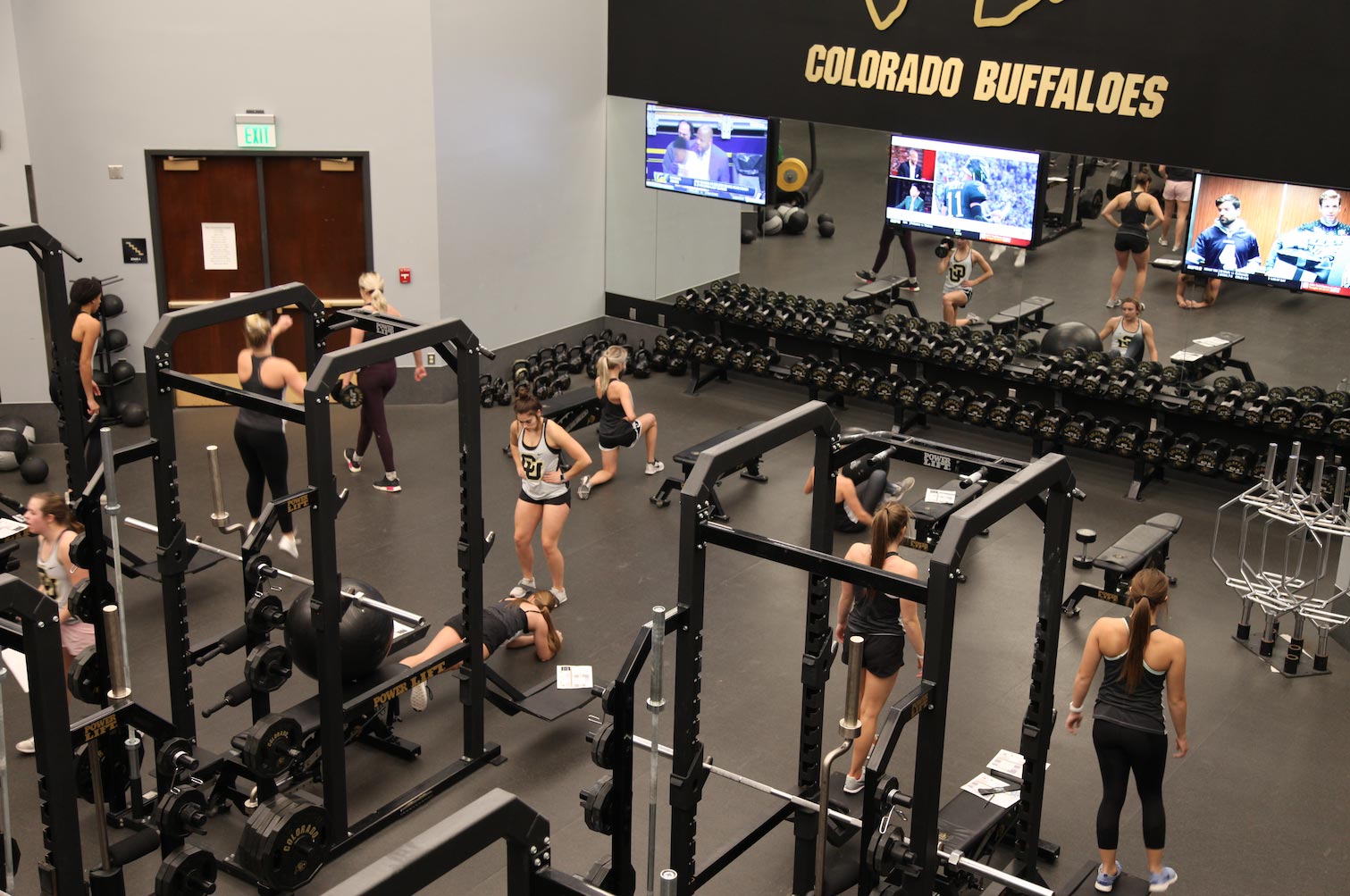
In 2018, the CU Boulder team outfitted a weight room in the Dal Ward Athletic Center—a campus facility for university student athletes, from weightlifters to cheerleaders—with a suite of air-sampling equipment. Instruments collected data from both the weight room and supply air, measuring a slew of airborne chemicals in real time before, during and after workouts of CU athletes. The team found the athletes’ bodies produced 3-5 times the emissions while working out, compared to when they were at rest.
“Using our state-of-the-art equipment, this was the first time indoor air analysis in a gym was done with this high level of sophistication. We were able to capture emissions in real time to see exactly how many chemicals the athletes were emitting, and at what rate,” said Demetrios Pagonis, postdoctoral researcher at CIRES and co-author on the new work.
Sweat Meets Sanitizers: A Chemical Cocktail
Many gym facilities frequently use chlorine bleach-based products to sanitize sweaty equipment. And while these cleaning products work to kill surface bacteria—they also combine with emissions from sweat—mixing to form a new cocktail of chemicals.
The team was the first to observe a chemical group called N-chloraldimines—a reaction product of bleach with amino acids—in gym air. That meant chlorine from bleach cleaner sprayed onto equipment was reacting with the amino acids released from sweating bodies, the authors report.
And although more research is needed to determine specific impacts this might have on indoor air quality, chemically similar reaction products of ammonia with bleach can be harmful to human health.
“Since people spend about 90 percent of our time indoors, it’s critical we understand how chemicals behave in the spaces we occupy,” said Joost de Gouw, CIRES Fellow, professor of Chemistry at CU Boulder and corresponding author on the paper. Although the researchers collected all data for this study pre-pandemic, the team says their results illustrate that a modern gym with low occupancy and good ventilation may still be relatively safe for a workout, especially if masks are used.
Reference: “Quantification and source characterization of volatile organic compounds from exercising and application of chlorine‐based cleaning products in a university athletic center” by Zachary Finewax, Demetrios Pagonis, Megan S. Claflin, Anne V. Handschy, Wyatt L. Brown, Olivia Jenks, Benjamin A. Nault, Douglas A. Day, Brian M. Lerner, Jose L. Jimenez, Paul J. Ziemann and Joost A. de Gouw, 18 December 2020, Indoor Air.
DOI: 10.1111/ina.12781
“Quantification and source characterization of volatile organic compounds from exercising and application of chlorine‐based cleaning products in a university athletic center” published in Wiley’s Indoor Air on December 18, 2020. Authors include: Zachary Finewax (CIRES, CU Boulder Chemistry), Demetrios Pagonis (CIRES, CU Boulder Chemistry), Megan S. Claflin (Aerodyne Research), Anne V. Handschy (CIRES, CU Boulder Chemistry), Wyatt L. Brown (CIRES, CU Boulder Chemistry), Olivia Jenks (CIRES, CU Boulder Chemistry), Benjamin A. Nault (CIRES, CU Boulder Chemistry), Douglas A. Day (CIRES, CU Boulder Chemistry), Brian M. Lerner (Aerodyne Research), Jose L. Jimenez (CIRES, CU Boulder Chemistry), Paul J. Ziemann (CIRES, CU Boulder Chemistry), Joost A. de Gouw (CIRES, CU Boulder Chemistry).
The authors gratefully acknowledge the Sloan Foundation for funding the measurements and instrumentation used in this study, and the CU Boulder Dal Ward Athletic Center for the use of their facilities to collect all data for this work.
Never miss a breakthrough: Join the SciTechDaily newsletter.
Follow us on Google and Google News.
2 Comments
Is farting considered an emission?
Indoor HEPA air purifiers are becoming cheap, there is no reason they shouldn’t have HEPA air filtration going in those sweat shops.