
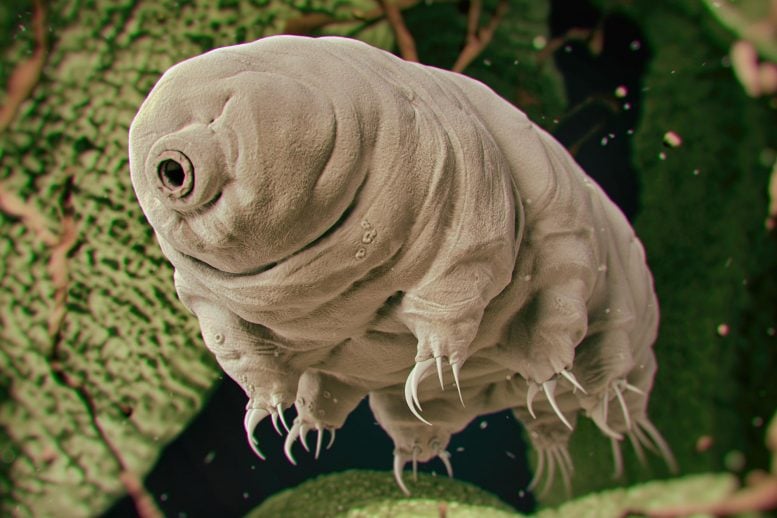
Researchers Improve Their Understanding of the Toughness of Tardigrades
Researchers at the University of Wyoming have learned more about the biological processes that enable tiny creatures known as tardigrades to endure harsh circumstances, such as being completely dried out in suspended animation for years.
Thomas Boothby, an assistant professor of molecular biology, and colleagues found how trehalose, a sugar, interacts with proteins to enable tardigrades to survive in the absence of water. Their findings were recently published in the journal Communications Biology.
Tardigrades, often known as water bears, are less than half a millimeter long and can tolerate being completely dried out, frozen to just above absolute zero (approximately minus 458 degrees Fahrenheit, when all molecular motion ceases), heated to more than 300 degrees Fahrenheit, irradiated several thousand times beyond what a person can withstand, and even survive the vacuum of outer space.
The Role of Trehalose in Survival
Tardigrades’ ability to survive being dried out has perplexed scientists since it seems to vary from that of a number of other species that can enter suspended animation. Previously, scientists believed tardigrades did not produce trehalose to survive drying out, but Boothby and his colleagues discovered that they do, although at lower levels than other organisms.
The researchers also found that, in tardigrades, trehalose works synergistically with another tardigrade-specific protein called CAHS D.
Ultimately, Boothby and other researchers hope that their discoveries can be applied to help solve societal and global health issues — in this case, water scarcity. Their work might lead to better ways of stabilizing pharmaceuticals and generating engineered crops that can cope with harsh environments.
“A long-term goal of this field is to understand better how to confer the adaptation abilities of tardigrades to organisms that do not naturally survive drying,” Boothby says. “This study and its findings provide a compelling argument that to do so may require the combination of different, synergistic protectants.”
Reference: “Trehalose and tardigrade CAHS proteins work synergistically to promote desiccation tolerance” by Kenny Nguyen, Shraddha KC, Tyler Gonzalez, Hugo Tapia and Thomas C. Boothby, 1 October 2022, Communications Biology.
DOI: 10.1038/s42003-022-04015-2
The study was funded by the National Science Foundation, the Defense Advanced Research Projects Agency, and the National Institutes of Health.
Never miss a breakthrough: Join the SciTechDaily newsletter.
Follow us on Google and Google News.
8 Comments
First start with Rough Experiment. Separate its Nucleus and inject into just delivered offsprings of Mice, Rats, Guinea pigs and Rabbits. If they die or nothing special is observed, inject various chromosomes into again new set of just delivered offsprings of Mice, Rats, Guinea pigs and Rabbits. If they die or nothing special is observed, move on to regular procedure of injecting Genes. Save all of the earlier ones at Absolute Temperature. Then, more advanced approach, which takes a lot of time. In other words, some special feature in the animals which received from the Tardigrade must be noted. As usual, limit them to the lab, because they should not be mixed with general animal population. Gene Transfers leading to Quick Evolution is the theme of this study. Finally, Blastulae & gastrulae of huge animals may similarly receive genes of tardigrades to shed more light on Tardigrade and general animal evolution that took/takes/is taking place.
Dsup Protein (Damage suppression protein) is found only in tardigrades. When Dsup is tested in human cells, it Protects them from X-rays; It binds to Chromatin inside the cells and then protects cells by forming a protective cloud that shields DNA from hydroxyl radicals, which are produced by X-ray irradiation. Dsup has 2 parts, one piece binding to chromatin and rest of it forming a kind of cloud that protects DNA from hydroxyl radicals.
https://scitechdaily.com/researchers-discover-how-water-bears-survive-extreme-conditions/
I Expect Genetics to progress by leaps and bounds. Why are we not able to transfer flight genes of Either Insects OR Birds to Frogs? (Not into Toads, because they can survive outside the water and may fly into the houses). Frogs Prefer Water to Soil. I do understand that Amphibians are far away from Arthropods & Avians in the Animal kingdom. Frog Eggs are laid in the water enabling manipulations by Researchers. Experiment may not go to the needed conclusion..but will reach a step for some others to continue later on !
Now, Tobacco Plant makes Cocaine! (Entire Biochemical Pathway for making Cocaine in Coca Plants now reproduced in Genetically modified Tobacco plant). In newscientist Website, on 11/25/2022.
There are 1,300 extremophilic species in Phylum Tardigrada and are only ½mm long, largest being 1½mm long; Tardigrades are found wherever moisture is available, in hot springs, on top of Himalayas, in polar regions, in deep sea, in lakes, ponds, meadows and in roofs etc., withstanding temp. of −273 °C to 150 °C. They can survive pressures 6X greater than those found in deepest Ocean trenches, ionizing radiation at doses hundreds of times higher than lethal dose for a human, and Vacuum of outer Space. They can go without food or water for >30 years. Their trehalase genes protect them from desiccation. 1 Species was discovered in 16 million years old fossil in amber. 1.2% of its genes were the result of horizontal gene transfer and have 75 to 800 megabase pairs of DNA.
https://upload.wikimedia.org/wikipedia/commons/transcoded/9/9d/Tardigrade_in_real_time.ogv/Tardigrade_in_real_time.ogv.480p.vp9.webm
This current article mentions that trehalose, a sugar, interacts with proteins to enable tardigrades to survive in the absence of water… Working synergistically with tardigrade-specific protein called CAHS D.
The Meek shall inherit the Earth.
No,Rassalas:the tardigrade will inherit the Earth.And I very much doubt they’ll have ANYTHING good to say about humans…