
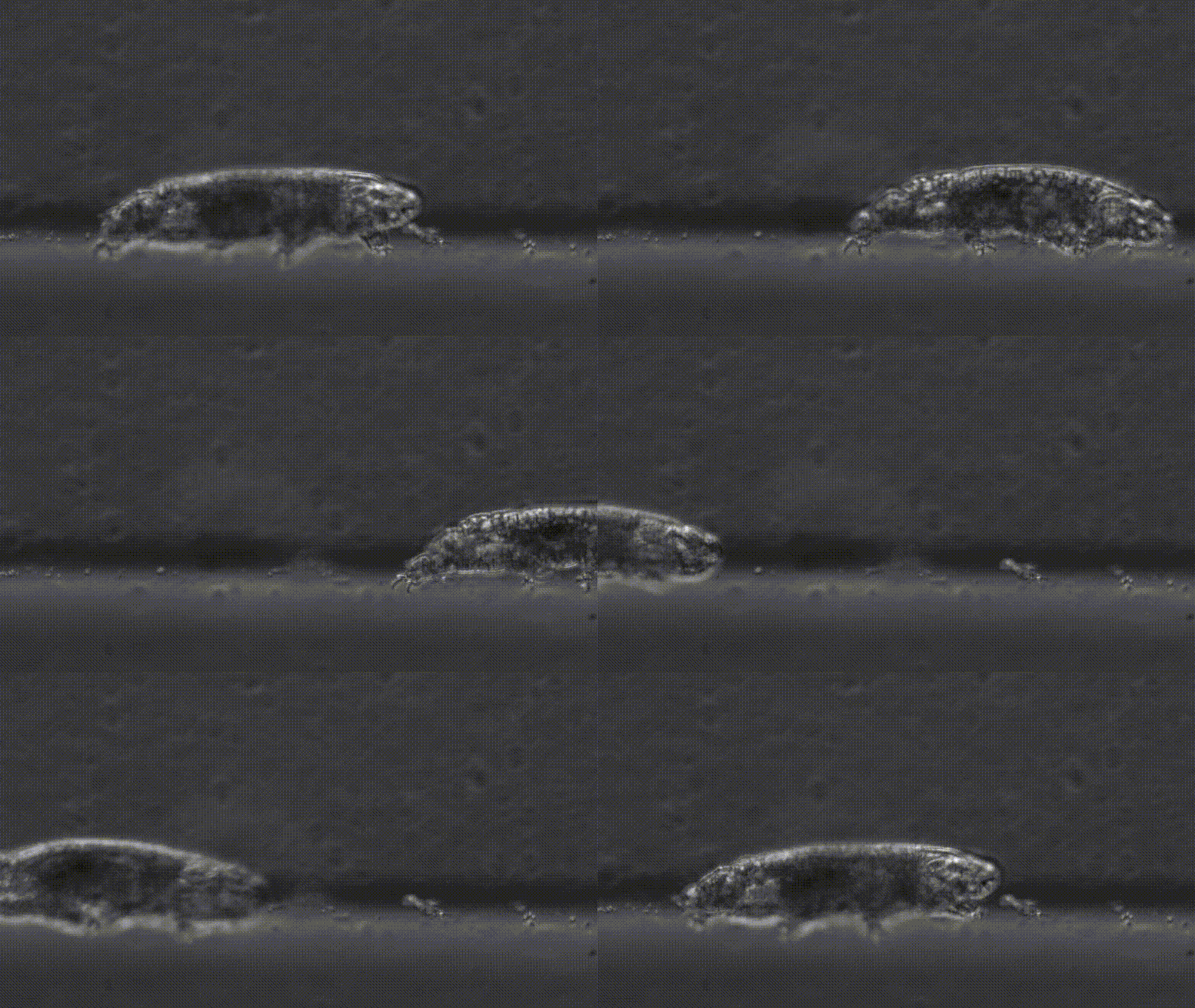
Tardigrades walk like insects, hinting at either shared ancestry or convergent evolution.
Plump and ponderous, tardigrades earned the nickname “water bears” when scientists first observed the 0.02-inch-long animals’ distinctive lumbering gaits in the 18th century. Their dumpy plod, however, raises the question of why tardigrades evolved to walk at all.
Animals as small and soft as tardigrades seldom have legs and almost never bother walking. For example, round worms of similar size and body type thrash about, slithering their doughy forms over unpredictable substrates. Yet the water bear, a micro-animal so distinct that scientists were forced to assign it to its own phylum, uses eight stubby legs to improbably propel itself through marine and freshwater sediment, across desert dunes, and beneath the soil.
Now, a new study in PNAS analyzes tardigrade gaits and finds that water bears walk in a manner most closely resembling that of insects 500,000 times their size. The discovery implies the existence of either a common ancestor or an evolutionary advantage that explains why one of the smallest and squishiest creatures evolved to walk just like larger, hard-bodied insects.
“Tardigrades have a robust and clear way of moving—they’re not these clumsy things stumbling around in the desert or in leaf litter,” says Jasmine Nirody, a fellow in Rockefeller’s Center for Studies in Physics and Biology. “The similarities between their locomotive strategy and that of much larger insects and arthropods opens up several very interesting evolutionary questions.”
Smooth Runners
Nirody and colleagues first determined how water bears walk and run. “If you watch tardigrades under a light microscope for long enough, you can capture a wide range of behavior,” Nirody says. “We didn’t force them to do anything. Sometimes they would be really chill and just want to stroll around the substrate. Other times, they’d see something they like and run towards it.”
Nirody found that, at their most leisurely, water bears lumber about half a body length per second. At full throttle, their loping strides carried them two body lengths in the same amount of time. But the surprise came when she observed how a water bear’s feet contact the ground as it gains momentum. Unlike vertebrates, which have distinct gaits for each speed—picture a horse’s hooves as it transitions from a walk to a gallop—tardigrades run more like insects, scurrying at increasing speeds without ever changing their basic stepping patterns.
“When vertebrates switch from walking to running, there is a discontinuity,” Nirody says. “With arthropods, all stepping patterns exist along the same continuum.”
Ancient Coordination
Why do tardigrades share a locomotive strategy with much larger, hard-bodied insects?
One possible explanation is that tardigrades, long assumed to fit neatly into no existing taxonomy, may share common ancestors—and even a common neural circuit— with insects such as fruit flies, ants, and other segmented scurrying creatures. In fact, some scientists advocate classifying tardigrades within the proposed panarthropod clade, a catchall group that would assign common shelf space to insects, crustaceans, velvet worms, and water bears.
Another possibility is that there is no ancestral connection between tardigrades and arthropods, but that the unrelated groups of organisms independently arrived at the same walking and running strategies because they were evolutionarily advantageous. Perhaps the best way to navigate unpredictable terrain with a microscopic body is to plod like a water bear.
Nirody is equally fascinated by both possibilities. “If there is some ancestral neural system that controls all of panarthropod walking, we have a lot to learn,” she says. “On the other hand, if arthropods and tardigrades converged upon this strategy independently, then there’s much to be said about what makes this strategy so palatable for species in different environments.”
Beyond the implications for evolutionary biology and the study of animal locomotion, the findings may have ramifications for the burgeoning fields of soft and microscale robotics.
By studying how small animals evolved to move across challenging environments, scientists may be able to design robots that can more efficiently squeeze into small spaces or operate at the microscale. “We don’t know much about what happens at the extremes of locomotion—how to make an efficient small walker, or how soft-bodied things should move,” Nirody says.
“Tardigrades are an important porthole into soft-bodied, microscale locomotion.”
Reference: “Tardigrades exhibit robust interlimb coordination across walking speeds and terrains” by Jasmine A. Nirody, Lisset A. Duran, Deborah Johnston and Daniel J. Cohen, 31 August 2021, Proceedings of the National Academy of Sciences.
DOI: 10.1073/pnas.2107289118
Never miss a breakthrough: Join the SciTechDaily newsletter.
Follow us on Google and Google News.