
Precision measurement of how a proton’s structure deforms in an electric field has revealed new details about an unexplained spike in proton data.
Nuclear physicists have confirmed that the current description of proton structure isn’t perfect. A bump in the data in probes of the proton’s structure has been revealed by a new precision measurement of the proton’s electric polarizability performed at the U.S. Department of Energy’s Thomas Jefferson National Accelerator Facility. When this was seen in earlier measurements, it was widely thought to be a fluke. However, this new, more precise measurement has confirmed the presence of the anomaly and raises important questions about its origin. The research was published on October 19 in the journal Nature.
“There is something that we’re clearly missing at this point. The proton is the only composite building block in nature that is stable. So, if we are missing something fundamental there, it has implications or consequences for all of physics.” Nikos Sparveris
Measurements of the proton’s electric polarizability reveal how susceptible the proton is to deformation, or stretching, in an electric field, according to Ruonan Li, first author on the new paper and a graduate student at Temple University. Like size or charge, the electric polarizability is a fundamental property of proton structure.
What’s more, a precision determination of the proton’s electric polarizability can help bridge the different descriptions of the proton. Depending on how it is probed, a proton may appear as an opaque single particle or as a composite particle made of three quarks held together by the strong force.
“We want to understand the substructure of the proton. And we can imagine it like a model with the three balanced quarks in the middle,” Li explained. “Now, put the proton in the electric field. The quarks have positive or negative charges. They will move in opposite directions. So, the electric polarizability reflects how easily the proton will be distorted by the electric field.”
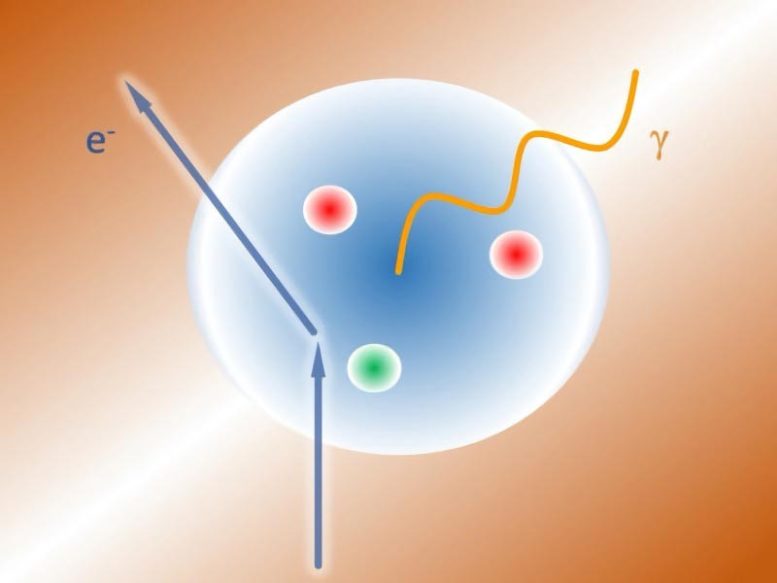
Probing the Proton with Virtual Compton Scattering
Nuclear physicists used a process called virtual Compton scattering to probe this distortion. This process starts with a carefully controlled beam of energetic electrons from Jefferson Lab’s Continuous Electron Beam Accelerator Facility, a DOE Office of Science user facility. The electrons are sent crashing into protons.
In virtual Compton scattering, electrons interact with other particles by emitting an energetic photon, or particle of light. The energy of the electron determines the energy of the photon it emits, which also determines how the photon interacts with other particles.
The Strong Nuclear Force (also called the strong force) is one of the four fundamental forces in nature (the others being gravity, the electromagnetic force, and the weak nuclear force). It is the strongest of the four, as its name suggests. However, it also has the shortest range, meaning that particles must be extremely close before its effects are felt. Its primary function is to hold together the subatomic particles of the nucleus (protons, which carry a positive charge, and neutrons, which carry no charge. These particles are collectively called nucleons).
Lower energy photons may bounce off the surface of the proton, while more energetic photons will blast inside the proton to interact with one of its quarks. Theory predicts that when these photon-quark interactions are plotted at from lower to higher energies, they will form a smooth curve.
The Unexpected Bump in Proton Polarizability
Nikos Sparveris, an associate professor of physics at Temple University and spokesperson for the experiment, said this simple picture didn’t hold up to scrutiny. The measurements instead revealed an as-yet-unexplained bump.
“What we see is that there is some local enhancement to the magnitude of the polarizability. The polarizability decreases as the energy increases as expected. And, at some point, it appears to be coming temporarily up again before it will go down,” he said. “Based on our current theoretical understanding, it should follow a very simple behavior. We see something that deviates from this simple behavior. And this is the fact that is puzzling us at the moment.”
The theory predicts that the more energetic electrons are more directly probing the strong force as it binds the quarks together to make the proton. This weird spike in the stiffness that nuclear physicists have now confirmed in the proton’s quarks signals that an unknown facet of the strong force may be at work.
“There is something that we’re clearly missing at this point. The proton is the only composite building block in nature that is stable. So, if we are missing something fundamental there, it has implications or consequences for all of physics,” Sparveris confirmed.
The physicists said that the next step is to further tease out the details of this anomaly and conduct precision probes to check for other points of deviation and to provide more information about the anomaly’s source.
“We want to measure more points at various energies to present a clearer picture and to see if there is any further structure there,” Li said.
Sparveris agreed.
“We also need to measure precisely the shape of this enhancement. The shape is important to further elucidating the theory,” he said.
Reference: “Measured proton electromagnetic structure deviates from theoretical predictions” by R. Li, N. Sparveris, H. Atac, M. K. Jones, M. Paolone, Z. Akbar, C. Ayerbe Gayoso, V. Berdnikov, D. Biswas, M. Boer, A. Camsonne, J.-P. Chen, M. Diefenthaler, B. Duran, D. Dutta, D. Gaskell, O. Hansen, F. Hauenstein, N. Heinrich, W. Henry, T. Horn, G. M. Huber, S. Jia, S. Joosten, A. Karki, S. J. D. Kay, V. Kumar, X. Li, W. B. Li, A. H. Liyanage, S. Malace, P. Markowitz, M. McCaughan, Z.-E. Meziani, H. Mkrtchyan, C. Morean, M. Muhoza, A. Narayan, B. Pasquini, M. Rehfuss, B. Sawatzky, G. R. Smith, A. Smith, R. Trotta, C. Yero, X. Zheng and J. Zhou, 19 October 2022, Nature.
DOI: 10.1038/s41586-022-05248-1
Never miss a breakthrough: Join the SciTechDaily newsletter.
Follow us on Google and Google News.
6 Comments
The interactions and balances of topological vortex fields cover all short-distance and long-distance contributions, and are the basis of the formation and evolution of cosmic matter. The material hierarchy and its interaction ways are vital for understanding proton structure. The physical phenomena we observe in scientific experiments are often not the whole picture of things, let alone the essence.
Maybe the displacement of space is a factor. When the density of the displacement increases the strong force increases. Can it be measured using one and minus one.
The result of this experiment that is crashing electron in to the proton to establish its internal composite structure is good and confirming.Bùt this simply is within scope of particle physìcs,related to the
descriptiòn of internal charm quark within proton by CERN.However,the complete facts arè hard to estabĺish by experiments.
This is really interesting science 💫 and thank you for this well written article. What will be the next?
The quark model has already been debunked in a government article called ‘The Successes and Failures of the Constituent Quark Model.’
It is more likely that protons are a geometrically stable, crystalline dense-pack structure of photons, AKA electron positron pairs. Matter has been made from photons in lab experiments.
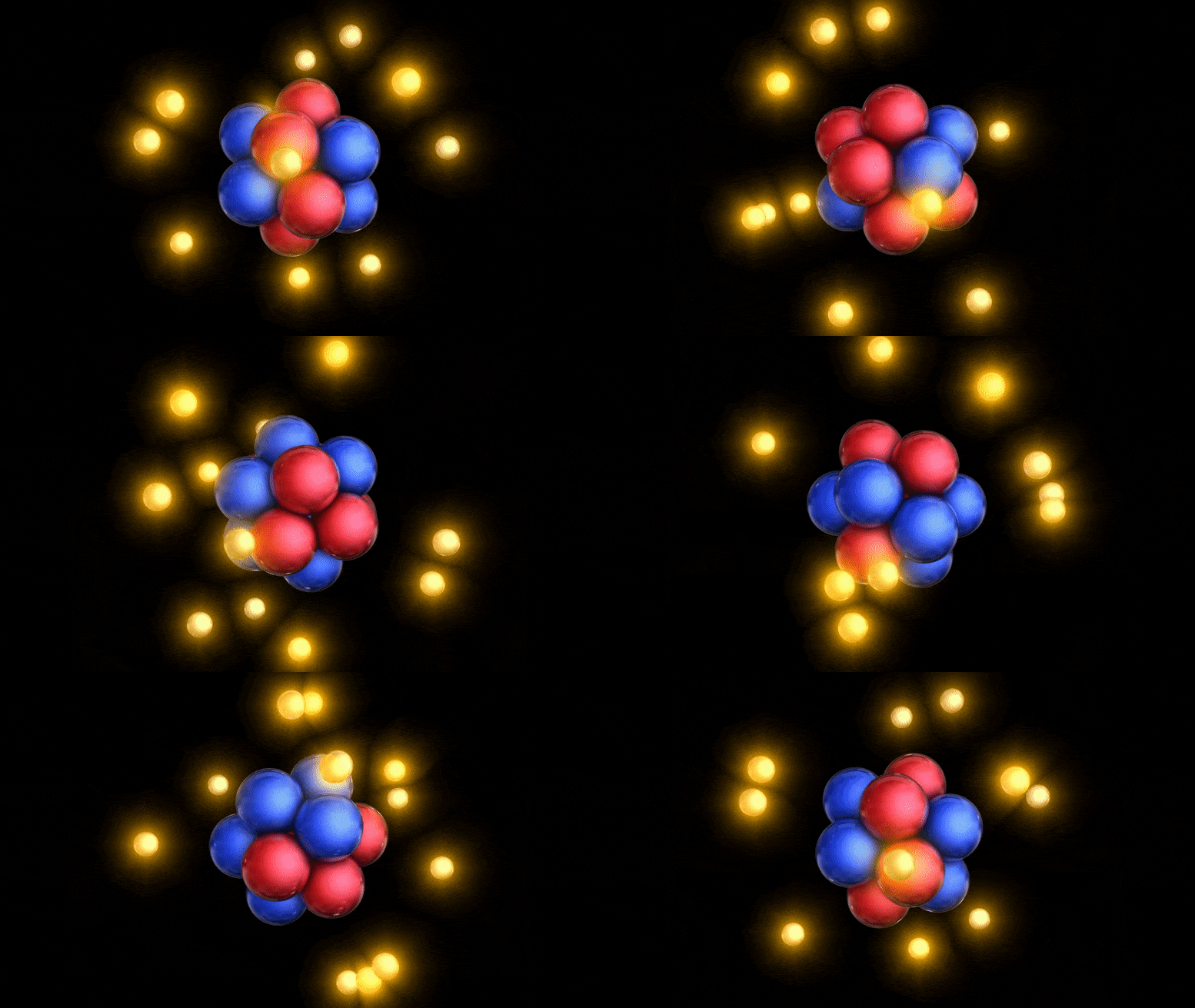
What does the atom animation have to do with the subject? It’s clearly an atom of mass A>20 showing neutrons and protons, but only one proton is probed here so H atom would be relevant.