
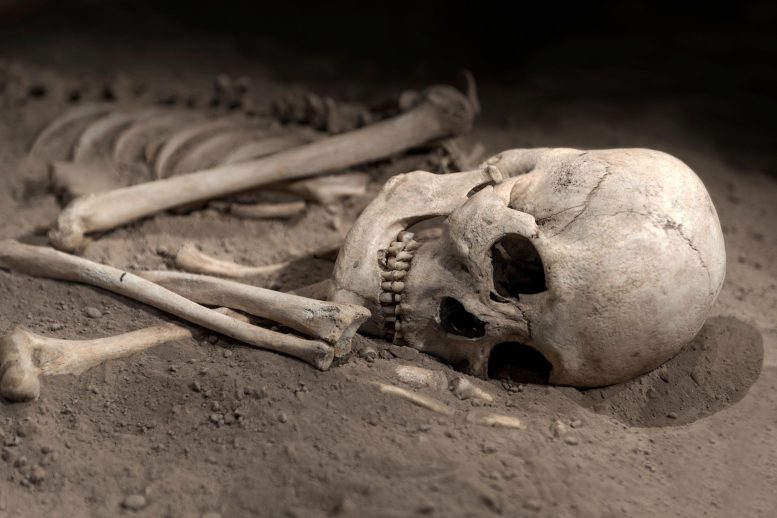
Ancient Indigenous people in Peru had a unique response to the looting and destruction of their ancestors’ graves during the European colonial period, an international team of archaeologists has discovered.
A study led by the University of East Anglia (UEA) found nearly 200 examples of human vertebrae threaded onto reed posts in the Chincha Valley, dating from AD 1450-1650. The period spanned the Inca rule and the start of the European colonization – a turbulent time of extensive famine and epidemics – that coincided with widespread desecration of Indigenous people’s graves by Europeans.
This distinctive treatment of the deceased has never before been documented in the region – although it’s not unlike rituals observed in other parts of the world, such as ancient Egypt.
Dr. Jacob L Bongers, an archaeologist from the Sainsbury Research Unit at UEA, is the lead author of the paper, ‘Assembling the dead: human vertebrae-on-posts in the Chincha Valley, Peru’. The study is published today in the journal Antiquity.
Indigenous Response to Colonialism
Andean peoples were known to have valued bodily integrity, Dr Bongers said, and the reconstruction of the dead may have been a way for Indigenous groups to restore the potency of their ancestors’ damaged remains.
Dr. Bongers said: “Our findings suggest that vertebrae-on-posts represent a direct, ritualized Indigenous response to European colonialism.”
Researchers discovered most of these reed post remains in large, elaborate Indigenous graves known as chullpas, hundreds of which are scattered throughout the region.
Radiocarbon dating suggests the threading of vertebrae onto reeds was done after the initial burial. People were returning to chullpas to reconstruct their dead, likely after they were damaged by looters.
Ultimately, the team discovered 192 examples of vertebrae-on-posts in the valley. In almost every case, each appears to have been made from the remains of a single individual. Adults and juveniles were selected for this practice.
Isotopic and ancient DNA analyses of the remains would yield insights into who was selected for the practice.
Significance of the Chincha Valley Findings
The Chincha Valley was home to the complex Chincha Kingdom from AD 1000-1400. They established an alliance with the Inca Empire and were eventually consolidated into it.
The arrival of Europeans precipitated a period of profound socio-political change. The Indigenous population declined catastrophically from more than 30,000 heads of household in 1533, to 979 in 1583.
Dr. Bongers, whose previous research documented hundreds of looted graves in the region, said: “Looting of Indigenous graves was widespread across the Chincha Valley in the Colonial period.
“Looting was primarily intended to remove grave goods made of gold and silver and would have gone hand-in-hand with European efforts to eradicate Indigenous religious practices and funerary customs.”
Bodily integrity after death was important to many Indigenous groups in the region. For instance, in Inca capacocha ceremonies, children were sometimes killed in non-bloody techniques, such as strangulation, drowning or live burial, so nothing ‘incomplete’ was offered to the sun.
The nearby Chinchorro people developed the first-known techniques for artificial mummification, millennia before ancient Egyptians. When mummies in the Andes were destroyed by Europeans, Indigenous people salvaged what they could to make new ritual objects.
Dr. Bongers said: “Ritual plays important roles in social and religious life, yet can become contested, especially during periods of conquest in which new power relationships become established.
“These finds reinforce how graves are one area where this conflict plays out.”
Broader Implications and Future Research
While there are strong indications that bodily reconstruction was in response to desecration by colonial invaders – supported by the fact that the threaded vertebrae were mostly found in graves that had been looted – there are many other plausible explanations that cannot be ruled out.
The threaded vertebrae may have been used to transport the remains of the dead to tombs, or as trophies or representations of status and power. They even may been used as ceremonial ‘rattles’, Dr. Bongers said.
“Overall, our research demonstrates that body parts continued to live social lives beyond biological death.
“We’re planning to carry out additional analyses to learn more about the identities of individuals whose vertebrae were strung on reed posts in the Chincha Valley.”
Reference: “Assembling the dead: human vertebrae-on-posts in the Chincha Valley, Peru” by Jacob L. Bongers, Juliana Gómez Mejía, Thomas K. Harper and Susanna Seidensticker, 2 February 2022, Antiquity.
DOI: 10.15184/aqy.2021.180
Never miss a breakthrough: Join the SciTechDaily newsletter.
Follow us on Google and Google News.
1 Comment
“Assembling the Dead: ‘Threaded Bone’ Rituals Restored Dignity After Looting of Indigenous Graves”
“There is something fascinating about science. One gets such wholesale returns of conjecture out of such a trifling investment of fact.” — Mark Twain