
Close Menu
    Facebook X (Twitter) Instagram
    SciTechDaily
    • Biology
    • Chemistry
    • Earth
    • Health
    • Physics
    • Science
    • Space
    • Technology
    Facebook X (Twitter) Pinterest YouTube RSS
    SciTechDaily
    Home»Earth»Stunning Satellite Image Shows Lava Burning a Path to the Sea From La Palma Volcano
    Earth

    Stunning Satellite Image Shows Lava Burning a Path to the Sea From La Palma Volcano

    By European Space Agency (ESA)October 4, 20211 Comment2 Mins Read
    Facebook Twitter Pinterest Telegram LinkedIn WhatsApp Email Reddit
    Share
    Facebook Twitter LinkedIn Pinterest Telegram Email Reddit
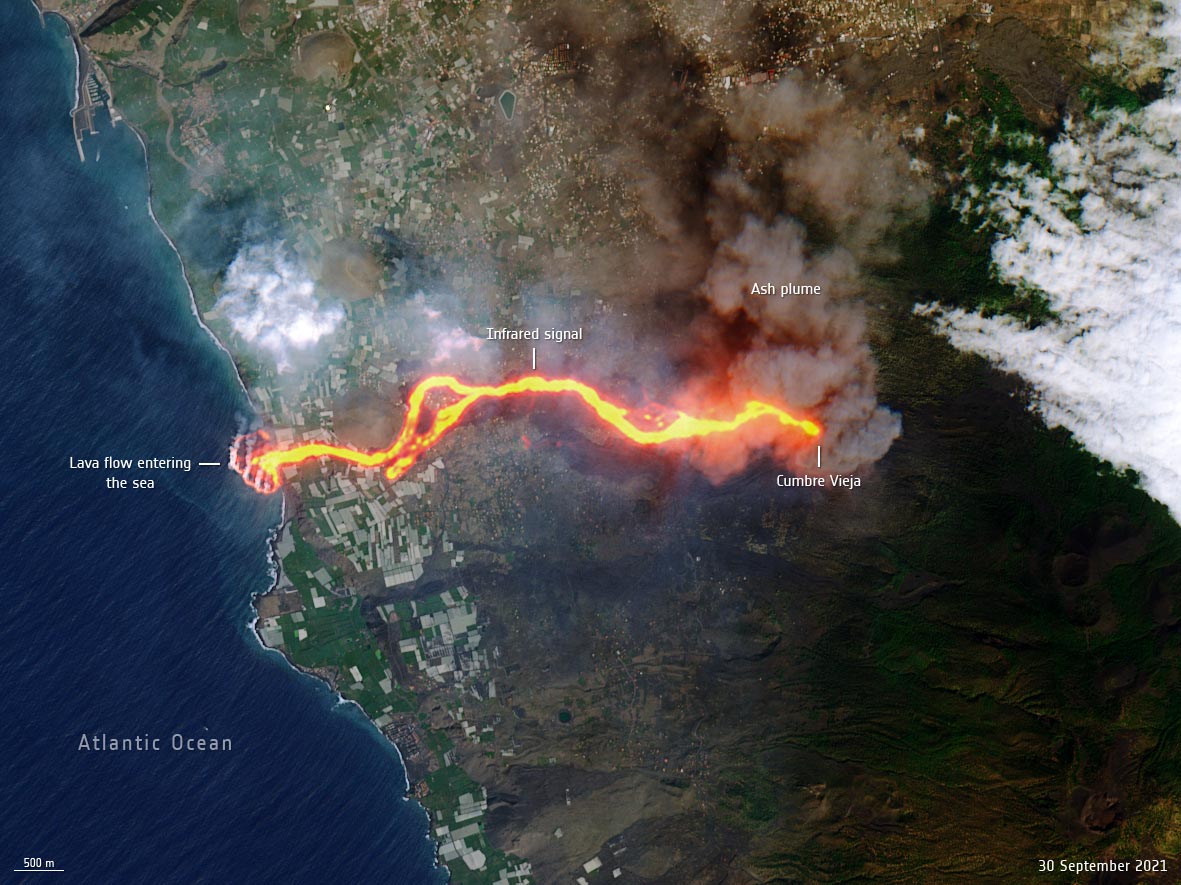
    La Palma Lava Flows Into the Sea
    Image of lava flow on the Spanish island of La Palma captured by the Copernicus Sentinel-2 mission on September 30, 2021. Credit: Contains modified Copernicus Sentinel data (2021), processed by ESA, CC BY-SA 3.0 IGO

    This image, captured by the Copernicus Sentinel-2 mission on September 30, 2021, shows the flow of lava from the volcano erupting on the Spanish island of La Palma. The cascade of lava can be seen spilling into the Atlantic Ocean, extending the size of the coastline. This ‘lava delta’ covered about 20 hectares (49 acres) when the image was taken.

    A crack opened in the Cumbre Vieja volcano on September 19, throwing plumes of ash and lava into the air. Lava flowed down the mountain and through villages engulfing everything in its path. By September 28, the 6-km (3.7-mi) lava flow had reached the ocean on the island’s west coast. Clouds of white steam were reported where the red-hot lava hit the water in the Playa Nueva area.

    This Sentinel-2 image has been processed in true color, using the shortwave infrared channel to highlight the lava flow. The Sentinel-2 mission is based on a constellation of two identical satellites, each carrying an innovative wide swath high-resolution multispectral imager with 13 spectral bands for monitoring changes in Earth’s land and vegetation.
    Cumbre Vieja Volcano on La Palma
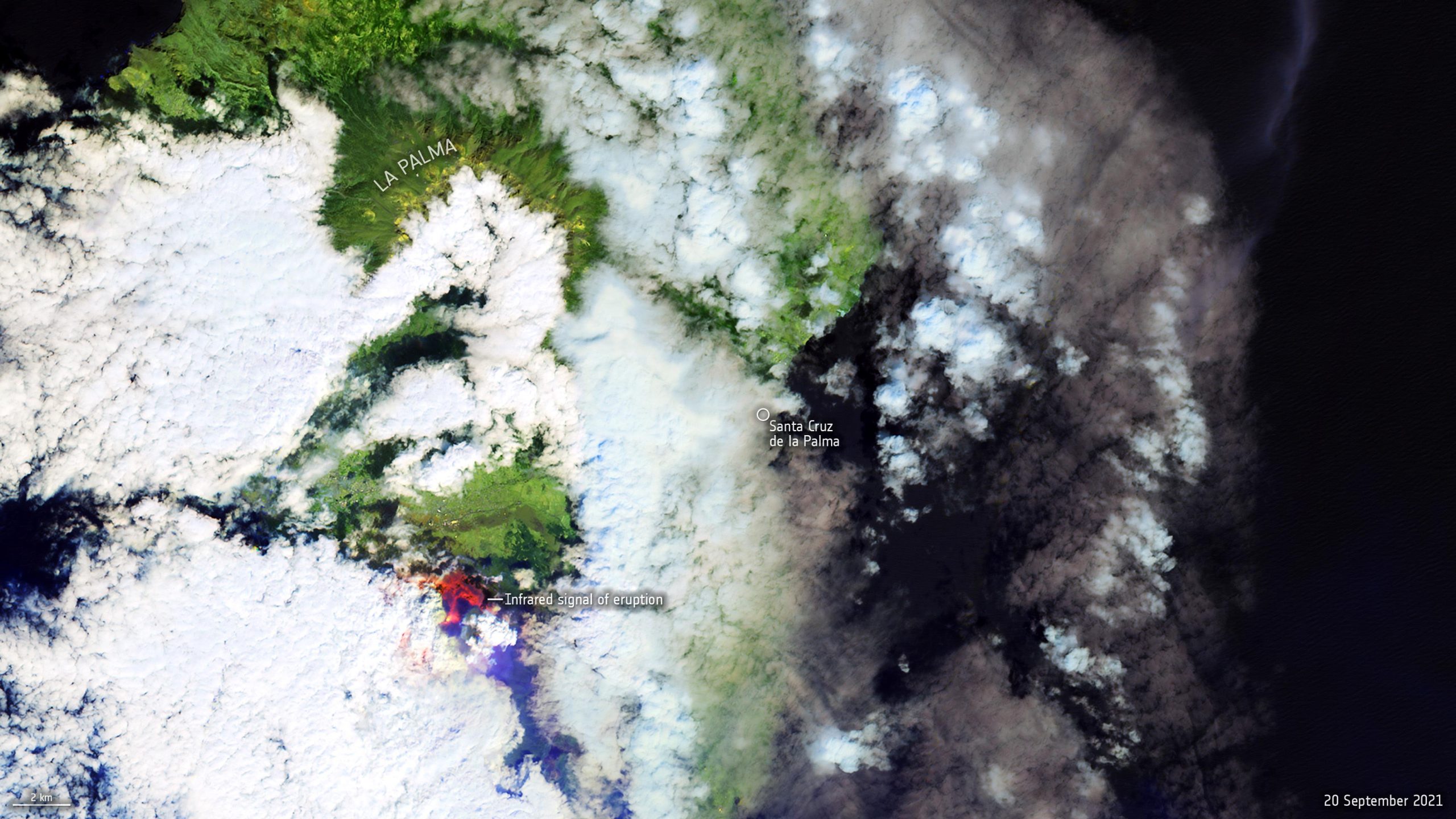
    Image of the Cumbre Vieja volcano on the Spanish Canary Island of La Palma captured by the Copernicus Sentinel-2 mission on September 20, 2021. Credit: Contains modified Copernicus Sentinel data (2021), processed by ESA, CC BY-SA 3.0 IGO

    In the image above, the Copernicus Sentinel-2 mission shows us a cloudy view of the Cumbre Vieja volcano on the Spanish Canary Island of La Palma. The volcano started erupting on September 19 after days of small tremors.

    The image, captured on September 20, 2021, has been processed using the mission’s shortwave-infrared band to show the ongoing activity in the volcano.

    Never miss a breakthrough: Join the SciTechDaily newsletter.
    Follow us on Google and Google News.

    European Space Agency Geography Popular Volcano
    Share. Facebook Twitter Pinterest LinkedIn Email Reddit

    Related Articles

    Mount Etna’s Fiery Fury: Lava and Ash Eruption Towers Over Sicily

    Stunning Photo Captured From Space: New Eruption at Krakatoa Volcano

    A Wolf Awakens in the Galápagos Islands at Night

    Seen From Space: Ever Given Container Ship Wedged in the Suez Canal – and the Resulting Traffic Jam

    Earth From Space: Awe-Inspiring Vatnajökull, Iceland [Video]

    Earth From Space: Great Rift Valley, Kenya – Shaped by Major Tectonic and Volcanic Activity

    Earth From Space: An Incredible View of Abu Dhabi

    Vast Mineral Deposits in the Atacama Desert Seen From Space

    Taal Volcano in the Philippines Erupted – See the Incredible Satellite View

    1 Comment

    1. Joseph on October 22, 2023 10:38 am

      This is really çool and educational, the pictures are awesome as well.

      Reply
    Leave A Reply Cancel Reply

    • Facebook
    • Twitter
    • Pinterest
    • YouTube

    Don't Miss a Discovery

    Subscribe for the Latest in Science & Tech!

    Trending News

    This Experimental Drug Repaired the Gut and Reversed Severe Fatty Liver Disease

    Physicists Just Turned a Black Hole Energy Theory Into Reality

    Stanford Scientists Solve a 252-Million-Year-Old Mass Extinction Mystery

    The Ancient Survival Mechanism Making Weight Loss So Difficult

    Just 3,000 Steps a Day May Help Protect the Brain From Alzheimer’s

    “Weird Clams” Reveal a New Invasion Along the U.S. Northeast Coast

    Archaeologists Decapitated Tutankhamun and Glued His Body Back Together

    New Black Hole Theory Solves a 50-Year-Old Problem

    Follow SciTechDaily
    • Facebook
    • Twitter
    • YouTube
    • Pinterest
    • Newsletter
    • RSS
    SciTech News
    • Biology News
    • Chemistry News
    • Earth News
    • Health News
    • Physics News
    • Science News
    • Space News
    • Technology News
    Recent Posts
    • Scientists Discover Why Teenage Memories Can Become Temporarily Inaccessible
    • Scientists Let Nature Take Over a Former Crop Field. The Results Were Remarkable
    • Scientists Name Bizarre New Beetle Genus After Popular Anime Character Luffy
    • New Tool Supercharges Immunotherapy Against Prostate Cancer
    • A Single Human Neuron Is Far More Powerful Than Scientists Thought
    Copyright © 1998 - 2026 SciTechDaily. All Rights Reserved.
    • Science News
    • About
    • Contact
    • Editorial Board
    • Privacy Policy
    • Terms of Use

    Type above and press Enter to search. Press Esc to cancel.