
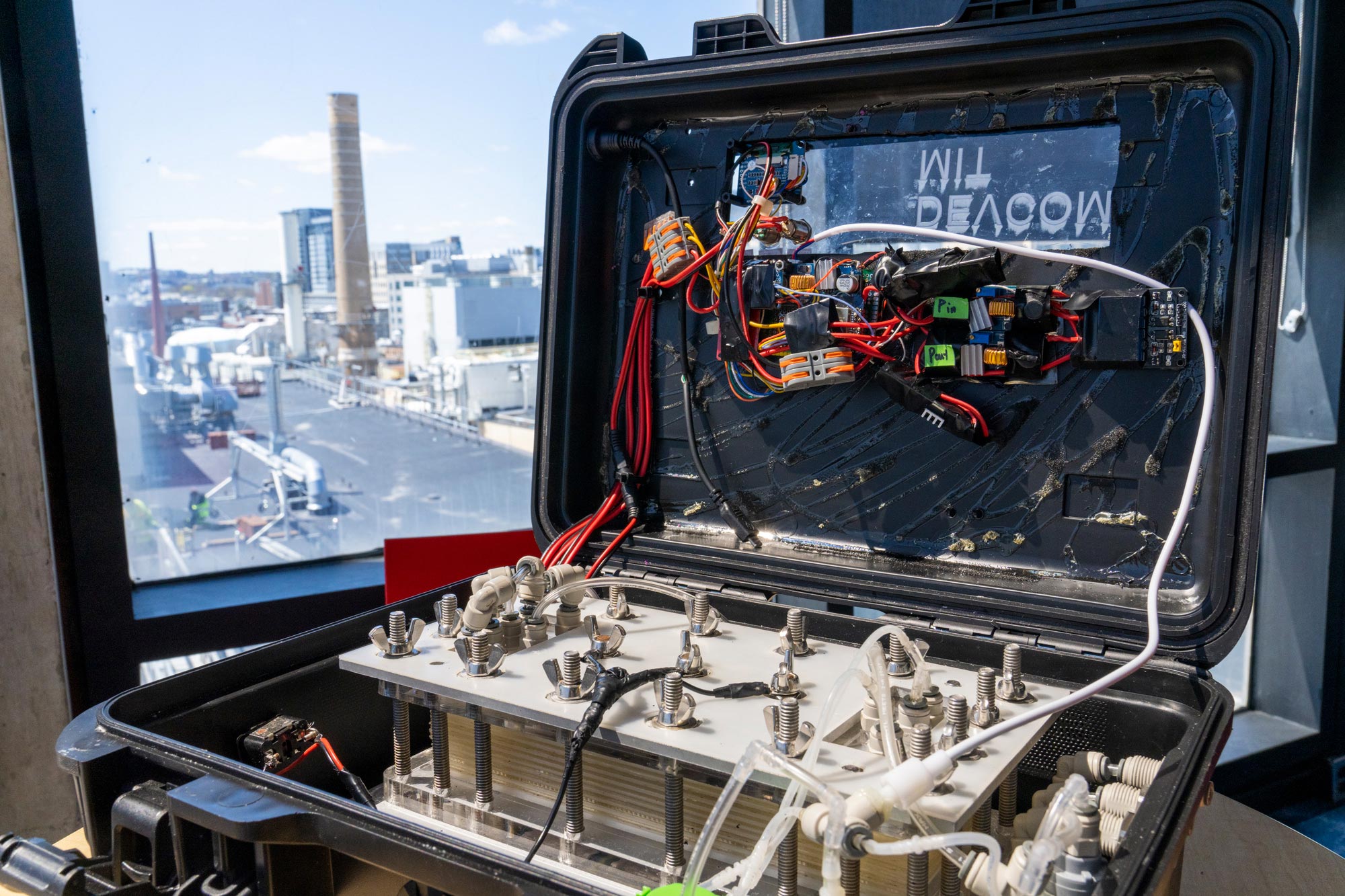
Researchers build a portable desalination unit that generates clear, clean drinking water without the need for filters or high-pressure pumps.
MIT researchers have developed a portable desalination unit, weighing less than 10 kilograms (22 pounds), that can remove particles and salts to generate fresh drinking water.
The device, which is about the size of a suitcase, needs less power to operate than a cell phone charger. It can also be driven by a small, portable solar panel, which can be purchased online for around $50. It automatically generates drinking water that exceeds World Health Organization (WHO) quality standards. The technology is packaged into a user-friendly device that runs with the push of a single button.
Unlike other portable desalination devices that require water to pass through filters, this unit utilizes electrical power to remove particles from drinking water. Eliminating the need for replacement filters significantly reduces the long-term maintenance requirements.
This could enable the unit to be deployed in remote and severely resource-limited areas, such as communities on small islands or aboard seafaring cargo ships. It could also be used to aid refugees fleeing natural disasters or by soldiers carrying out long-term military operations.
“This is really the culmination of a 10-year journey that I and my group have been on. We worked for years on the physics behind individual desalination processes, but pushing all those advances into a box, building a system, and demonstrating it in the ocean, that was a really meaningful and rewarding experience for me,” says senior author Jongyoon Han, a professor of electrical engineering and computer science and of biological engineering, and a member of the Research Laboratory of Electronics (RLE).
Joining Han on the paper are first author Junghyo Yoon, a research scientist in RLE; Hyukjin J. Kwon, a former postdoc; SungKu Kang, a postdoc at Northeastern University; and Eric Brack of the U.S. Army Combat Capabilities Development Command (DEVCOM). The research has been published online in the journal Environmental Science and Technology.
Filter-Free Technology
Commercially available portable desalination units typically require high-pressure pumps to push water through filters, which are very difficult to miniaturize without compromising the energy-efficiency of the device, explains Yoon.
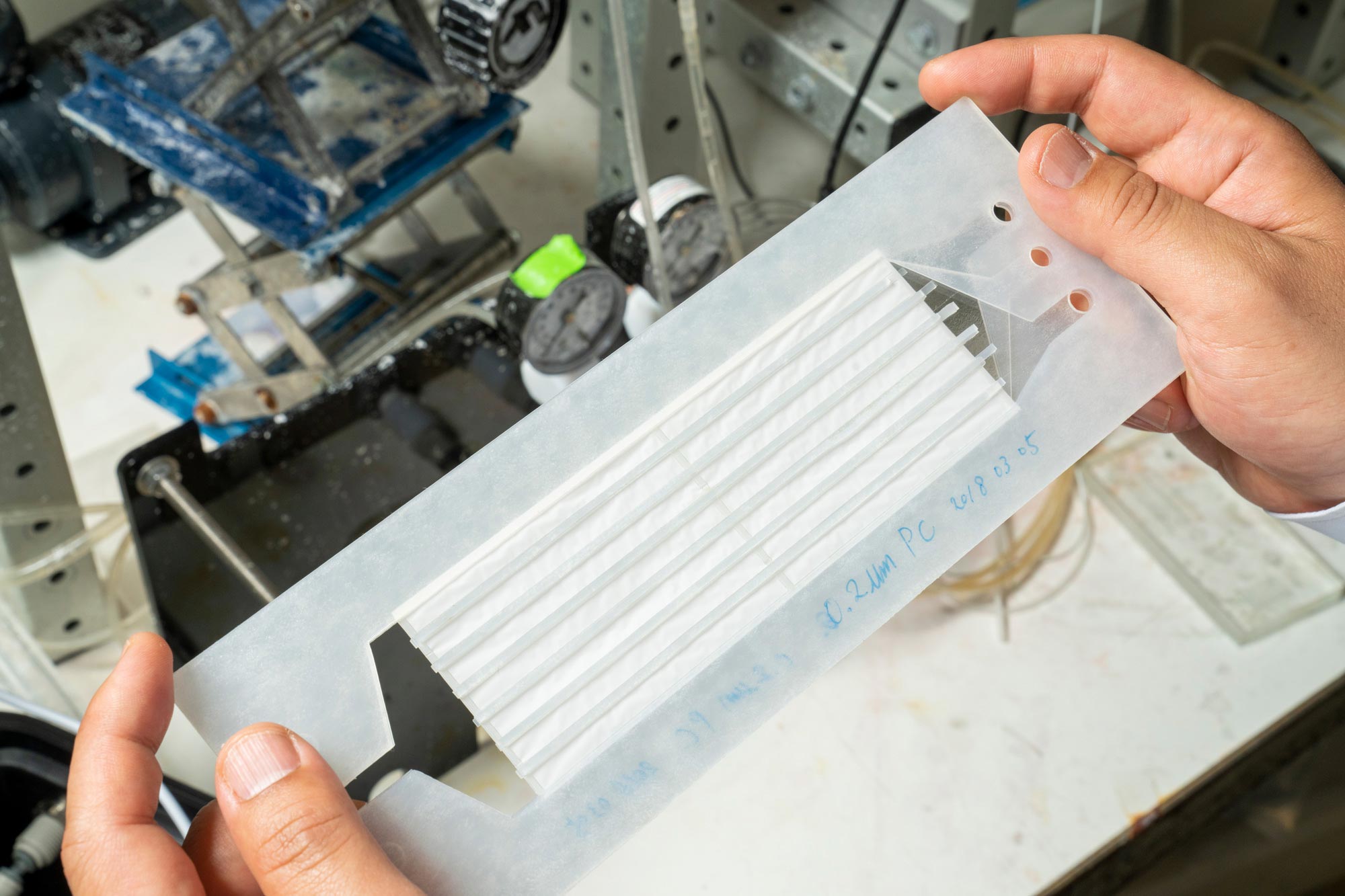
Instead, their unit relies on a technique called ion concentration polarization (ICP), which was pioneered by Han’s group more than 10 years ago. Rather than filtering water, the ICP process applies an electrical field to membranes placed above and below a channel of water. The membranes repel positively or negatively charged particles — including salt molecules, bacteria, and viruses — as they flow past. The charged particles are funneled into a second stream of water that is eventually discharged.
The process removes both dissolved and suspended solids, allowing clean water to pass through the channel. Since it only requires a low-pressure pump, ICP uses less energy than other techniques.

But ICP does not always remove all the salts floating in the middle of the channel. So the researchers incorporated a second process, known as electrodialysis, to remove remaining salt ions.
Yoon and Kang used machine learning to find the ideal combination of ICP and electrodialysis modules. The optimal setup includes a two-stage ICP process, with water flowing through six modules in the first stage then through three in the second stage, followed by a single electrodialysis process. This minimized energy usage while ensuring the process remains self-cleaning.
“While it is true that some charged particles could be captured on the ion exchange membrane, if they get trapped, we just reverse the polarity of the electric field and the charged particles can be easily removed,” Yoon explains.
They shrunk and stacked the ICP and electrodialysis modules to improve their energy efficiency and enable them to fit inside a portable device. The researchers designed the device for nonexperts, with just one button to launch the automatic desalination and purification process. Once the salinity level and the number of particles decrease to specific thresholds, the device notifies the user that the water is drinkable.
The researchers also created a smartphone app that can control the unit wirelessly and report real-time data on power consumption and water salinity.
Beach Tests
After running lab experiments using water with different salinity and turbidity (cloudiness) levels, they field-tested the device at Boston’s Carson Beach.
Yoon and Kwon set the box near the shore and tossed the feed tube into the water. In about half an hour, the device had filled a plastic drinking cup with clear, drinkable water.

“It was successful even in its first run, which was quite exciting and surprising. But I think the main reason we were successful is the accumulation of all these little advances that we made along the way,” Han says.
The resulting water exceeded World Health Organization quality guidelines, and the unit reduced the amount of suspended solids by at least a factor of 10. Their prototype generates drinking water at a rate of 0.3 liters per hour, and requires only 20 watts of power per liter.
“Right now, we are pushing our research to scale up that production rate,” Yoon says.
One of the biggest challenges of designing the portable system was engineering an intuitive device that could be used by anyone, Han says.
Yoon hopes to make the device more user-friendly and improve its energy efficiency and production rate through a startup he plans to launch to commercialize the technology.
In the lab, Han wants to apply the lessons he’s learned over the past decade to water-quality issues that go beyond desalination, such as rapidly detecting contaminants in drinking water.
“This is definitely an exciting project, and I am proud of the progress we have made so far, but there is still a lot of work to do,” he says.
For example, while the “development of portable systems using electro-membrane processes is an original and exciting direction in off-grid, small-scale desalination,” the effects of fouling, especially if the water has high turbidity, could significantly increase maintenance requirements and energy costs, notes Nidal Hilal, professor of engineering and director of the New York University Abu Dhabi Water research center, who was not involved with this research.
“Another limitation is the use of expensive materials,” he adds. “It would be interesting to see similar systems with low-cost materials in place.”
Reference: “Portable Seawater Desalination System for Generating Drinkable Water in Remote Locations” by Junghyo Yoon, Hyukjin J. Kwon, SungKu Kang, Eric Brack and Jongyoon Han, 14 April 2022, Environmental Science and Technology.
DOI: 10.1021/acs.est.1c08466
The research was funded, in part, by the DEVCOM Soldier Center, the Abdul Latif Jameel Water and Food Systems Lab (J-WAFS), the Experimental AI Postdoc Fellowship Program of Northeastern University, and the Roux AI Institute.
Never miss a breakthrough: Join the SciTechDaily newsletter.
Follow us on Google and Google News.
17 Comments
What a game changer! This could help so may people with water issues throughout Asia, Africa, centeral and sout america. THIS needs investment!
… it is a question how efficient it is, and with that in mind then one can bring the scale and try to make it big, and then the deserts will be thing of the past. Perhaps…
Wouldent a distillation process do the same thing ? I’m not discounting this at all, I just don’t understand it one bit and there is a lack of resources for someone to learn how this works, unless I looked over something here there isn’t a mention of how to reproduce this, just a vauage overview of the process (that makes zero sense to me). This is great and all, but being able to reproduce it myself at home is going to be much more valuable than something where I don’t even know where to start. Makes me want to break out my lab equipment and test if I can purify saltwater myself though, and if done under vaccume could be done quicker? and at lower temperature! I confirmed that distilling alcohol under a vaccume can be done at much lower temperature that if done at regular atmospheric pressure. 20 degrees lower if I remember correctly. Funny how something that simple isn’t mentioned anywhere on the internet’s. Perhaps because it’s too simple and everyone knows already? Doubtful.. perhaps I should YouTube it and write an article? Would anyone be interested?
You can buy a desalination unit for a boat that does 65L/h @ 600W. This unit seems to be about 1/10th as efficient?
These jokers are just ripping off Magna Imperio’s Electro Nano Diffusion tech. IP lawsuits are expensive, Petunia.
60 watts is not a measure of total power. 60 watts for 3 hours is 180 watt-hours for a liter of water. Surely the author knows the difference.
I think it must’ve taken 20 watts for one hour. That’s 20 watt hours, which would be respectable for 8 oz (-250ml), 80WH/l.
I love the very cool video of the professor at Carson beach!!
The video states clearly: 20 watts for one hour for 250 ml. That is 80WH/l.
This desalination device is a blessing and a curse. One scenario improves the chance for the lesser educated to sustain life. The other situation allows us to foolishly consume/abuse the supply/demand philosophy. How can it be policed or taxed?
When can I purchase this awesome machine?
Fresh water is critical but any solution’s on leftover salt content? that’s a problem too
Believe in technology, it will supply the answers to all your questions and problems. Take nuclear fusion for example.
If we tap into sea for its water , we must understand that interfering with nature’s own reason for supporting d vast marine life would be catastrophic consequence to all living beings. Do not work against natural laws but rather find other solutions , take leafet from Sadguru who has brilliant ideas how to enhance and increase our rain catchment areas and how to preserve and increase our natural water supply , stop the massive deforestation for greed preserve these areas fir Humanity’s sake. Plant more trees . Yes d biggest factor is to compulsory reduce our uncontrolled expansion human birth population . Here us d starting point get this right , d demand for natural resources will diminish.save our planet by adding to it and not extracting from it , here in lies d solution . Thnk you
Fill lake Mead. Please use the invention to fill lake Mead. We are desperate.
It’s nice to read about this but it’s just another in a long series of articles about a proof of concept from extensive research that we never heard about again. Look at the long list of other articles here that are just like this. Trials in a Africa, scientists starting businesses … and THEN what? They all go into a black hole and disappear. What’s THAT story?
Great. Now we can all sit on 5he beach with a big ole straw in our hands waiting to drink that water up too! I agree with Dan Naidu and Sadguru on all points. Putting a bandaid on using up our only world’s resources by too much consumerism by too many people is not going to SAVE anyone or anything! Plant Trees!!! Stop using and consuming and tearing down. Slow the birth rate, ration everything. Destruction in the name of construction is not CONSTRUCTIVE!
Yes to all who abuse mother Earth of its fascinating supplies of water and oxygen. Greed of humanity will end drastically. Learn from the past history events. Quit repeating it. Tearing down trees for cows and farming. Insane actions to nature. Tesla was right to want to give free electricity, politicians and banks only wanted money or taxes. Shame on the human race to destroy nature’s free viable offerings. The day of reckoning is here not near.