
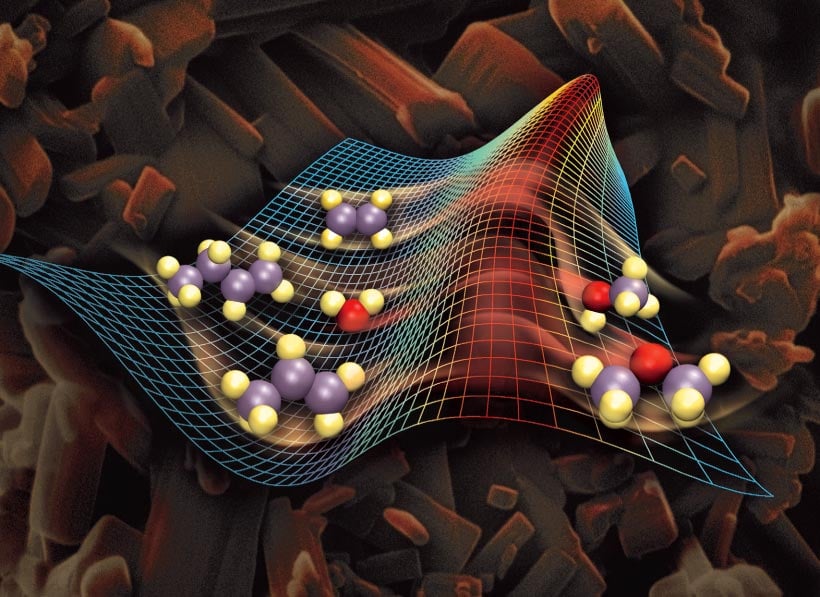
In chemistry, a catalyst is a substance that increases the rate of a chemical reaction without being consumed in the process. Catalysts work by providing an alternative pathway for the reaction to occur that requires less energy, which lowers the activation energy required for the reaction to proceed. As a result, the reaction can occur more quickly and/or at a lower temperature than it would without the catalyst.
What Are Catalysts?
A catalyst is a substance that speeds up a chemical reaction, or lowers the temperature or pressure needed to start one, without itself being consumed during the reaction. Catalysis is the process of adding a catalyst to facilitate a reaction.
During a chemical reaction, the bonds between the atoms in molecules are broken, rearranged, and rebuilt, recombining the atoms into new molecules. Catalysts make this process more efficient by lowering the activation energy, which is the energy barrier that must be surmounted for a chemical reaction to occur. As a result, catalysts make it easier for atoms to break and form chemical bonds to produce new combinations and new substances.
Using catalysts leads to faster, more energy-efficient chemical reactions. Catalysts also have a key property called selectivity, by which they can direct a reaction to increase the amount of desired product and reduce the amount of unwanted byproducts. They can produce entirely new materials with entirely new potential uses.
Over the past several decades, scientists have developed increasingly specialized catalysts for essential real-world applications. In particular, powerful catalysts have transformed the chemical industry. These advances have led to biodegradable plastics, new pharmaceuticals, and environmentally safer fuels and fertilizers.
Fast Facts
- Humans have been using catalysts for thousands of years. For example, the yeast we use to make bread contains enzymes, which are natural catalysts that aid the conversion of flour into bread.
- The 2005 Nobel Prize in Chemistry was awarded to three researchers (Yves Chauvin, Robert H. Grubbs, and Richard R. Schrock) for their work on metathesis catalysts. Drs. Grubbs and Schrock were funded in part by DOE for their Nobel-Prize research. Dr. Schrock continues to be funded by DOE.
- The 2018 Nobel Prize in Chemistry was awarded to Frances H. Arnold for her pioneering work to direct the evolution of enzymes for applications such as renewable fuels that are environmentally harmless. She is funded in part by DOE.
- Visit Argonne National Lab for seven more things you may not know about catalysis.
DOE Office of Science: Contributions to Catalyst Research
The Department of Energy (DOE) Office of Science Basic Energy Sciences program actively supports basic research on catalysts. DOE focuses on the design of new catalysts and on the use of catalysts to control chemical transformations at the molecular and sub-molecular levels. DOE research emphasizes understanding these reactions and how to make them more efficient and targeted. DOE’s overarching goal is to develop new concepts in catalysis and new catalysts to help industry produce fuels and chemicals from fossil and renewable raw materials more efficiently and sustainably. This research is helping advance solar fuels, which are fuels companies make using the sun and common chemicals like carbon dioxide and nitrogen. This research is also creating advanced methods for transforming discarded plastic into new products.
Never miss a breakthrough: Join the SciTechDaily newsletter.
Follow us on Google and Google News.