

Close Menu
    Facebook X (Twitter) Instagram
    SciTechDaily
    • Biology
    • Chemistry
    • Earth
    • Health
    • Physics
    • Science
    • Space
    • Technology
    Facebook X (Twitter) Pinterest YouTube RSS
    SciTechDaily
    Home»Science»Groundbreaking New System Provides Never-Before-Seen Images of the Brain
    Science

    Groundbreaking New System Provides Never-Before-Seen Images of the Brain

    By Society of Nuclear Medicine and Molecular ImagingJune 19, 2024No Comments5 Mins Read
    Facebook Twitter Pinterest Telegram LinkedIn WhatsApp Email Reddit
    Share
    Facebook Twitter LinkedIn Pinterest Telegram Email Reddit
    Human Brain Anatomy Illustration
    The NeuroEXPLORER, an advanced brain PET system, showcased at the 2024 Society of Nuclear Medicine and Molecular Imaging (SNMMI) Annual Meeting, delivers unprecedented image quality and resolution, highlighting its capacity to enhance the diagnosis and treatment of brain diseases. This system, recognized with the 2024 SNMMI Henry N. Wagner, Jr., Image of the Year award, promises significant advancements in neuroscience research and clinical applications.

    A new ultra-high-performance brain PET system allows for the direct measurement of brain nuclei as never before seen or quantified. With its ultra-high sensitivity and resolution, the NeuroEXPLORER provides exceptional brain PET images and has the potential to spur advances in the treatment of many brain diseases. This research was presented at the 2024 Society of Nuclear Medicine and Molecular Imaging (SNMMI) Annual Meeting, and the grouping of images highlighting targeted tracer uptake in specific brain nuclei has been selected as the 2024 SNMMI Henry N. Wagner, Jr., Image of the Year.

    Each year, SNMMI chooses an image that best exemplifies the most promising advances in the field of nuclear medicine and molecular imaging. The state-of-the-art technologies captured in these images demonstrate the capacity to improve patient care by detecting disease, aiding diagnosis, improving clinical confidence, and providing a means of selecting appropriate treatments. This year, the SNMMI Image of the Year was chosen from more than 1,500 abstracts submitted for the meeting.

    Design and Capabilities of NeuroEXPLORER

    The image quality of PET systems has improved in recent years, mostly by increases in sensitivity, including enhanced time-of-flight capabilities. However, these systems have shown only minimal improvement in intrinsic resolution. To address these issues, researchers designed the NeuroEXPLORER PET scanner with a focus on ultra-high sensitivity and resolution, as well as continuous head motion correction.
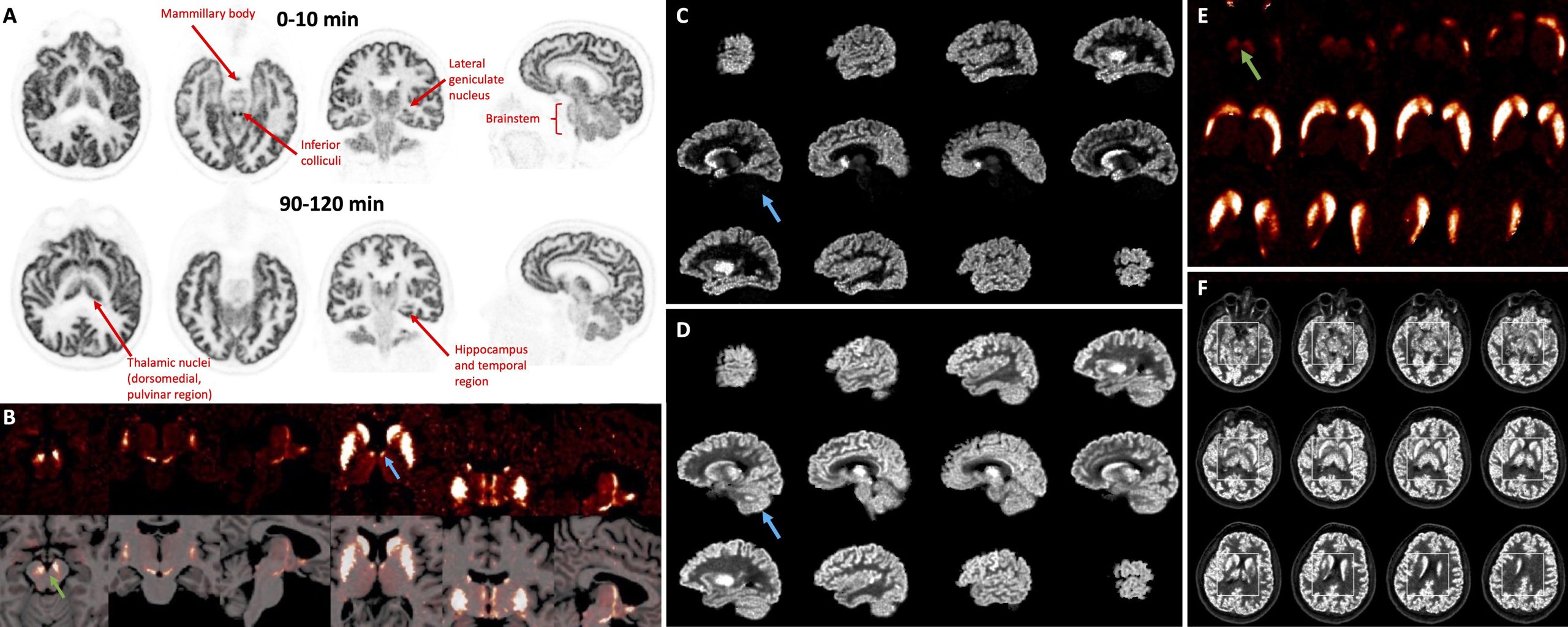
    Ultra High Resolution PET Provides Never Before Seen Images of the Brain
    Figure 1. A. 18F-SynVesT-1 images at early (0-10) and late (90-120 minute) times postinjection. There is clear identification of high flow regions in the early images. The late images show the synaptic (SV2A) pattern which differs from the flow pattern, e.g., in the thalamus. B. 11C-PHNO binding potential (BPND) images shown in transverse, coronal, and sagittal orientations of PET alone and PET overlaid with MRI. Left: Region of substantia nigra (green arrow, max display: 4.0). Right: Thalamic region (max: 2.5) showing focal bilateral binding in a specific thalamic nucleus (blue arrow, likely anteroventral nucleus). C. Sagittal images of 11C-LSN3172176 M1 muscarinic cholinergic BPND (max display: 10). D. R1 images of the same tracer (max: 2). Cerebellum (blue arrow) shows no specific binding (C) and high tracer delivery (D). E. 18F-FE-PE2I dopamine transporter BPND images (zoomed, max display: 6) showing striatum and substantia nigra (green arrow). F. R1 images of the same tracer (max: 2) with inset showing zoomed region in E. Credit: Images created by Richard E. Carson, et al., Yale University, New Haven, CT

    In the study, researchers conducted human brain imaging with both the NeuroEXPLORER and the High Resolution Research Tomograph, or HRRT (the previous state-of-the-art imaging tool). Multiple targeted radiopharmaceuticals were administered to observe synaptic density, dopamine receptors and transporters, muscarinic cholinergic receptors, and glutamate receptors. Images from both scanners were then compared.

    A striking improvement in image contrast and quality of the NeuroEXPLORER compared to the HRRT was evident. NeuroEXPLORER images demonstrated low noise and exquisite resolution, showing focal uptake in specific brain nuclei.

    Testimonials and Future Potential

    “The high resolution of NeuroEXPLORER images is due to the system’s unique detector design and exceptional sensitivity produced by its long axial field-of-view,” said Richard E. Carson, PhD, professor of Biomedical Engineering and of Radiology and Biomedical Imaging and Emeritus director of the PET Center at Yale University in New Haven, Connecticut. “This technology will provide the opportunity for advanced research on all types of neuronal molecular and functional activity.”

    “The dramatic improvement in resolution and overall quality of the NeuroEXPLORER images compared to the HRRT images is clear,” noted SNMMI Scientific Program Committee chair Heather Jacene, MD. “The NeuroEXPLORER has the potential to be a game-changer in research for conditions such as Alzheimer’s disease, Parkinson’s disease, epilepsy, and mental illnesses.”

    Reference: “Exceptional Brain PET Images from the NeuroEXPLORER: Scans with Targeted Radiopharmaceuticals and Comparison to HRRT” by Richard Carson, Jean-Dominique Gallezot, Takuya Toyonaga, Tommaso Volpi, Nikkita Khattar, Mika Naganawa, Praveen Honhar, Tianyi Zeng, Kathryn Fontaine, Tim Mulnix, Shannan Henry, David Matuskey, Rajiv Radhakrishnan, Nabeel Nabulsi, Yiyun Huang, Ramsey Badawi, Simon Cherry, Ansel Hillmer, Terry Jones, Chi Liu, Evan Morris, Jinyi Qi and Hongdi Li, 9 June 2024, Society of Nuclear Medicine and Molecular Imaging Annual Meeting.

    The NeuroEXPLORER scanner was built as a collaboration with Yale University, University of California, Davis, and United Imaging Healthcare of America, and was funded by a National Institutes of Health Brain Initiative grant. While the NeuroEXPLORER is currently used for research purposes, Carson and colleagues hope that once the excellent image quality is recognized by physicians it will become available for clinical use.

    Never miss a breakthrough: Join the SciTechDaily newsletter.
    Follow us on Google and Google News.

    Brain Imaging Neuroscience
    Share. Facebook Twitter Pinterest LinkedIn Email Reddit

    Related Articles

    Revolutionary Microscope Unveils the Brain’s Deepest Secrets

    SynapShot Unveiled: Observing the Processes of Memory and Cognition in Real Time

    How the Brain Changes During Depression Treatment

    Study of Mice Watching Movies Reveals Brain Circuit That Ensures Vision Remains Reliable

    Researchers Use FDDNP–PET Scanning to Predict Cognitive Decline

    Listening to Mozart Can Make You Smarter but No More Than Justin Bieber

    MIT Neuroscientists Research Brain Activity Related to Face Recognition

    Neuroscientists Predict Which Parts of the Fusiform Gyrus are Face-Selective

    Be Like Neo and Learn New Skills Matrix-Style

    Leave A Reply Cancel Reply

    • Facebook
    • Twitter
    • Pinterest
    • YouTube

    Don't Miss a Discovery

    Subscribe for the Latest in Science & Tech!

    Trending News

    Bone-Strengthening Discovery Could Reverse Osteoporosis

    Scientists Uncover Hidden Trigger Behind Stem Cell Aging

    Scientists Find Way to Reverse Fatty Liver Disease Without Changing Diet

    Could Humans Regrow Limbs? New Study Reveals Promising Genetic Pathway

    Scientists Reveal Eating Fruits and Vegetables May Increase Your Risk of Lung Cancer

    Scientists Reverse Brain Aging With Simple Nasal Spray

    Scientists Uncover Potential Brain Risks of Popular Fish Oil Supplements

    Scientists Discover a Surprising Way To Make Bread Healthier and More Nutritious

    Follow SciTechDaily
    • Facebook
    • Twitter
    • YouTube
    • Pinterest
    • Newsletter
    • RSS
    SciTech News
    • Biology News
    • Chemistry News
    • Earth News
    • Health News
    • Physics News
    • Science News
    • Space News
    • Technology News
    Recent Posts
    • Revolutionary Technique Sends Healthy Mitochondria Exactly Where They’re Needed
    • This Student Recreated the Universe in a Bottle. What She Discovered Could Help Reveal How Life Started on Earth
    • Alzheimer’s Symptoms May Start Outside the Brain, Study Finds
    • Cancer’s Secret Weapon? Scientists Reveal How Tumors “Learn” To Survive Treatment
    • Millions Take This Popular Supplement – Scientists Discover a Concerning Link to Heart Failure
    Copyright © 1998 - 2026 SciTechDaily. All Rights Reserved.
    • Science News
    • About
    • Contact
    • Editorial Board
    • Privacy Policy
    • Terms of Use

    Type above and press Enter to search. Press Esc to cancel.