
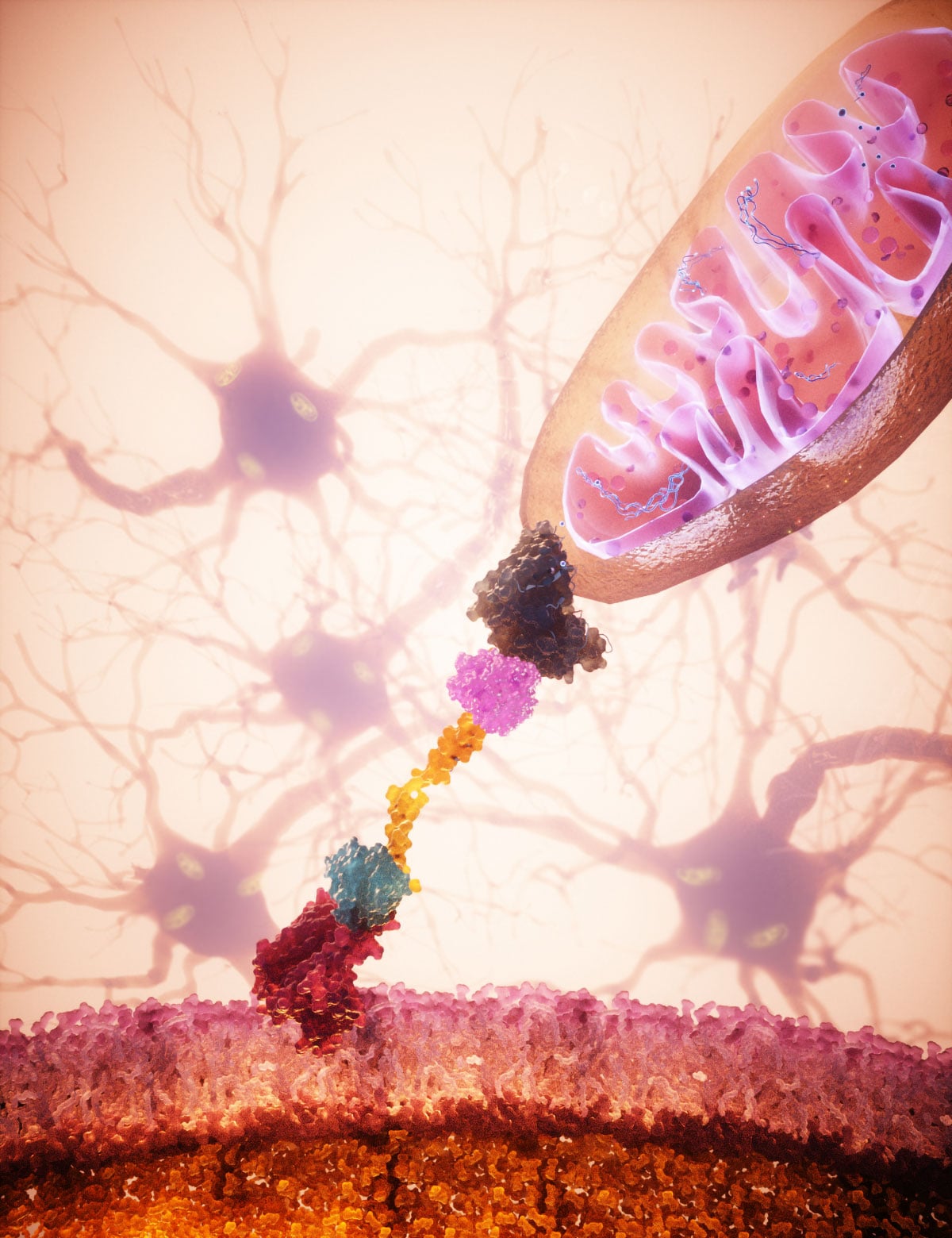
A novel method for directing mitochondria to specific cells could reshape how scientists approach diseases driven by cellular dysfunction.
Scientists have unveiled a new way to deliver one of the cell’s most vital components exactly where it is needed. Led by Botond Roska at the Institute of Molecular and Clinical Ophthalmology Basel (IOB), the team developed MitoCatch, a system that guides healthy mitochondria into specific types of damaged cells. The approach could reshape how researchers think about treating diseases driven by cellular energy failure.
Mitochondrial dysfunction plays a role in many conditions that currently have no effective treatments, including neurodegenerative diseases such as Parkinson’s and Alzheimer’s, optic nerve atrophy, and heart failure. Although scientists have investigated transplanting healthy mitochondria as a possible therapy, existing techniques have struggled to deliver them accurately and efficiently to the cells that need them most.
MitoCatch addresses this challenge by using engineered protein binders that connect donor mitochondria to target cells. It operates through three main strategies: binders placed on the cell surface (MitoCatch-C), binders attached to mitochondria (MitoCatch-M), and bispecific binders that link mitochondria directly to cell membranes (MitoCatch-Bi). By adjusting how strongly these binders interact and combining multiple binding interactions, the team achieved efficient, cell type-specific delivery in both human and mouse models across a range of cell types.
Key Experimental Findings
The study, led by first authors Temurkhan Ayupov and Veronica Moreno-Juan along with their collaborators, reported several important results:
- MitoCatch successfully directs donor mitochondria to selected cell types, including neurons, retinal, cardiac, endothelial, and immune cells.
- Using binders significantly improves mitochondrial uptake compared to non-targeted approaches.
- Once inside the cell, mitochondria delivered by MitoCatch become exposed to the cytosol, remain active, and can undergo fusion and fission within recipient cells.
- The protein binders can be engineered to fine-tune both delivery efficiency and targeting specificity.
- Targeted mitochondrial transfer increased the survival of damaged neurons in vitro and retinal ganglion cells in vivo. The method was also well tolerated in animal studies, with no detectable immune response.
A Platform for Precision Mitochondrial Medicine
MitoCatch represents the first method capable of efficiently delivering healthy mitochondria to specific cell types most affected by disease.
By solving a long-standing challenge in mitochondrial transplantation, it creates new opportunities for both basic research and the development of treatments for a range of disorders linked to mitochondrial dysfunction. Its ability to work across multiple human cell types highlights its potential as a versatile platform for precision mitochondrial medicine.
Reference: “Cell-type-targeted mitochondrial transplantation rescues cell degeneration” by Temurkhan Ayupov, Verónica Moreno-Juan, Serena Curtoni, Alex Fratzl, Upnishad Sharma, Susana Posada-Céspedes, Ramona Ratiu, Rei Morikawa, Alexandra Graff Meyer, Margherita Pezzoli, Glenn Bantug, Morgan Chevalier, Yanyan Hou, Sarah A. Nadeau, Álvaro Herrero-Navarro, Vikram Ayinampudi, Elizabeth Kastanaki, Natasha Whitehead, Rebecca A. Siwicki, Mariana M. Ribeiro, Ji Hoon Han, Annalisa Bucci, Christoph Hess, Simone Picelli, Magdalena Renner, Daniel J. Müller, Cameron S. Cowan, Simon Hansen and Botond Roska, 15 April 2026, Nature.
DOI: 10.1038/s41586-026-10391-0
Funding: EMBO Postdoctoral Fellowship to Alex Fratzl, EMBO Postdoctoral Fellowship to Álvaro Herrero-Navarro, NCCR Molecular Systems Engineering | Grant to Botond Roska, Swiss National Science Foundation | Grant to Botond Roska, Carigest – FONDAZIONE TEOFILO ROSSI DI MONTELERA E DI PREMUDA | Grant to Botond Roska, Louis-Jeantet Foundation award, Körber Foundation | Award to Botond Roska, European Research Council | Advanced Grant to Botond Roska, Swiss National Science Foundation | Synergia grant to Botond Roska, Sedinum Foundation | Grant to Botond Roska and IOB PhD / MD PhD Program
Never miss a breakthrough: Join the SciTechDaily newsletter.
Follow us on Google and Google News.
1 Comment
thanks for this