
Close Menu
    Facebook X (Twitter) Instagram
    SciTechDaily
    • Biology
    • Chemistry
    • Earth
    • Health
    • Physics
    • Science
    • Space
    • Technology
    Facebook X (Twitter) Pinterest YouTube RSS
    SciTechDaily
    Home»Biology»Coloring Tumors Reveals Their Bad Influence: Detecting the Very Initial Steps That Lead to Cancer Development
    Biology

    Coloring Tumors Reveals Their Bad Influence: Detecting the Very Initial Steps That Lead to Cancer Development

    By Institute of Molecular BiotechnologyJune 13, 2021No Comments4 Mins Read
    Facebook Twitter Pinterest Telegram LinkedIn WhatsApp Email Reddit
    Share
    Facebook Twitter LinkedIn Pinterest Telegram Email Reddit
    Red2Onco Confocal Microscopy
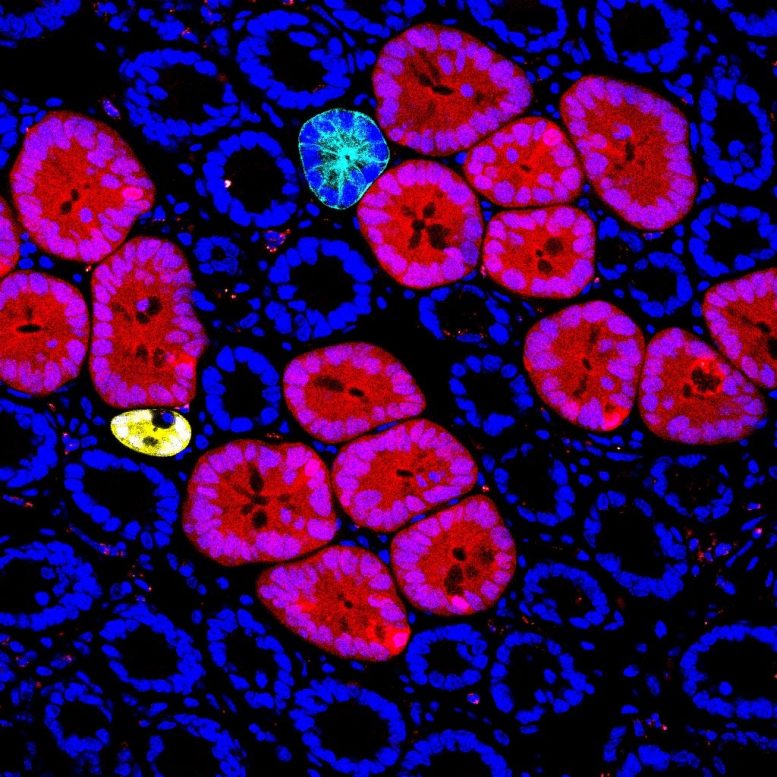
    Confocal micrograph of mouse small intestine with the Red2Onco technology. With Red2Onco, the oncogenic mutant clones (Red clones), and normal or wild-type clones (Yellow or Cyan clones) can be labeled in the same tissue. The mutant clones expand considerably faster than wild-type clones, suggesting field expansion of the mutant clones. Images acquired after 6 months of tissue lineage tracing. Credit: ©Yum/IMBA

    A New Window Into Cancer’s Earliest Moments

    Red2Onco, an innovative genetic mouse model, allows to detect the very initial steps that lead to cancer development. Red2Onco’s multi-color labeling system allows to trace intestinal tumor development after the first oncogenic hit at the single cell level. The research carried out at IMBA – Institute of Molecular Biotechnology of the Austrian Academy of Sciences – and the University of Cambridge is now published in the journal Nature.

    Studies on cancer are limited by the threshold at which cellular transformations become clinically detectable. However, the very initial phase on the way to malignancy is histologically invisible, as the process originates from one single cell. In this early phase, a so-called “seeding cell” acquires an initial pro-cancerous mutation, also known as the “first oncogenic hit”, while being completely surrounded by normal tissue. To overcome the detection barrier, a team of researchers around IMBA group leader Bon-Kyoung Koo and University of Cambridge group leader Professor Benjamin D. Simons developed a laboratory system to dissect the pre-cancerous steps that remained under the radar up until present.
    Red2Onco Confocal Micrograph
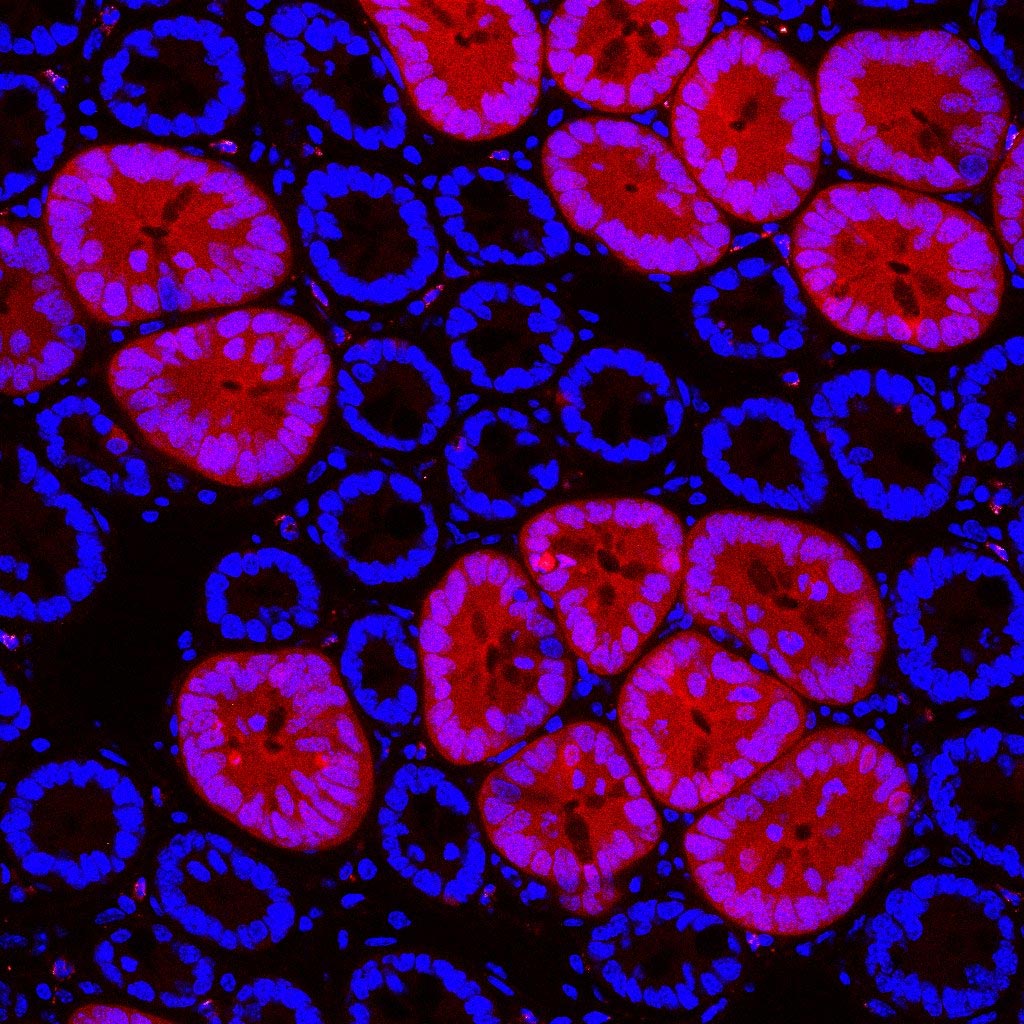
    Another confocal micrograph of mouse small intestine with the Red2Onco technology. Credit: ©Yum/IMBA

    On the Hunt for the Roots of Cancer

    “With the advance of technologies like deep targeted DNA sequencing, researchers noticed that cancer-associated mutations are already present in normal tissues, which is very scary!” states Bon-Kyoung Koo, referring to the turning point that set him, like a forensic detective, on the traces of the first oncogenic hit.

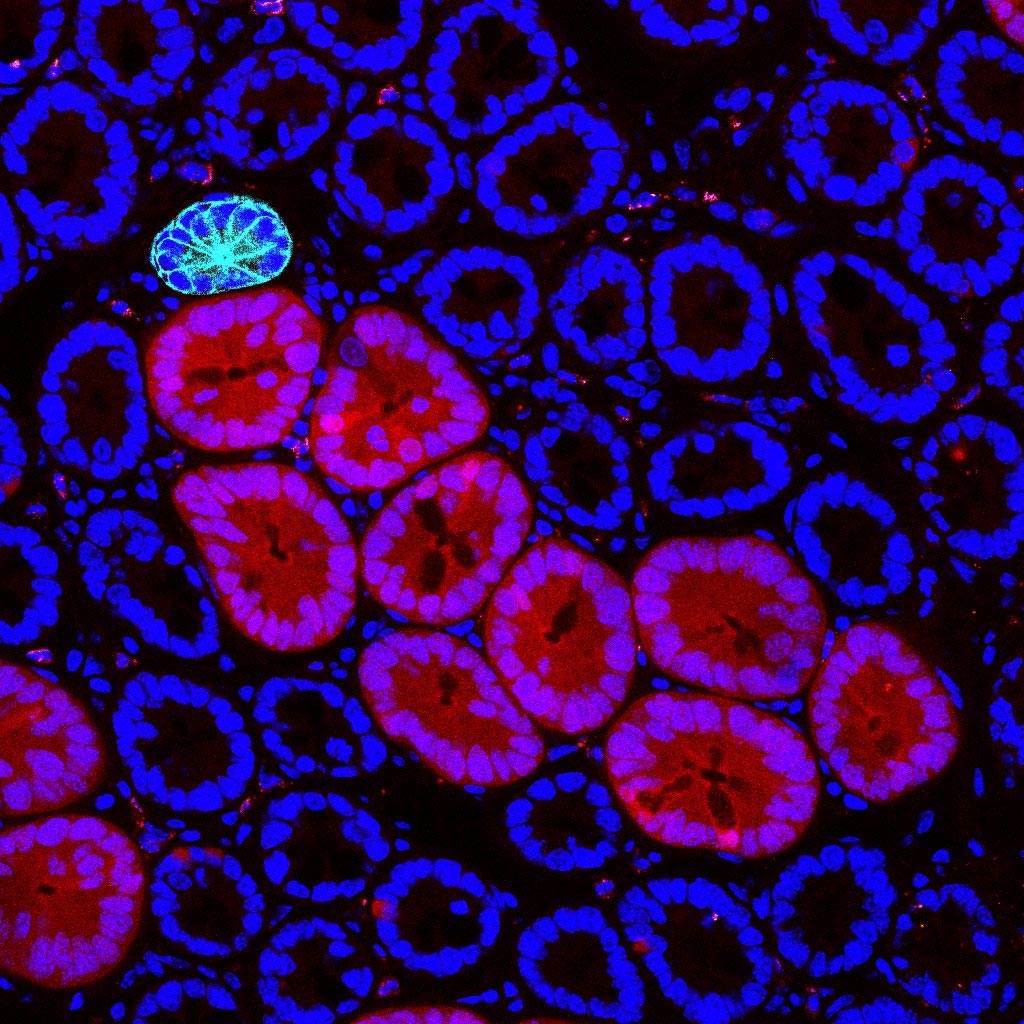
    As most human cancer types originate in the epithelium, Koo, a geneticist, decided to build a genetic model to examine the effect of the first oncogenic transformations in the mouse gut. This genetic model, which the team termed “Red2Onco,” is a multi-color labeling technology that allows to track the initiation of tumorigenesis from a single mutant cell. With Red2Onco, the team found that mutant cells create a hostile environment to their neighboring non-mutant cells and massively deregulate the normal stem cell niche in the mouse intestinal tissue.

    “This is by far the most exciting approach that we have tried!” states Bon-Kyoung Koo.
    Red2Onco Confocal Micrograph Mouse Intestine
    Another confocal micrograph of mouse small intestine with the Red2Onco technology. Credit: ©Yum/IMBA

    Oncogenic Factors and Ruthless Crosstalk Mechanisms

    Using Red2Onco, the team was able to study the mechanisms initiated by two separate “first oncogenic hits”. These are mutations to known proto-oncogenes, KRAS and PI3K, respectively, being known as pro-cancerous factors driving malignancy in declared tumors. To their surprise, the researchers found that even in the event of such a first oncogenic hit, the mutated pre-cancerous cell or “seeding cell” imparts a “negative influence” on its neighbors. The surrounding normal tissue loses its stem cells, which in turn favours the territorial expansion of oncogenic mutant stem cells and their progenies. “Through this process of ‘field transformation’, the colonization of intestinal tissue by mutant cells increases the chance for further oncogenic hits, which may lead in turn to cancer,” explains Benjamin Simons of the Gurdon Institute, University of Cambridge.

    The first author on the study, Min Kyu Yum of the Gurdon Institute, expands: “oncogenic mutant cells influence the fate behavior of their wild-type neighbors both directly, through secretion of signaling factors, and indirectly through induced changes in the shared tissue environment,” before co-first author Seungmin Han sums up: “Using comparative single-cell analyses and organoid culture methods, we were able to dissect the molecular mechanisms that mediate cellular crosstalk.”

    The Aggressive Influence Can Be Suppressed

    The relevance of the work is major, to say the least. In this sense, the authors have shown that inhibiting BMP (Bone Morphogenic Protein) signaling coming from the oncogenic mutant relieves the “negative influence” on the normal stem cells. “As well as enabling detection of early events of tumorigenesis, our discovery paves the way for intervention strategies that target cellular crosstalk mechanisms,” concludes Min Kyu Yum.

    Reference: “Tracing oncogene-driven remodelling of the intestinal stem cell niche” by Min Kyu Yum, Seungmin Han, Juergen Fink, Szu-Hsien Sam Wu, Catherine Dabrowska, Teodora Trendafilova, Roxana Mustata, Lemonia Chatzeli, Roberta Azzarelli, Irina Pshenichnaya, Eunmin Lee, Frances England, Jong Kyoung Kim, Daniel E. Stange, Anna Philpott, Joo-Hyeon Lee, Bon-Kyoung Koo and Benjamin D. Simons, 2 June 2021, Nature.
    DOI: 10.1038/s41586-021-03605-0

    Never miss a breakthrough: Join the SciTechDaily newsletter.
    Follow us on Google and Google News.

    Biomedical Engineering Biotechnology Cancer Cell Biology Genetics Institute of Molecular Biotechnology Molecular Biology
    Share. Facebook Twitter Pinterest LinkedIn Email Reddit

    Related Articles

    Activating Genes With a Smartwatch to Control Insulin Production

    Scientists Shrink Pancreatic Cancer Tumors by Starving Their Cellular “Neighbors”

    NIRVANA: Fast, Portable Test Can Diagnose COVID-19 and Track Variants

    Heart Recovery After Heart Attack Mapped in Great Detail

    Neuroscientists Link Brain Cancer to Tissue Healing

    Evolution May Be to Blame for High Risk of Advanced Cancers in Humans – “Gene Has Gone Rogue”

    New Genetic Systems Created by Biologists to Neutralize Gene Drives

    CRISPR-HOT: New Genetic Tool Can Label Specific Genes and Cells

    MIT Develops a Synthetic Gene Circuit to Trigger Immune System Attack on Cancer

    Leave A Reply Cancel Reply

    • Facebook
    • Twitter
    • Pinterest
    • YouTube

    Don't Miss a Discovery

    Subscribe for the Latest in Science & Tech!

    Trending News

    Artificial Sweeteners May Harm Future Generations, Study Suggests

    Splashdown! NASA Artemis II Returns From Record-Breaking Moon Mission

    What If Consciousness Exists Beyond Your Brain

    Scientists Finally Crack the 100-Million-Year Evolutionary Mystery of Squid and Cuttlefish

    Beyond “Safe Levels”: Study Challenges What We Know About Pesticides and Cancer

    Researchers Have Found a Dietary Compound That Increases Longevity

    Scientists Baffled by Bizarre “Living Fossil” From 275 Million Years Ago

    Your IQ at 23 Could Predict Your Wealth at 27, Study Finds

    Follow SciTechDaily
    • Facebook
    • Twitter
    • YouTube
    • Pinterest
    • Newsletter
    • RSS
    SciTech News
    • Biology News
    • Chemistry News
    • Earth News
    • Health News
    • Physics News
    • Science News
    • Space News
    • Technology News
    Recent Posts
    • What if Dark Matter Has Two Forms? Bold New Hypothesis Could Explain a Cosmic Mystery
    • Researchers Expose Hidden Chemistry of “Ore-Forming” Elements in Biology
    • Geologists Reveal the Americas Collided Earlier Than We Thought
    • 20x Difference: Study Reveals True Source of Airborne Microplastics
    • Scientists Uncover Hidden Force Powering Yellowstone’s Supervolcano
    Copyright © 1998 - 2026 SciTechDaily. All Rights Reserved.
    • Science News
    • About
    • Contact
    • Editorial Board
    • Privacy Policy
    • Terms of Use

    Type above and press Enter to search. Press Esc to cancel.