
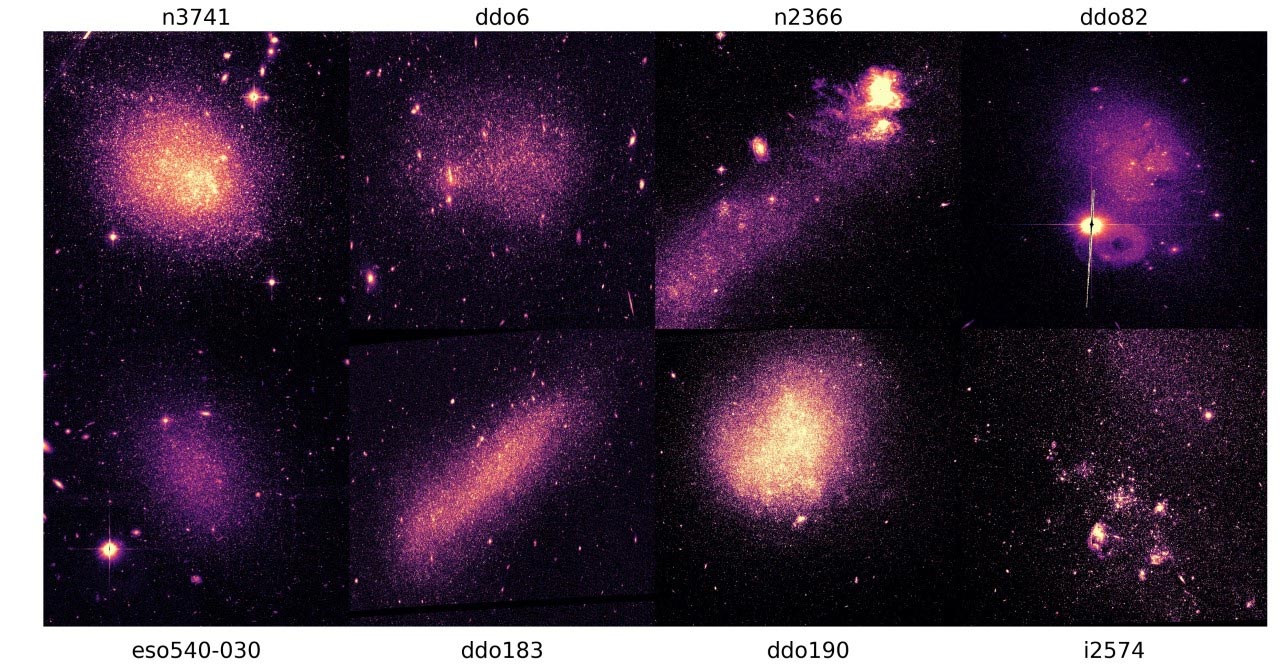
Surprising Finding Challenges Current Theories on How Galaxies Grow
Three dozen dwarf galaxies far from each other had a simultaneous “baby boom” of new stars, an unexpected discovery that challenges current theories on how galaxies grow and may enhance our understanding of the universe.
Galaxies more than 1 million light-years apart should have completely independent lives in terms of when they give birth to new stars. But galaxies separated by up to 13 million light-years slowed down and then simultaneously accelerated their birth rate of stars, according to a Rutgers-led study published in the Astrophysical Journal.
“It appears that these galaxies are responding to a large-scale change in their environment in the same way a good economy can spur a baby boom,” said lead author Charlotte Olsen, a doctoral student in the Department of Physics and Astronomy in the School of Arts and Sciences at Rutgers University–New Brunswick.
“We found that regardless of whether these galaxies were next-door neighbors or not, they stopped and then started forming new stars at the same time, as if they’d all influenced each other through some extra-galactic social network,” said co-author Eric Gawiser, a professor in the Department of Physics and Astronomy.

Shared Decline and Rise in Star Formation
The simultaneous decrease in the stellar birth rate in the 36 dwarf galaxies began 6 billion years ago, and the increase began 3 billion years ago. Understanding how galaxies evolve requires untangling the many processes that affect them over their lifetimes (billions of years). Star formation is one of the most fundamental processes. The stellar birth rate can increase when galaxies collide or interact, and galaxies can stop making new stars if the gas (mostly hydrogen) that makes stars is lost.
Star formation histories can paint a rich record of environmental conditions as a galaxy “grew up.” Dwarf galaxies are the most common but least massive type of galaxies in the universe, and they are especially sensitive to the effects of their surrounding environment.
Implications of a Synchronized Galactic Event
The 36 dwarf galaxies included a diverse array of environments at distances as far as 13 million light-years from the Milky Way. The environmental change the galaxies apparently responded to must be something that distributes fuel for galaxies very far apart. That could mean encountering a huge cloud of gas, for example, or a phenomenon in the universe we don’t yet know about, according to Olsen.
The scientists used two methods to compare star formation histories. One uses light from individual stars within galaxies; the other uses the light of a whole galaxy, including a broad range of colors.
“The full impact of the discovery is not yet known as it remains to be seen how much our current models of galaxy growth need to be modified to understand this surprise,” Gawiser said. “If the result cannot be explained within our current understanding of cosmology, that would be a huge implication, but we have to give the theorists a chance to read our paper and respond with their own research advances.”
“The James Webb Space Telescope, scheduled to be launched by NASA this October, will be the ideal way to add that new data to find out just how far outwards from the Milky Way this ‘baby boom’ extended,” Olsen added.
Reference: “Star Formation Histories from Spectral Energy Distributions and Color–magnitude Diagrams Agree: Evidence for Synchronized Star Formation in Local Volume Dwarf Galaxies over the Past 3 Gyr” by Charlotte Olsen, Eric Gawiser, Kartheik Iyer, Kristen B. W. McQuinn, Benjamin D. Johnson, Grace Telford, Anna C. Wright, Adam Broussard and Peter Kurczynski, 24 May 2021, The Astrophysical Journal.
DOI: 10.3847/1538-4357/abf3c2
Rutgers co-authors include Professor Kristen B. W. McQuinn; Grace Telford, a postdoctoral associate; and Adam Broussard, a doctoral student. Scientists at the University of Toronto, the Harvard-Smithsonian Center for Astrophysics, Johns Hopkins University and NASA’s Goddard Space Flight Center contributed to the study.
Never miss a breakthrough: Join the SciTechDaily newsletter.
Follow us on Google and Google News.
4 Comments
i tell u what it looks like
3,000,000,000 years ago the milky way collided with another galaxy sculptor or a another x or y or z
3,000,000,000 years ago a galactic collision occurs
in both galaxies a stellar baby boom occurs ie milky way boom and x or y or z boom
the milky way gobbles up most of the a another stars which will have to be confirmed by the infantry of stellar types in our own milky way galaxy matching x or y or z
and the sculptor galaxy or x or y or z has been morphed into 17 relics of its former massive self some going east some going west some going north
all moved in proper motion maximum 30,000,000 light years apart 2020
so could a simulation be done slow motion action replay rewind
rewinding the cosmic clock 3 billion years to discover where each galaxy euclids xyz position would be
and lets see if we have a collision making a cause and effect
How can we detect light coming to us from 3 billion years ago AND detect light from 6 billion years ago? How do we compress that 3 billion years difference for us to detect both?
the stellar object age in each galaxy can provide its birth time
ie how old it is now 2020 from its stellar composition
and the light from the birth age travels across space and time
ie 6,000,000,000 years ago generation 1 granddaddy and granmammy
ie 4,567,000,000 years ago for our stellar solar sun to travel 4,500,000,000 light years out to inform anyone out there at a distance of 4,567 billion light years distance from us that we are here
ie 3,000,000,000 years ago when the milky way collided with another galaxy and formed new stars that shine their light generation 2 daddy and mammy
but the 6,000,000,000 and 3,000,000,00 years old stars are now a maximum distance of 33,000,000 light years away still shining their light to us but really to an envelope size of 6,000,000,000 or 3,000,000,000 light years diameter for anyone out there to detect
compression is not occurring
observation is happening
x or y or z. Mammy