
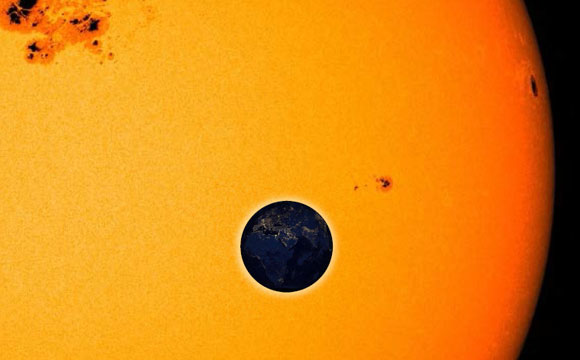
New research suggests that future searches for habitable planets and for the signals from extraterrestrial observers focus on that part of the sky in which potential distant observers of the planetary system can notice the yearly transit of the Earth in front of the Sun.
Are we alone in the universe? To answer this question, astronomers have been using a variety of methods in the past decades to search for habitable planets and signals from extraterrestrial observers – to date, with no success. Maybe the search strategy has not been optimized until now, say researchers from the Max Planck Institute for Solar System Research in Göttingen and from McMaster University in Canada. They suggest that future searches focus on that part of the sky in which potential distant observers of the planetary system can notice the yearly transit of the Earth in front of the Sun.
When a planet passes in front of its host star, it causes a small transient dimming of the star. This so-called transit can be measurable, depending on the size of the planet and the sensitivity of the instrument. In fact, the majority of the exoplanets known to us today have been discovered with this transit method. A similar technique, called transit spectroscopy, might enable astronomers in the future to scan the atmospheres of exoplanets for gaseous indicators of life.
In the first step, the two researchers identified the region in the sky from which one sees the transits less than half a solar radius from the center of the solar disk. The possible exoplanetary systems that offer this perspective are all located in a small strip in the sky, the projection of the Earth’s orbit around the Sun (the ecliptic) onto the celestial sphere. The area of this strip amounts only to about two-thousandths of the entire sky.
“The key point of this strategy is that it confines the search area to a very small part of the sky. As a consequence, it might take us less than a human life span to find out whether or not there are extraterrestrial astronomers who have found the Earth. They may have detected Earth’s biogenic atmosphere and started to contact whoever is home,” explains René Heller from the MPS.
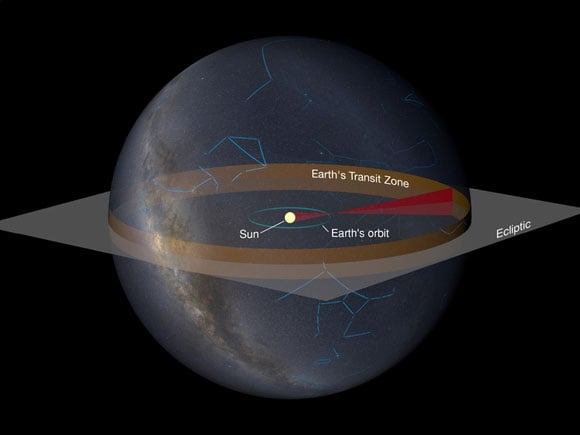
Not every star is equally well suited as a home of extraterrestrial life. The more massive a star is, the shorter its life span. Yet, a long stellar life is considered a prerequisite for the development of higher life forms. Therefore the researchers compiled a list of stars that are not only in the advantageous part of the sky but also offer good chances of hosting evolved forms of life, that is, intelligent life. The researchers compiled a list of 82 nearby Sun-like stars that satisfy their criteria. This catalog can now serve as an immediate target list for SETI initiatives.
But astronomers are far from knowing every star in our Milky Way. The more distant a star, the dimmer its light appears. And the small, particularly long-lived stars are also particularly faint. In order to estimate how many stars in addition to the 82 nearby ones could reside in Earth’s transit zone, Heller and his Canadian colleague Ralph Pudritz projected the celestial sphere onto a model of the stellar density of our Galaxy. The result: about 100,000 nearby stars could harbor planets with inhabitants who could have discovered us and who could be trying to contact us.
A part of these planets might be discovered with the PLATO mission of the European Space Agency, scheduled for 2024. René Heller from MPS is also involved in this mission. PLATO will use the transit method to find small planets, some of them possibly Earth-like, around bright stars.
“PLATO might even detect the transits of exoplanets, whose possible inhabitants would be able to see the Earth transiting the Sun,” Heller adds. “Such a crazy setup would offer both them and us the possibility of studying each other’s planets with the transit method.”
Reference: “The Search for Extraterrestrial Intelligence in Earth’s Solar Transit Zone” by René Heller and Ralph E. Pudritz, 15 April 2016, Astrobiology.
DOI: 10.1089/ast.2015.1358
Never miss a breakthrough: Join the SciTechDaily newsletter.
Follow us on Google and Google News.
5 Comments
If the ‘plane’ of a distant solar system is just off by a few degrees, then the star could house dozens of planets, that remain unseen, because they don’t pass in front of their individual star….. based on the location from which we are looking…..therefore, are we missing billions of undiscovered planets? I really wish I were an Astronomer. (sad face)
yep, pretty much.
I think the number is something in the 1-2 % area that we are able to detect by the transient method.
The estimations for number of planets in the milkyway around host stars are always done with this in mind and the transit detection method won’t be the last one they come up with..
Sun is not a big star in our galaxy and it would be seen dim even if we go to our neighboring stars. Hence occlusion method of finding this ‘exoplanet-earth’ for alien astronomers will also be dim by the occlusion method. They will be interested in other conspicuous stars which they may see in the galaxy rather than concentrating on this uninteresting star -Sun for their probe. Thank YOu.
I hardly think advanced civilizations would be using crude telescopes. I saw a multidimensional UFO a couple of years ago so I’m sure there’s plenty of extraterrestrials out there.
very good thanks