
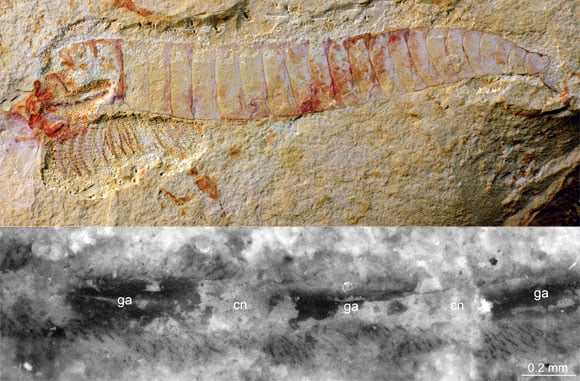
Researchers from the University of Cambridge have discovered a 520 million-year-old fossilized nervous system is the most complete and best example found to date.
Researchers have found one of the oldest and most detailed fossils of the central nervous system yet identified, from a crustacean-like animal that lived more than 500 million years ago. The fossil, from southern China, has been so well preserved that individual nerves are visible, the first time this level of detail has been observed in a fossil of this age.
The findings, published in the Proceedings of the National Academy of Sciences, are helping researchers understand how the nervous system of arthropods – creepy crawlies with jointed legs – evolved. Finding any fossilized soft tissue is rare, but this particular find, by researchers in the UK, China, and Germany, represents the most detailed example of a preserved nervous system yet discovered.
The animal, called Chengjiangocaris kunmingensis, lived during the Cambrian ‘explosion’, a period of rapid evolutionary development about half a billion years ago when most major animal groups first appear in the fossil record. C. kunmingensis belongs to a group of animals called fuxianhuiids, and was an early ancestor of modern arthropods – the diverse group that includes insects, spiders, and crustaceans.
“This is a unique glimpse into what the ancestral nervous system looked like,” said study co-author Dr Javier Ortega-Hernández, of the University of Cambridge’s Department of Zoology. “It’s the most complete example of a central nervous system from the Cambrian period.”
Over the past five years, researchers have identified partially-fossilized nervous systems in several different species from the period, but these have mostly been fossilized brains. And in most of those specimens, the fossils only preserved details of the profile of the brain, meaning the amount of information available has been limited.
C. kunmingensis looked like a sort of crustacean, with a broad, almost heart-shaped head shield, and a long body with pairs of legs of varying sizes. Through careful preparation of the fossils, which involved chipping away the surrounding rock with a fine needle, the researchers were able to view not only the hard parts of the body, but fossilized soft tissue as well.
The vast majority of fossils we have are mostly bone and other hard body parts such as teeth or exoskeletons. Since the nervous system and soft tissues are essentially made of fatty-like substances, finding them preserved as fossils is extremely rare. The researchers behind this study first identified a fossilized central nervous system in 2013, but the new material has allowed them to investigate the significance of these finding in much greater depth.
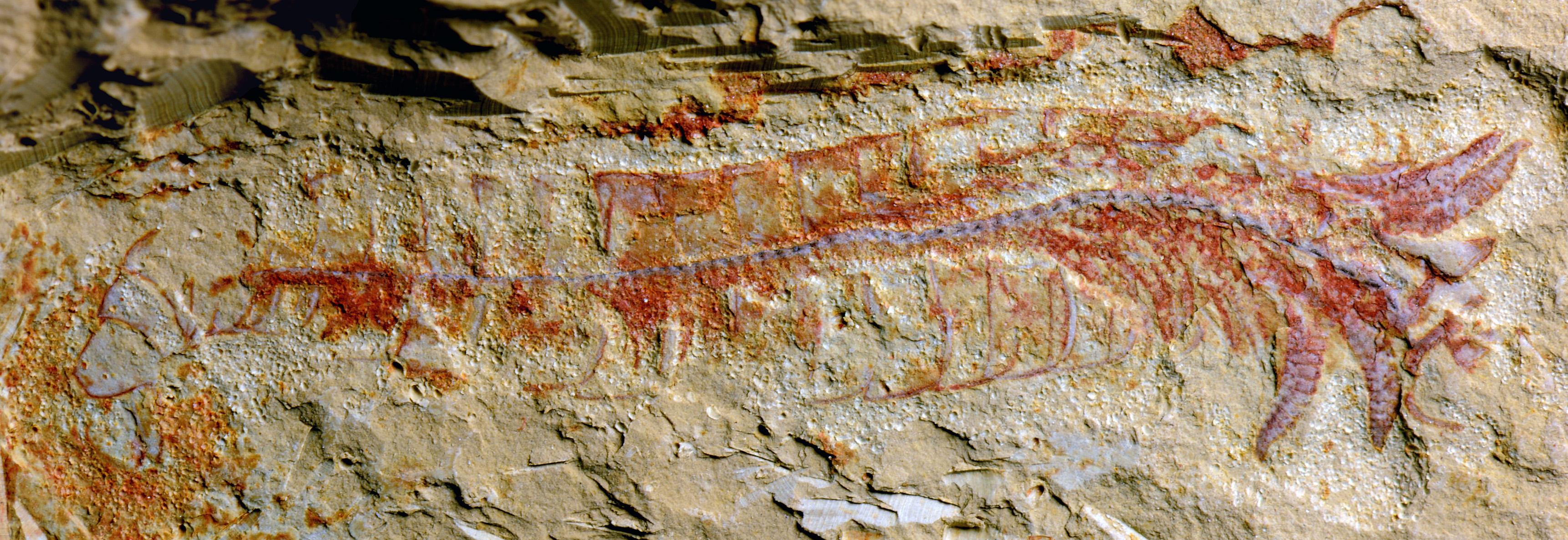
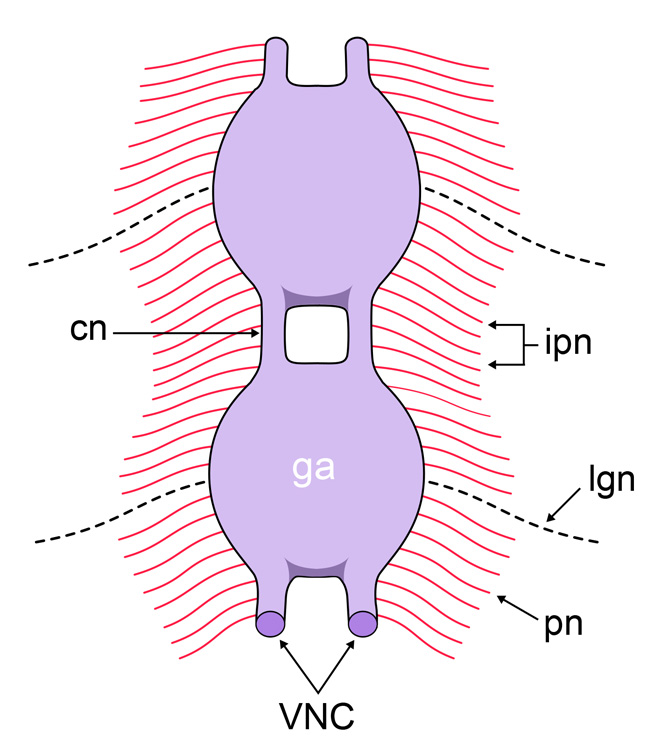
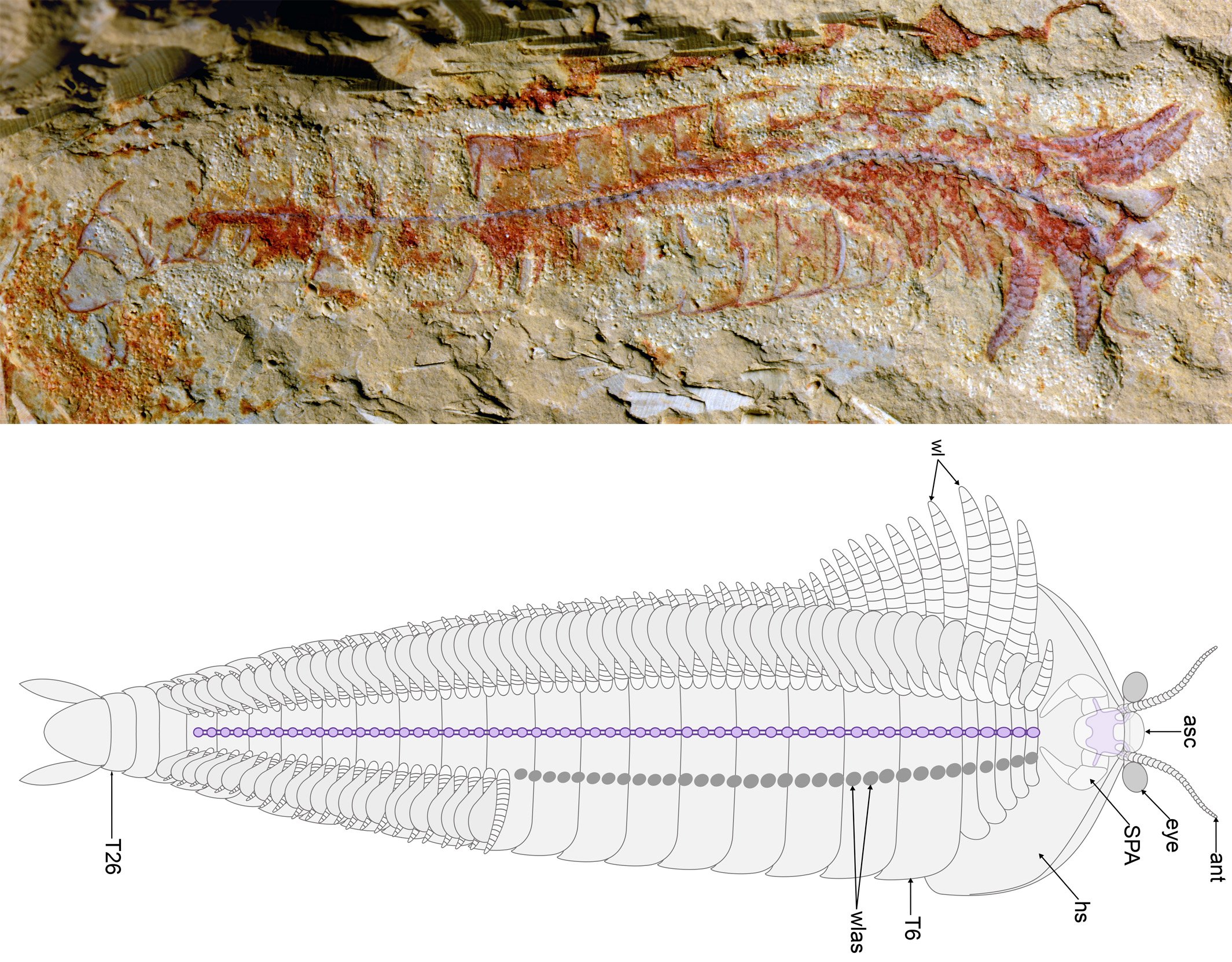
The central nervous system coordinates all neural and motor functions. In vertebrates, it consists of the brain and spinal cord, but in arthropods it consists of a condensed brain and a chain-like series of interconnected masses of nervous tissue called ganglia that resemble a string of beads.
Like modern arthropods, C. kunmingensis had a nerve cord – which is analogous to a spinal cord in vertebrates – running throughout its body, with each one of the bead-like ganglia controlling a single pair of walking legs.
Closer examination of the exceptionally preserved ganglia revealed dozens of spindly fibers, each measuring about five thousandths of a millimeter in length. “These delicate fibers displayed a highly regular distribution pattern, and so we wanted to figure out if they were made of the same material as the ganglia that form the nerve cord,” said Ortega-Hernández. “Using fluorescence microscopy, we confirmed that the fibers were in fact individual nerves, fossilized as carbon films, offering an unprecedented level of detail. These fossils greatly improve our understanding of how the nervous system evolved.”
For Ortega-Hernández and his colleagues, a key question is what this discovery tells us about the evolution of early animals, since the nervous system contains so much information. Further analysis revealed that some aspects of the nervous system in C. kunmingensis appear to be structured similar to that of modern priapulids (penis worms) and onychophorans (velvet worms), with regularly-spaced nerves coming out from the ventral nerve cord.
In contrast, these dozens of nerves have been lost independently in the tardigrades (water bears) and modern arthropods, suggesting that simplification played an important role in the evolution of the nervous system.
Possibly one of the most striking implications of the study is that the exceptionally preserved nerve cord of C. kunmingensis represents a unique structure that is otherwise unknown in living organisms. The specimen demonstrates the unique contribution of the fossil record toward understanding the early evolution of animals during the Cambrian period. “The more of these fossils we find, the more we will be able to understand how the nervous system – and how early animals – evolved,” said Ortega-Hernández.
Reference: “Fuxianhuiid ventral nerve cord and early nervous system evolution in Panarthropoda” by Jie Yang, Javier Ortega-Hernández, Nicholas J. Butterfield, Yu Liu, George S. Boyan, Jin-bo Hou, Tian Lan and Xi-guang Zhang, 14 November 2015, PNAS.
DOI: 10.1073/pnas.1522434113
Never miss a breakthrough: Join the SciTechDaily newsletter.
Follow us on Google and Google News.
2 Comments
The finding of the 520 million year old arthropod is interesting. In Arthropods like spider the brain hangs over the body in its eight legs too instead of concentrated at one spot like ours. So the primordial nerve system has done away with spinal cord and not distributed through them. The space for the brain (which is in fact a bundle of nervous system) is distributed all over the body. Thank You.
nice topic