
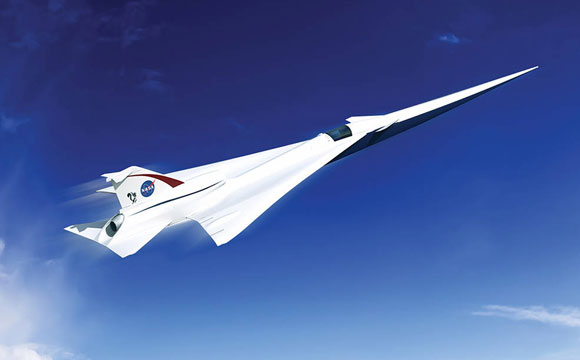
NASA’s award of a contract for the preliminary design of a “low boom” flight demonstration aircraft brings the return of supersonic passenger air travel is one step closer to reality. This is the first in a series of ‘X-planes’ in NASA’s New Aviation Horizons initiative, introduced in the agency’s Fiscal Year 2017 budget.
NASA Administrator Charles Bolden announced the award at an event Monday at Ronald Reagan Washington National Airport in Arlington, Virginia.
“NASA is working hard to make flight greener, safer, and quieter – all while developing aircraft that travel faster, and building an aviation system that operates more efficiently,” said Bolden. “To that end, it’s worth noting that it’s been almost 70 years since Chuck Yeager broke the sound barrier in the Bell X-1 as part of our predecessor agency’s high-speed research. Now we’re continuing that supersonic X-plane legacy with this preliminary design award for a quieter supersonic jet with an aim toward passenger flight.”
NASA selected a team led by Lockheed Martin Aeronautics Company of Palmdale, California, to complete a preliminary design for Quiet Supersonic Technology (QueSST). The work will be conducted under a task order against the Basic and Applied Aerospace Research and Technology (BAART) contract at NASA’s Langley Research Center in Hampton, Virginia.
After conducting feasibility studies and working to better understand acceptable sound levels across the country, NASA’s Commercial Supersonic Technology Project asked industry teams to submit design concepts for a piloted test aircraft that can fly at supersonic speeds, creating a supersonic “heartbeat” — a soft thump rather than the disruptive boom currently associated with supersonic flight.
“Developing, building, and flight testing a quiet supersonic X-plane is the next logical step in our path to enabling the industry’s decision to open supersonic travel for the flying public,” said Jaiwon Shin, associate administrator for NASA’s Aeronautics Research Mission.
Lockheed Martin will receive about $20 million over 17 months for QueSST preliminary design work. The Lockheed Martin team includes subcontractors GE Aviation of Cincinnati and Tri Models Inc. of Huntington Beach, California.
The company will develop baseline aircraft requirements and a preliminary aircraft design, with specifications, and provide supporting documentation for concept formulation and planning. This documentation would be used to prepare for the detailed design, building, and testing of the QueSST jet. Performance of this preliminary design also must undergo analytical and wind tunnel validation.
In addition to design and building, this Low Boom Flight Demonstration (LBFD) phase of the project also will include validation of community response to the new, quieter supersonic design. The detailed design and building of the QueSST aircraft, conducted under the NASA Aeronautics Research Mission Directorate’s Integrated Aviation Systems Program, will fall under a future contract competition.
NASA’s 10-year New Aviation Horizons initiative has the ambitious goals of reducing fuel use, emissions, and noise through innovations in aircraft design that departs from the conventional tube-and-wing aircraft shape.
The New Aviation Horizons X-planes will typically be about half-scale of a production aircraft and likely are to be piloted. Design-and-build will take several years with aircraft starting their flight campaign around 2020, depending on funding.
Never miss a breakthrough: Join the SciTechDaily newsletter.
Follow us on Google and Google News.
3 Comments
Just so long as they give it the range to cross the Pacific! That damned ocean is way too big and it takes too long to cross!
people will be able to fly at the speed of light and we will with flying car in no time if we keep this up.if we can think of super sonic jets we will sone be able to travel through space like star wars
nice topic