
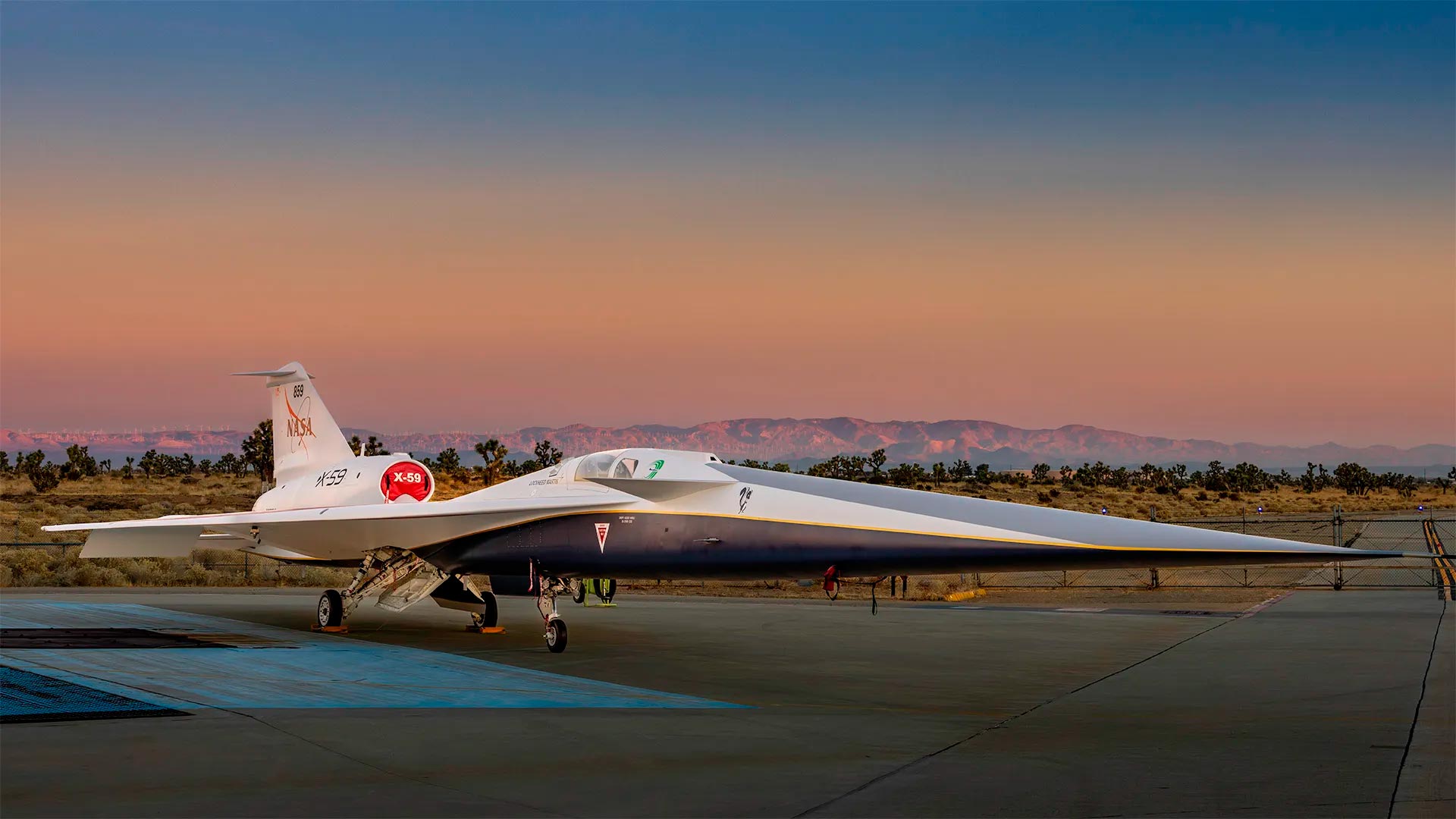
NASA’s X-59 quiet supersonic aircraft, developed with Lockheed Martin, aims to enable faster air travel with minimal noise impact, potentially changing commercial flight regulations.
NASA and Lockheed Martin formally debuted the agency’s X-59 quiet supersonic aircraft on Friday, January 12. Using this one-of-a-kind experimental airplane, NASA aims to gather data that could revolutionize air travel, paving the way for a new generation of commercial aircraft that can travel faster than the speed of sound.
“This is a major accomplishment made possible only through the hard work and ingenuity from NASA and the entire X-59 team,” said NASA Deputy Administrator Pam Melroy. “In just a few short years we’ve gone from an ambitious concept to reality. NASA’s X-59 will help change the way we travel, bringing us closer together in much less time.”
Melroy and other senior officials revealed the aircraft during a ceremony hosted by prime contractor Lockheed Martin Skunk Works at its Palmdale, California facility.
Watch the rollout of NASA’s newly painted X-59 Quesst supersonic aircraft live from Lockheed Martin’s Skunk Works facility in Palmdale, California. Credit: NASA
The X-59’s Design and Purpose
The X-59 is at the center of NASA’s Quesst mission, which focuses on providing data to help regulators reconsider rules that prohibit commercial supersonic flight over land. For 50 years, the U.S. and other nations have prohibited such flights because of the disturbance caused by loud, startling sonic booms on the communities below. The X-59 is expected to fly at 1.4 times the speed of sound, or 925 mph. Its design, shaping and technologies will allow the aircraft to achieve these speeds while generating a quieter sonic thump.
“It’s thrilling to consider the level of ambition behind Quesst and its potential benefits,” said Bob Pearce, associate administrator for aeronautics research at NASA Headquarters in Washington. “NASA will share the data and technology we generate from this one-of-a-kind mission with regulators and with industry. By demonstrating the possibility of quiet commercial supersonic travel over land, we seek to open new commercial markets for U.S. companies and benefit travelers around the world.”
Preparations for First Flight and Future Plans
With rollout complete, the Quesst team will shift to its next steps in preparation for first flight: integrated systems testing, engine runs, and taxi testing for the X-59.
The aircraft is set to take off for the first time later this year, followed by its first quiet supersonic flight. The Quesst team will conduct several of the aircraft’s flight tests at Skunk Works before transferring it to NASA’s Armstrong Flight Research Center in Edwards, California, which will serve as its base of operations.
“Across both teams, talented, dedicated, and passionate scientists, engineers, and production artisans have collaborated to develop and produce this aircraft,” said John Clark, vice president and general manager at Lockheed Martin Skunk Works. “We’re honored to be a part of this journey to shape the future of supersonic travel over land alongside NASA and our suppliers.”
Once NASA completes flight tests, the agency will fly the aircraft over several to-be-selected cities across the U.S., collecting input about the sound the X-59 generates and how people perceive it. NASA will provide that data to the Federal Aviation Administration and international regulators.
Advanced Features of the X-59
The X-59 is a unique experimental airplane, not a prototype – its technologies are meant to inform future generations of quiet supersonic aircraft.
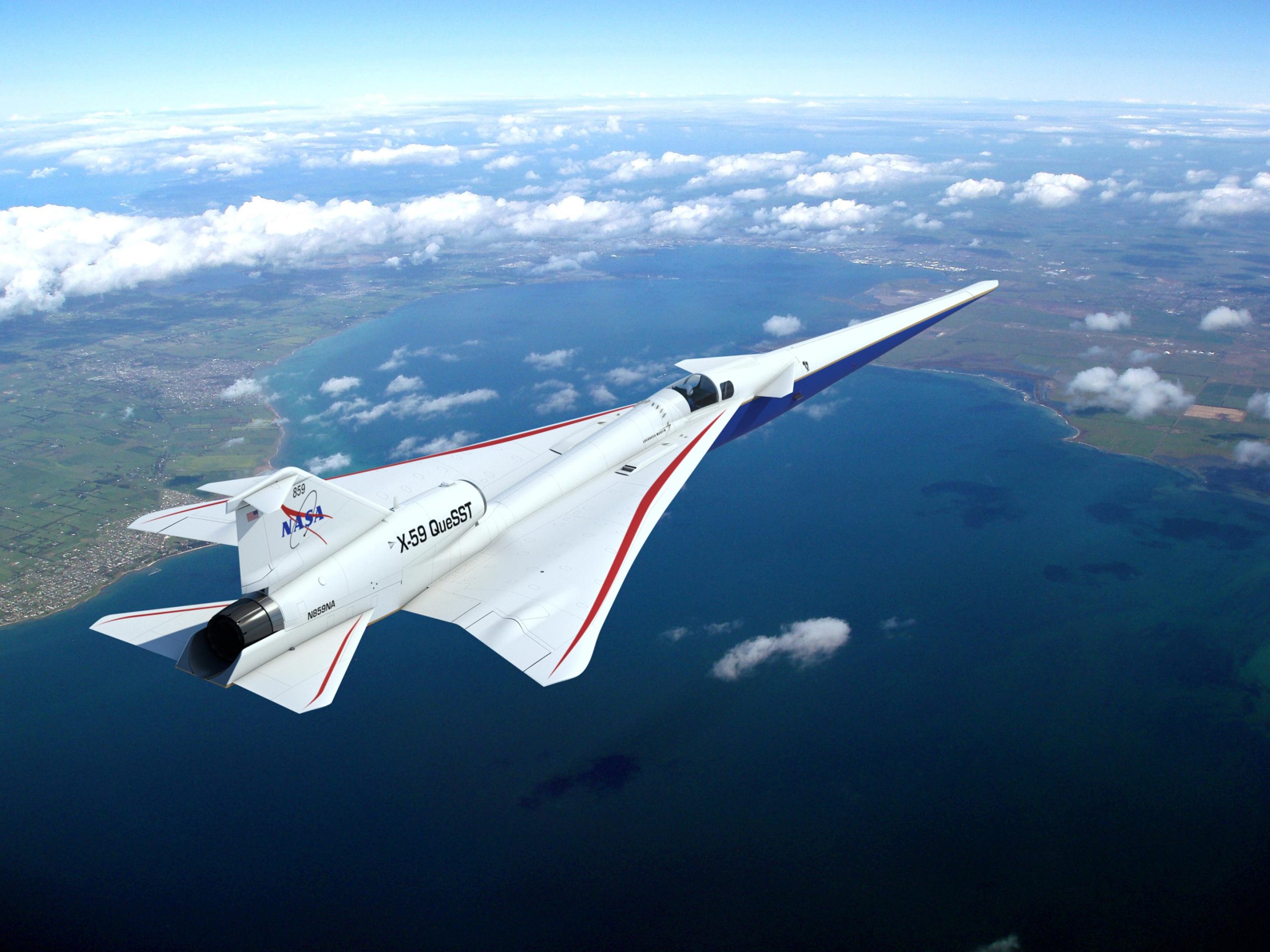
At 99.7 feet long and 29.5 feet wide, the aircraft’s shape and the technological advancements it houses will make quiet supersonic flight possible. The X-59’s thin, tapered nose accounts for almost a third of its length and will break up the shock waves that would ordinarily result in a supersonic aircraft causing a sonic boom.
Due to this configuration, the cockpit is located almost halfway down the length of the aircraft – and does not have a forward-facing window. Instead, the Quesst team developed the eXternal Vision System, a series of high-resolution cameras feeding a 4K monitor in the cockpit.
The Quesst team also designed the aircraft with its engine mounted on top and gave it a smooth underside to help keep shockwaves from merging behind the aircraft and causing a sonic boom.
Never miss a breakthrough: Join the SciTechDaily newsletter.
Follow us on Google and Google News.
1 Comment
Is it just me or is this plane sexy. I like that profile baby.