
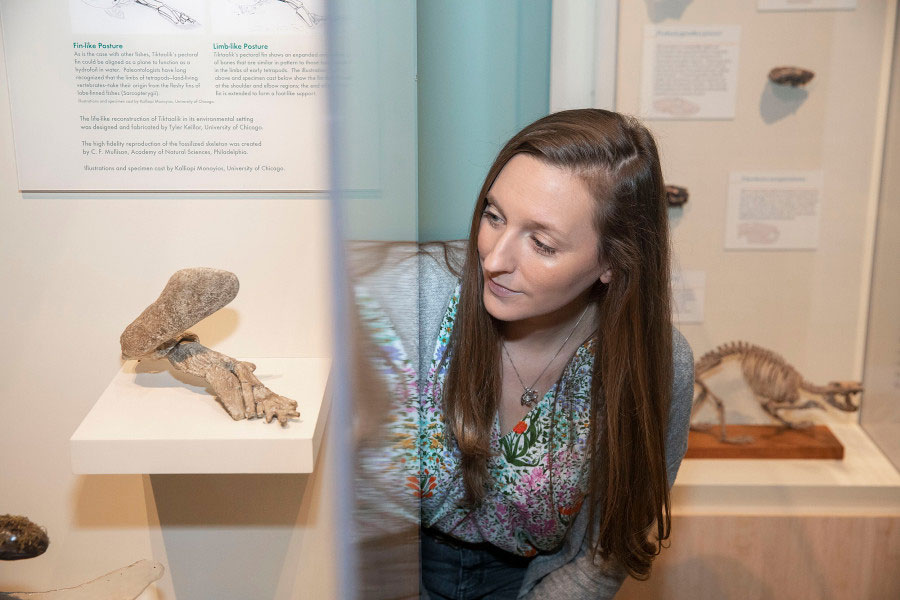
About 400 million years ago, vertebrates first began to crawl from the primordial seas onto land. Last week, thanks to a cutting-edge mathematical-analysis technique, a global research team uncovered how a crucial stage in evolution made that advance possible. Published May 8 in Science Advances, the paper deciphers crucial information about how those sea-dwelling creatures’ fins became the specialized limbs that made life on dry land feasible.
“All animals that have limbs with hands and feet and fingers and toes [that is, tetrapods] arose from animals that were fish with fins that lived in the water,” explained Stephanie E. Pierce, associate professor of organismic and evolutionary biology and curator of vertebrate paleontology at Harvard’s Museum of Comparative Zoology (MCZ). “One of the big puzzles is, how did that happen?”
In collaboration with lead authors Borja Esteve-Altava and John Hutchinson at London’s Royal Veterinary College, Pierce and her colleagues present new research that may explain how. Although paleontologists have accumulated plentiful fossil evidence of this particular evolutionary change, it was only when the team examined it via an innovative technique called anatomical network analysis (AnNA) that clear patterns emerged. AnNA, created in 2015 for biological and biomedical research, deals with structures of pairwise relations between objects. Based on graph theory, which essentially compares connections and relations between objects — in this case, the fossilized remains of fins and limb bones — a pattern emerged.
As tetrapods evolved, limb structures became simpler and more modular. In other words, where fin bones tend to be widely interconnected in many directions, the bones in limbs tend to be linked end to end, or “in a string,” as Pierce put it. “So one bone is connected to the bone before it and the bone after it. Fingers show this perfectly.”
However, Pierce added, “though we have this decrease in complexity in bone contacts, that doesn’t mean that the limbs themselves were not doing interesting things.”
In particular, as would-be limbs became simpler, they also became more modular, with each limb developing what, in a human, would be an upper arm, a forearm, a hand, and fingers. This modularization may have allowed for increasing specialization. In humans, for example, it would explain the development of the opposable thumb, whereas a different specialization of the same modular unit — the fingers — in a bat evolved into the long, light bones of a wing.
For creatures emerging from the relatively gravity-free environment of the water to a more varied and complex open-air landscape, such anatomical flexibility would be vital. “How the structure is put together probably allowed tetrapods, once they came out of the water and onto land, to adapt to all the new and unexplored terrestrial niches afforded to them,” said Pierce.
The next step (pun intended) is to understand how those changes allowed land-based tetrapods to walk, a question Pierce is currently working on in collaboration with others. “We’re building computer-simulation models across the fish/tetrapod transition to understand how the skeleton and muscles might have changed and what the impact was on locomotion,” said Pierce. The muscles of fish, she explained, are much less varied than those of land animals. As tetrapods emerged from water, “the skeleton became simplified, but the musculature became much more complex to deal with the forces of gravity.”
For Pierce, who is the MCZ’s first female curator of vertebrate paleontology, the makeup of the research team is almost as groundbreaking as its finds. The research was primarily funded by the European Union’s Horizon 2020 research and innovation program via a Marie Skłodowska-Curie fellowship for Esteve-Altava. Esteve-Altava (now at the Institute of Evolutionary Biology in Barcelona, Spain)came to Harvard to code specimens in the MCZ collection, while the rest of the team — which included Julia Molnar from New York Institute of Technology, Rui Diogo from Howard University, and Peter Johnston from the University of Auckland— brought expertise and experience from around the world.
“Science is becoming much more collaborative and much more diverse,” said Pierce.
Reference: “Evolutionary parallelisms of pectoral and pelvic network-anatomy from fins to limbs” by Borja Esteve-Altava, Stephanie E. Pierce, Julia L. Molnar, Peter Johnston, Rui Diogo and John R. Hutchinson, 8 May 2019, Science Advances.
DOI: 10.1126/sciadv.aau7459
Never miss a breakthrough: Join the SciTechDaily newsletter.
Follow us on Google and Google News.