
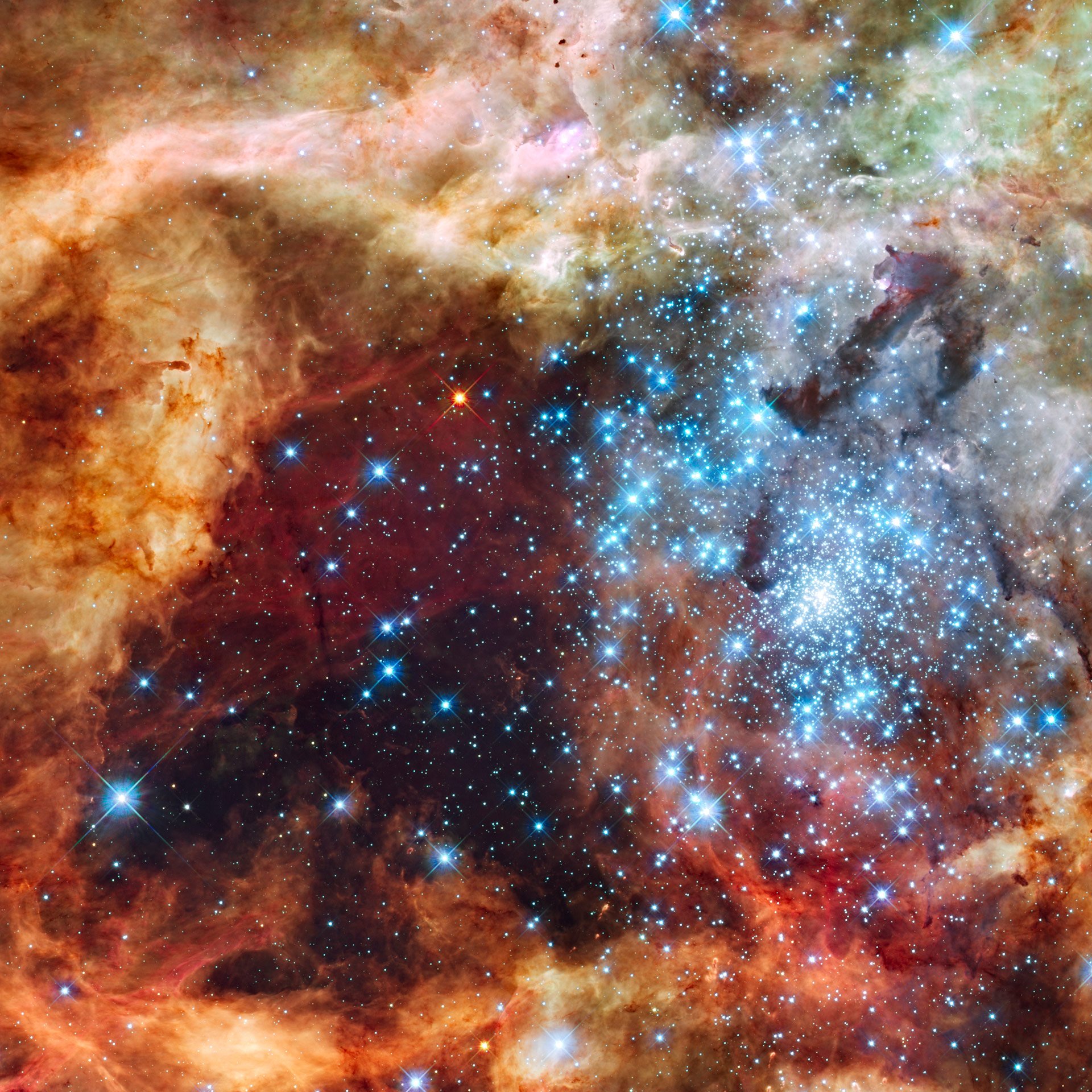
New research presented at the 10th Edoardo Amaldi Conference on Gravitational Waves suggests that stellar collisions between massive stars with masses between 200 and 300 times that of our own Sun won’t occur anytime soon.
One might expect that collisions between the remains of monstrous stars, with masses reaching 200-300 times that of our Sun, would be among the most spectacular phenomena in the Universe. Perhaps they are, but we will unfortunately probably never have the chance to find out. Astrophysicists from the Astronomical Observatory of the Faculty of Physics at the University of Warsaw have discovered that the first such collisions will not occur until billions of years from now.
For a long time, astronomers have believed that the biggest stars in the Universe do not exceed 150 solar masses. However, three years ago star clusters in the Magellanic Clouds were discovered to house “impossible” stars – tremendous monsters with masses between 200 and 300 times that of our own Sun. The discovery aroused great interest among astrophysicists, in particular those involved in the century-long search for gravitational waves. If such stellar monsters formed tight binary systems, collisions between their remnants could occur. The gravitational waves resulting from such an event would be powerful enough that even our current detectors could sense them – and at distances much larger than for typical stellar black holes. “But we cannot count on detecting any such spectacular collision,” says Dr. Krzysztof Belczyński of the Astronomical Observatory of the Faculty of Physics at the University of Warsaw.
Dr. Belczyński’s team discussed the latest results of their research with participants at the 10th Edoardo Amaldi Conference on Gravitational Waves, now being held in Warsaw in conjunction with the 20th International Conference on General Relativity and Gravitation (GR20/Amaldi10).
Stars with large masses may end their lives in two ways: their material can be blown into space or they can collapse under their own gravity into a black hole. A few months ago, astrophysicists led by Dr Norhasliza Yusof at the University of Kuala Lumpur demonstrated, using computer modeling, that some supermassive stars can form black holes. This means that the universe might indeed play host to binary systems of supermassive stars which later evolved or transformed into systems of two black holes with masses much larger than these typically observed for black holes.
Objects orbiting in tight binary systems composed of neutron stars or ordinary black holes lose their energy over time, leading to closer and closer orbits and finally a collision. Such a collision may have the astronomically observable effect of a powerful gamma-ray burst, and the explosion should also be accompanied by the emission of gravitational waves. However, up to now we have failed to observe these waves. Current detectors can only “see” the collision of typical black holes in the local Universe. The collision of black holes produced by supermassive stars would be something else entirely. Then, the gravitational waves should be strong enough that they might be detected in the near future.
But such a collision turns out not to be in the cards.
The components of common large star binary systems with masses of, say, 50, or even 100 solar masses, are formed at a distance from each other of at least several hundred or even several thousand solar radii. Such objects cannot be born closer together, because the resulting density of matter would collapse into one star and a binary system would not be created. Therefore, for an already-formed binary system to collide, its components must somehow lose orbital energy. This happens due to the rapid evolution of one of the objects, which at a particular point begins to expand rapidly. The second component of the system then moves in the atmosphere of its companion and – as a result of interaction with it – quickly loses energy. As a consequence of this, the orbit tightens in what is known as a common envelope event.
“In a supermassive binary star system, the situation is different,” says Dr. Belczyński. “We know that the components of such a system must be formed at a relatively large distance from each other. We also know that supermassive stars do not expand, so there cannot be a common envelope phase. This means that there is no physical mechanism that would effectively cause the orbit to tighten!”
In this situation, the only process that allows for a gradual loss of energy by the remnants of supermassive stars in a binary system is the emission of gravitational waves. But the gravitational waves emitted by such a system of widely separated stars or black holes are very weak and the energy loss is slow.
“It will take many tens of billions of years, perhaps hundreds of billions of years, for the black holes to collide. That is many times longer than the amount of time which has passed since the Big Bang, so we stand practically no chance of detecting the gravitational waves from such a collision in the heavens. Unless…,” Dr. Daniel Holz of the University of Chicago trails off in mid-sentence.
Exactly: unless the current models of stellar evolution and the formation of binary stars in dust clouds of matter are wrong. Then the observation of such a spectacular catastrophe in space would mean a spectacular disaster for contemporary astrophysical theories.
Dr. Belczyński’s research group was funded by a grant from the MASTER program of the Foundation for Polish Science.
The Edoardo Amaldi Conference on Gravitational Waves is organized biannually under the auspices of the International Committee on Gravitational Waves. This year, the tenth conference (Amaldi10), taking place in Warsaw on 7-13 July, coupled with the 20th International Conference on the General Theory of Relativity and Gravitation (GR20). The joint conference GR20/Amaldi10 is an unprecedented event, which has attracted to Warsaw 900 of the most distinguished physicists and astronomers working on theories of quantum gravity and gravitational waves. This year’s event is being organized by the Polish Society on Relativity and the Faculty of Physics at the University of Warsaw.
Never miss a breakthrough: Join the SciTechDaily newsletter.
Follow us on Google and Google News.