
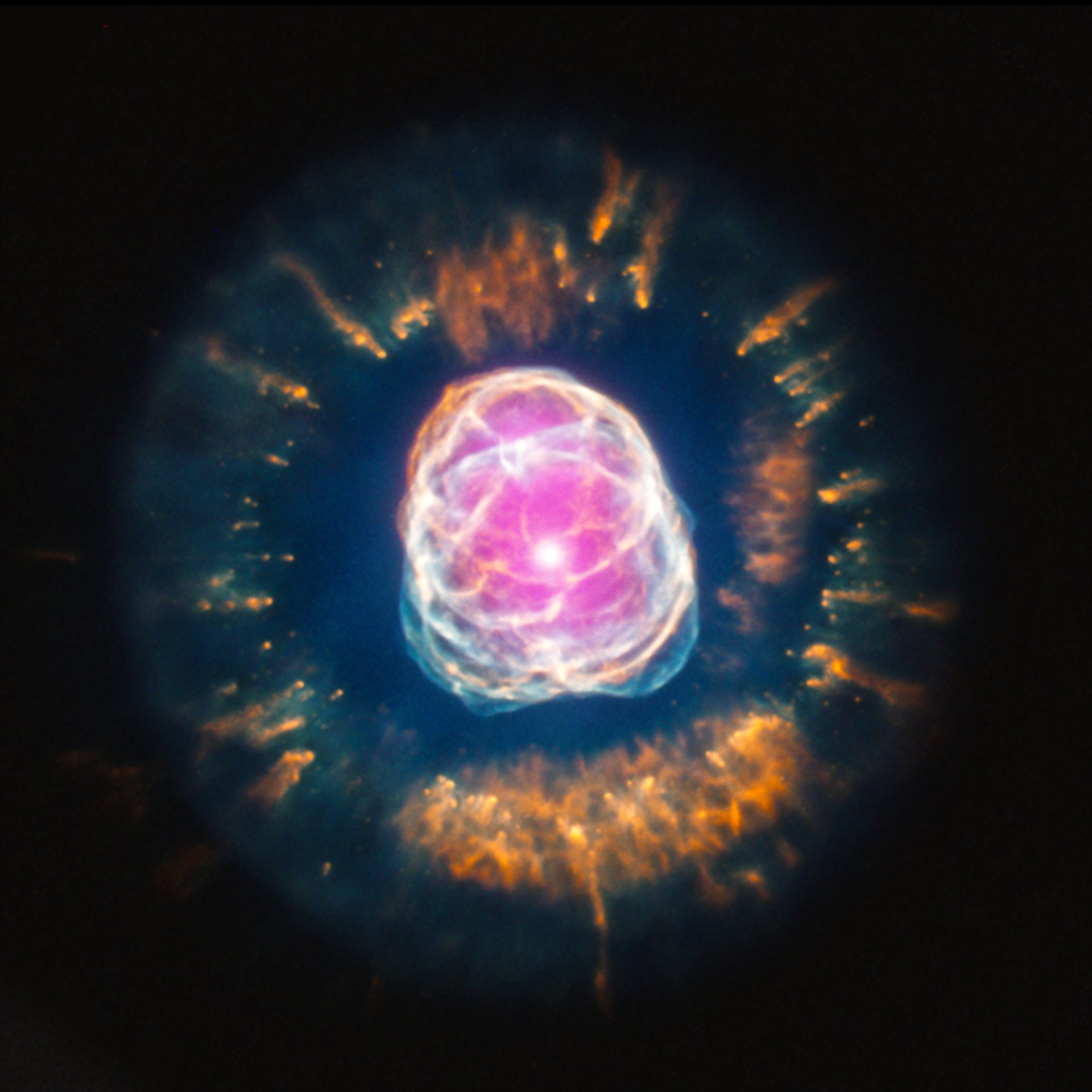
Using data from NASA’s Chandra X-ray Observatory and Hubble Telescope, astronomers studied NGC 2392 and two other planetary nebulas with hot gas in their center, revealing that NGC 2392 has unusually high levels of X-ray emission compared to the other two.
Stars like the Sun can become remarkably photogenic at the end of their life. A good example is NGC 2392, which is located about 4,200 light years from Earth. NGC 2392, nicknamed the “Eskimo Nebula,” is what astronomers call a planetary nebula. This designation, however, is deceiving because planetary nebulas actually have nothing to do with planets. The term is simply a historic relic since these objects looked like planetary disks to astronomers in earlier times looking through small optical telescopes.
Instead, planetary nebulas form when a star uses up all of the hydrogen in its core — an event our Sun will go through in about five billion years. When this happens, the star begins to cool and expand, increasing its radius by tens to hundreds of times its original size. Eventually, the outer layers of the star are carried away by a thick 50,000-kilometer-per-hour (31,000 mph) wind, leaving behind a hot core. This hot core has a surface temperature of about 50,000 degrees Celsius (90,000 degrees Fahrenheit), and is ejecting its outer layers in a much faster wind traveling six million kilometers per hour. The radiation from the hot star and the interaction of its fast wind with the slower wind creates the complex and filamentary shell of a planetary nebula. Eventually, the remnant star will collapse to form a white dwarf star.
Nowadays, astronomers using space-based telescopes are able to observe planetary nebulas such as NGC 2392 in ways their scientific ancestors probably could never imagine. This composite image of NGC 2392 contains X-ray data from NASA’s Chandra X-ray Observatory in purple showing the location of million-degree gas near the center of the planetary nebula. Data from the Hubble Space Telescope show – colored red, green, and blue – the intricate pattern of the outer layers of the star that have been ejected. The comet-shaped filaments form when the faster wind and radiation from the central star interact with cooler shells of dust and gas that were already ejected by the star.
The observations of NGC 2392 were part of a study of three planetary nebulas with hot gas in their center. The Chandra data show that NGC 2392 has unusually high levels of X-ray emission compared to the other two. This leads researchers to deduce that there is an unseen companion to the hot central star in NGC 2392. The interaction between a pair of binary stars could explain the elevated X-ray emission found there. Meanwhile, the fainter X-ray emission observed in the two other planetary nebulas in the sample – IC 418 and NGC 6826 – is likely produced by shock fronts (like sonic booms) in the wind from the central star. A composite image of NGC 6826 was included in a gallery of planetary nebulas released in 2012. [http://chandra.harvard.edu/photo/2012/pne/]
A paper describing these results was published in the April 10th, 2013 issue of The Astrophysical Journal. The first author is Nieves Ruiz of the Instituto de Astrofísica de Andalucía (IAA-CSIC) in Granada, Spain, and the other authors are You-Hua Chu, and Robert Gruendl from the University of Illinois, Urbana; Martín Guerrero from the Instituto de Astrofísica de Andalucía (IAA-CSIC) in Granada, Spain, and Ralf Jacob, Detlef Schönberner and Matthias Steffen from the Leibniz-Institut Für Astrophysik in Potsdam (AIP), Germany.
NASA’s Marshall Space Flight Center in Huntsville, Alabama, manages the Chandra program for NASA’s Science Mission Directorate in Washington. The Smithsonian Astrophysical Observatory controls Chandra’s science and flight operations from Cambridge, Massachusetts.
Reference: “Detection of Diffuse X-Ray Emission from Planetary Nebulae with Nebular O VI” by N. Ruiz, Y.-H. Chu, R. A. Gruendl, M. A. Guerrero, R. Jacob, D. Schönberner and M. Steffen, 22 March 2013, The Astrophysical Journal.
DOI: 10.1088/0004-637X/767/1/35
arXiv:1302.3886
Never miss a breakthrough: Join the SciTechDaily newsletter.
Follow us on Google and Google News.