
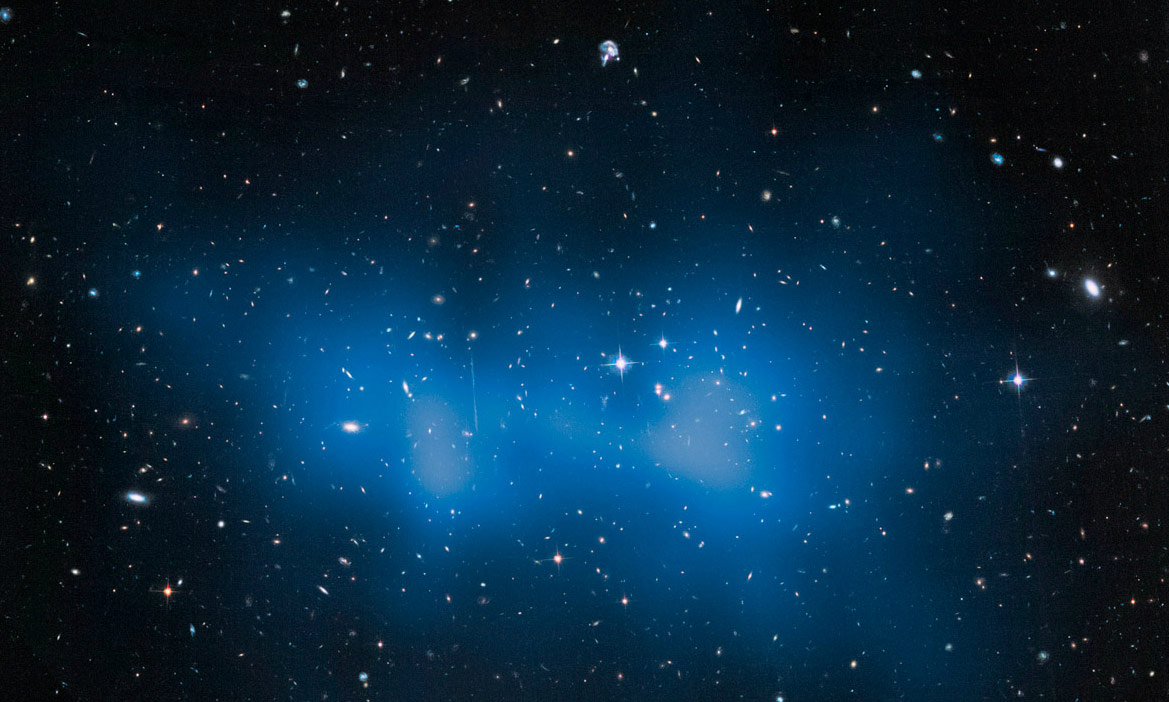
Researchers have measured the mass of the El Gordo Galaxy Cluster, calculating the cluster’s mass to be as much as 3 million billion times the mass of our sun.
NASA’s Hubble Space Telescope has weighed the largest known galaxy cluster in the distant universe, cataloged as ACT-CL J0102-4915, and found it definitely lives up to its nickname — El Gordo (Spanish for “the fat one”).
By measuring how much the cluster’s gravity warps images of galaxies in the distant background, a team of astronomers has calculated the cluster’s mass to be as much as 3 million billion times the mass of our sun. Hubble data show the galaxy cluster, which is 9.7 billion light-years away from Earth, is roughly 43 percent more massive than earlier estimates.
The team used Hubble to measure how strongly the mass of the cluster warped space. Hubble’s high resolution allowed measurements of so-called “weak lensing,” where the cluster’s immense gravity subtly distorts space like a funhouse mirror and warps images of background galaxies. The greater the warping, the more mass is locked up in the cluster.
“What I did is basically look at the shapes of the background galaxies that are farther away than the cluster itself,” explained lead author James Jee of the University of California at Davis. “It’s given us an even stronger probability that this is really an amazing system very early in the universe.”
A fraction of this mass is locked up in several hundred galaxies that inhabit the cluster and a larger fraction is in hot gas that fills the entire volume of the cluster. The rest is tied up in dark matter, an invisible form of matter that makes up the bulk of the mass of the universe.
Though equally massive galaxy clusters are found in the nearby part of the universe, such as the Bullet cluster, nothing like this has ever been discovered to exist so far back in time, when the universe was roughly half its current estimated age of 13.8 billion years. The team suspects such monster galaxy clusters are rare in the early universe, based on current cosmological models.
The immense size of El Gordo was first reported in January 2012. Astronomers estimated its mass based on observations made by NASA’s Chandra X-ray Observatory, and galaxy velocities measured by the European Southern Observatory’s Very Large Telescope array in Paranal, Chile. They were able to put together estimates of the cluster’s mass based on the motions of the galaxies moving inside the cluster and the temperatures of the hot gas between those galaxies.
The challenge was that El Gordo looked as if it might have been the result of a titanic collision between a pair of galaxy clusters — an event researchers describe as two cosmic cannonballs hitting each other.
“We wondered what happens when you catch a cluster in the midst of a major merger and how the merger process influences both the X-ray gas and the motion of the galaxies,” explained John Hughes of Rutgers University. “So, the bottom line is because of the complicated merger state, it left some questions about the reliability of the mass estimates we were making.”
That is where the Hubble data came in, according to Felipe Menanteau of the University of Illinois at Urbana-Champaign.
“We were in dire need for an independent and more robust mass estimate given how extreme this cluster is and how rare its existence is in the current cosmological model. There was all this kinematic energy that was unaccounted for and could potentially suggest that we were actually underestimating the mass,” Menanteau said.
The expectation of “unaccounted energy” comes from the fact the merger of galaxy clusters is occurring tangentially to the observers’ line-of-sight. This means they are potentially missing a good fraction of the kinetic energy of the merger because their spectroscopic measurements only track the radial speeds of the galaxies.
The team’s next step with Hubble will be to compile an image of the cluster. Because El Gordo does not fit into Hubble’s field of view, the team will capture images of sections of the galaxy cluster and piece them together into a mosaic.
Researchers say it is like observing a giant from the side.
“We can tell it’s a pretty big El Gordo, but we don’t know what kind of legs he has, so we need to have a larger field of view to get the complete picture of the giant,” said Menanteau.
Reference: “Weighing “El Gordo” with a Precision Scale: Hubble Space Telescope Weak-lensing Analysis of the Merging Galaxy Cluster ACT-CL J0102-4915 at z=0.87″ by M. James Jee, John P. Hughes, Felipe Menanteau, Cristobal Sifon, Rachel Mandelbaum, L. Felipe Barrientos, Leopoldo Infante and Karen Y. Ng, 21 March 2014, The Astrophysical Journal.
DOI: 10.1088/0004-637X/785/1/20
arXiv:1309.5097
The Hubble Space Telescope is a project of international cooperation between NASA and the European Space Agency. NASA’s Goddard Space Flight Center in Greenbelt, Maryland, manages the telescope. The Space Telescope Science Institute (STScI) in Baltimore conducts Hubble science operations. STScI is operated for NASA by the Association of Universities for Research in Astronomy, Inc., in Washington.
Never miss a breakthrough: Join the SciTechDaily newsletter.
Follow us on Google and Google News.