
Close Menu
    Facebook X (Twitter) Instagram
    SciTechDaily
    • Biology
    • Chemistry
    • Earth
    • Health
    • Physics
    • Science
    • Space
    • Technology
    Facebook X (Twitter) Pinterest YouTube RSS
    SciTechDaily
    Home»Space»Irregular Outbursts From a Double Star System – Energy Equivalent to 10 Million Trillion Hydrogen Bombs
    Space

    Irregular Outbursts From a Double Star System – Energy Equivalent to 10 Million Trillion Hydrogen Bombs

    By Chandra X-ray ObservatoryAugust 8, 2020No Comments2 Mins Read
    Facebook Twitter Pinterest Telegram LinkedIn WhatsApp Email Reddit
    Share
    Facebook Twitter LinkedIn Pinterest Telegram Email Reddit
    Outbursts From Double Star System
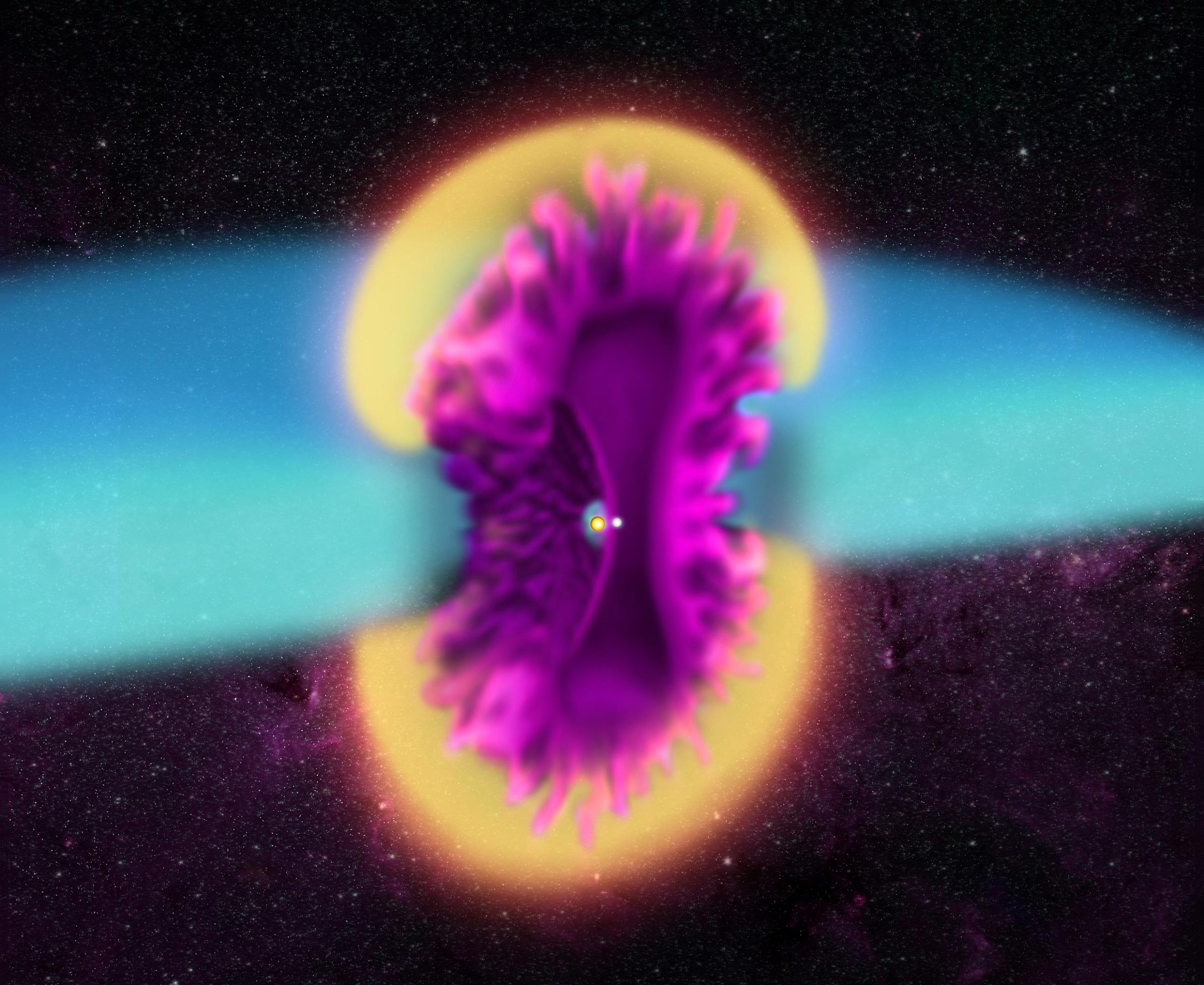
    The double star system V745 Sco, which is located about 25,000 light-years from Earth. Credit: NASA/CXC/M.Weiss

    For decades, astronomers have known about irregular outbursts from the double star system V745 Sco, which is located about 25,000 light-years from Earth. V745 Sco is a binary star system that consists of a red giant star and a white dwarf locked together by gravity. These two stellar objects orbit so closely around one another that the outer layers of the red giant are pulled away by the intense gravitational force of the white dwarf.  This material gradually falls onto the surface of the white dwarf. Over time, enough material may accumulate on the white dwarf to trigger a colossal thermonuclear explosion, causing a dramatic brightening of the binary called a nova. Astronomers saw V745 Sco fade by a factor of a thousand in optical light over the course of about 9 days.

    In 2014, astronomers finally got their chance to see the phenomena, using the Chandra X-Ray Observatory. Their key finding was it appeared that most of the material ejected by the explosion was moving towards us and developed a 3-D computer model of the explosion that explained the observations. In this model they included a large disk of cool gas around the equator of the binary caused by the white dwarf pulling on a wind of gas streaming away from the red giant.

    In the figure showing the new 3-D model of the explosion, the blast wave is yellow, the mass ejected by the explosion is purple, and the disk of cooler material, which is mostly untouched by the effects of the blast wave, is blue. An extraordinary amount of energy was released during the explosion, equivalent to about 10 million trillion hydrogen bombs.

    Never miss a breakthrough: Join the SciTechDaily newsletter.
    Follow us on Google and Google News.

    Astronomy Astrophysics Chandra X-ray Observatory NASA Popular
    Share. Facebook Twitter Pinterest LinkedIn Email Reddit

    Related Articles

    X-Ray Echoes Unveil the Hidden 3D Landscape of Our Galaxy’s Heart

    Black Holes Cook Their Own Fuel in a Cosmic Feast

    Black Hole Tears Star to Shreds, Unleashing Cosmic Shockwaves

    Centaurus A’s Massive 13,000 Light-Year Jet Captured in Stunning Detail

    Historic Discovery: Twin Titans Clash As NASA Unveils Closest Supermassive Black Hole Duo

    Astronomical Appetite: NASA Telescopes Decode a Supermassive Black Hole’s Snack Schedule

    Chandra’s Epic Anniversary: 25 Breathtaking New Images Unveiling Cosmic Discoveries

    Telescopes Reveal Rapid Spin of Milky Way’s Black Hole Warping Spacetime

    Breaking the Cosmic Code: NASA Telescopes Start the Year With a Double Bang

    Leave A Reply Cancel Reply

    • Facebook
    • Twitter
    • Pinterest
    • YouTube

    Don't Miss a Discovery

    Subscribe for the Latest in Science & Tech!

    Trending News

    Researchers Warn Widely Prescribed Blood Pressure Drugs Could Be Harming Diabetic Kidneys

    James Webb Spots Something Strange Between Day and Night on an Alien Planet

    How Ancient People Moved a 6-Ton Stone 700 Kilometers to Stonehenge

    The Unexpected Gut Health Risk of Cutting Out Sugar

    Popular Weight-Loss Drugs Like Ozempic Linked to Lower Breast Cancer Risk

    AI Learned the Rules of the Universe and That Became a Problem

    Scientists Found a Hidden Brain Signal That Predicts Social Behavior

    Even GPT-5 Failed This Human Attention Test

    Follow SciTechDaily
    • Facebook
    • Twitter
    • YouTube
    • Pinterest
    • Newsletter
    • RSS
    SciTech News
    • Biology News
    • Chemistry News
    • Earth News
    • Health News
    • Physics News
    • Science News
    • Space News
    • Technology News
    Recent Posts
    • Ancient Black Holes May Have Survived a Cosmic Era Before the Big Bang
    • What if Time Isn’t Fundamental? Physicists Just Tested the Idea in the Lab
    • Scientists Let People Play Video Games Using Only Their Thoughts
    • Women’s Brains May Be More Vulnerable to Dementia Risk Factors Than Scientists Realized
    • Scientists Say We’ve Been Wrong About the Aging Brain
    Copyright © 1998 - 2026 SciTechDaily. All Rights Reserved.
    • Science News
    • About
    • Contact
    • Editorial Board
    • Privacy Policy
    • Terms of Use

    Type above and press Enter to search. Press Esc to cancel.